
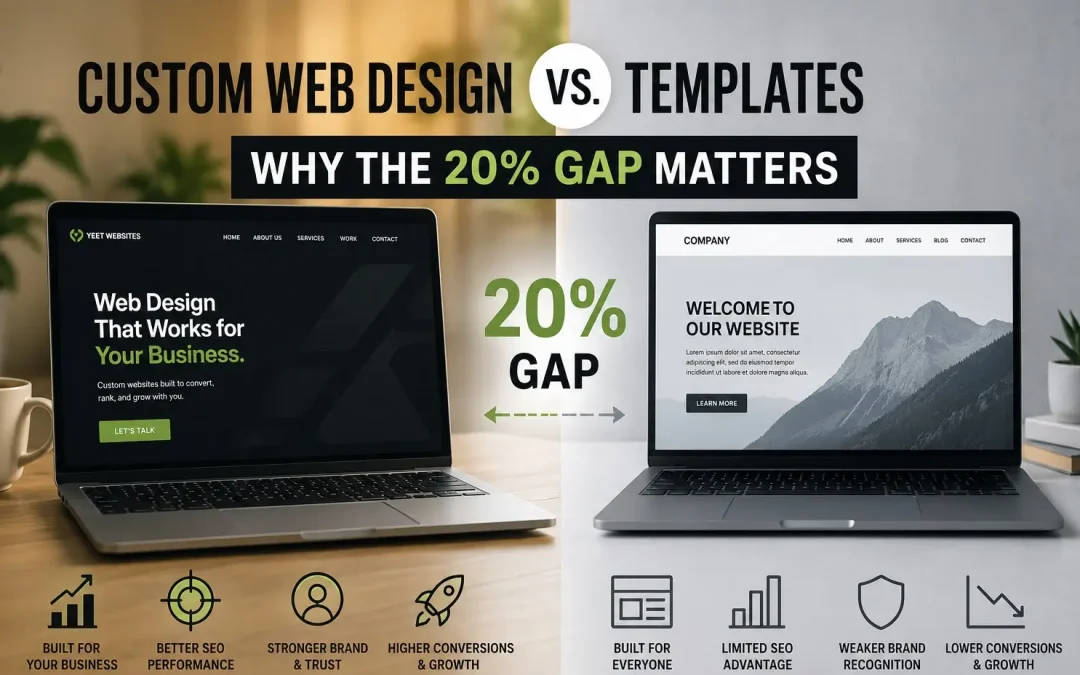
Post Summary: What a Template Decides Before You Ever See It
A template and a custom build cover most of the same ground. What separates them is the remainder: heading length, image ratio, layout hierarchy, all decided in advance by a framework built for a business that isn’t yours.
A pest control company saw this measured. The same payment and chat tools, moved off a template onto a custom foundation, roughly doubled the site’s speed score and brought load time under a second.
Below is why that difference stays invisible until you have something to compare it against, and why chasing a higher speed score stops paying off sooner than you would think.
Custom Doesn’t Mean Magic, It Means Better Odds
We want to be as honest and transparent about this as possible, because this gets oversold.
Custom doesn’t mean magic. It doesn’t mean a template can’t do what you need. Both a custom site and a well-built template live in roughly the same 80% realm of what’s possible on the web. Most things both approaches can do. That’s the truth, and it’s worth saying before anything else. That overlap is the whole starting point in any discussion of website templates vs custom websites.
The difference is the other 20%.
And here’s the thing about 20%, it sounds modest until you think about what 20% means at the top of any field. If you’re the top 20% tennis player in the world, you’re pretty good. You’d beat almost everyone you’d ever play against casually. But you’re not making it to an amateur tournament final. Not even close. You need to be top 3% to compete at the ITF level. The guys at the club who crush the top-20% player? They’re getting crushed by anyone in the top 3%. That’s what a 20% gap looks like when the stakes are real.
Your website is operating in a competitive market. That 20% is where the wins are.
What Custom Means, and What It Doesn’t
Custom means we can put any element in any position on the website. That’s the mechanical definition. You’re not working inside a framework that was designed for someone else’s layout decisions. You’re starting from a blank canvas built around your business specifically. Custom websites are different and what happens in a website strategy session help define and shape what the site will look like. But the secret sauce is in the questions web designers ask.
What custom doesn’t mean: some entirely different category of the internet that templates can’t access. The honest version is that most things both approaches can do, contact forms, galleries, service pages, about pages, mobile responsiveness. Templates aren’t junk. Some of them are well-built. The question isn’t “can a template exist”, it’s “can a template make the decisions your business needs made.”
The answer to that is almost always no, and most business owners don’t realize it because they’ve never seen what the decisions they didn’t get to make would have looked like.
What a Template Forces You Into
A template works in preset mode and some industries need a special website, a custom website, because the prebuilt fields of a template just won’t work. That’s not an insult to templates, it’s a description of how they’re built. The framework makes decisions in advance: a set number of characters for a heading, a set image size for the hero section, a set number of items in a features row. Those decisions were made for a hypothetical business. Not yours.
The compromises tend to be invisible to the business owner because they never see the alternative. What if their tagline is longer than the template’s heading field accommodates, and it looks truncated or wraps awkwardly? What if their explanation paragraph needs to be bulleted to make sense, but the template’s text block isn’t built for that? What if the image they have for a section is a different ratio than what the template expects, so it crops wrong or stretches?
None of those are catastrophic failures. They’re quiet degradations. The site works. It just doesn’t quite fit. And “doesn’t quite fit” is the gap between a site that converts and one that sits there.
Jared Spool, founder of User Interface Engineering and one of the most recognized researchers in web usability, described this dynamic in an article on how users experience design:
“When things are going well in a design, we don’t pay attention to them. We only pay attention to things that bother us. It’s like an air conditioner in a conference room. Nobody ever interrupts our meetings to tell us how comfortable the temperature is. They don’t even notice. We only notice the conference room temperature when it is too cold or too hot. Or perhaps we notice if the unit is too loud or is leaking all over the floor. But when it’s working perfectly, it becomes invisible. The same is true with online designs. We attend to things that aren’t working far more than we attend to things that are.”
— Jared M. Spool, Co-Founder of Center Centre, Founder of UIE. Source: articles.centercentre.com
The real cost is what you can’t measure: the version of the site that was built around your business instead of adapted to a framework. You never see it, so you never miss it. But your visitors feel it.
A Pest Control Rebuild, Measured
One of the clearest places where custom versus template shows up in measurable terms is third-party software integration. Integrating external tools, payment systems, chat interfaces, scheduling platforms, into a template isn’t always impossible. Most templates can technically do it. The problem is how it loads and the drag it creates on page speed.
We did a pest control company rebuild that demonstrated this exactly. The previous site had a third-party payment interface and chat interface from the same provider, a well-built system, good software. On the template-based site, you could tell it just functionally wasn’t working correctly. The site loaded terrible. On Google’s PageSpeed Insights, they were scoring in the 50s, a 52 specifically.
We rebuilt the site custom, integrated the same third-party tools, and the score jumped to 73 on both mobile and desktop. Same tools. Different foundation. On Pingdom, a separate tool we use to cross-reference, they measured at 83, with a load time of 819 milliseconds. Less than a second. When you pull that site up on a phone, it renders fast. That’s not a number on a report, that’s what the customer experiences.
The template wasn’t broken. It just couldn’t carry what the business needed without slowing down. Custom could.
Why a Score Above 73 Stops Mattering
Since we’re talking about PageSpeed Insights numbers, something worth saying: those scores measure a lot of things that never show up in real-world experience. The measuring standards are odd in ways that matter. A site scoring 73 on PageSpeed Insights and loading in under a second is a fast site. The difference between a 73 and a 90, in real-world load time, is something you’re not going to notice. It’s faster than we can process information as humans.
Getting from 73 to 90 on PageSpeed Insights requires getting very technical, doing significant optimization work, and spending real money. And when you’re done, the visitor pulling up your site on their phone experiences… essentially the same thing they did at 73. At that level, a high score is more of a status symbol than a business outcome.
Multiple data points matter. PageSpeed Insights is one tool. Pingdom is another. Real-world load behavior matters more than either. What we care about: does the site load fast for the person on it? The pest control site at 73 loads in under a second. That’s the answer that matters. If you haven’t yet thought through how to evaluate a web design company before committing, how to vet a web design company is a good place to start.
The Decisions a Template Can’t Make for You
Here’s the practical version of what custom design makes possible, separated from the abstract:
A template decides your layout hierarchy before you walk in the door. It decides where the hero image goes, how large the headline can be, what a two-column section looks like. If your business communicates better with a different hierarchy, a strong statement before a visual, or a service comparison before a contact prompt, the template may not accommodate that without workarounds that compromise the result.
Custom design starts from the conversation. What does your customer need to understand first? What’s the objection they’re walking in with? What does trust look like in your specific industry? Those are design decisions. A template makes them in the abstract. Custom makes them for you.
The underlying question, why a template holds a site back, is really a question about fit. A template is built for everyone. That means it’s optimized for no one. The 20% gap isn’t a list of features a template lacks. It’s the accumulated weight of every decision that was made for a hypothetical business instead of yours.
What the Cost Comparison Usually Gets Wrong
The assumption that custom web design is expensive is almost always built on the wrong comparison. The comparison isn’t custom versus template, it’s $130 a month versus $200, $300, $500 a month for something that limits you. You can get a good small business website in a price range you can afford.
We build custom sites, not a template with your logo dropped in, for $600 to start and $130 a month. No contracts. No limitation on where elements can go. No framework forcing your business into someone else’s layout. If you’re looking at template options right now because you think custom is out of reach, that assumption is worth testing before you commit to the constraints.
The posts in this cluster go deeper on specific pieces of this: why we don’t use templates and what we do instead, how the conversation becomes the foundation of the design, what custom looks like across completely different industries, and what the deep-dive process looks like in practice. And if you want to understand how the build process works after you’ve decided to move forward, the communication side of the build is worth reading.
The case for custom isn’t that templates are bad. It’s simpler than that: we can build you something that isn’t going to limit where things go. That’s what custom at Yeet Websites means.
See what a site built around your specific business looks like, not a template with your name on it.
Frequently Asked Questions
What’s the real difference between custom and template web design?
The mechanical difference is placement freedom, custom lets us put any element anywhere on the page. The practical difference is that a template makes layout decisions in advance for a hypothetical business. Custom makes them for yours. Both approaches cover most of what a website needs to do. The gap lives in the 20% where your business has specific needs a preset framework wasn’t built to handle.
Are template websites slower than custom sites?
Not automatically, but integrating third-party tools into a template tends to create load drag that a custom build handles more cleanly. We rebuilt a pest control site that was scoring a 52 on Google PageSpeed Insights. Same third-party payment and chat integrations, rebuilt on a custom foundation, scored 73 on PageSpeed and 83 on Pingdom with an 819-millisecond load time. The tools didn’t change. The foundation did.
How much does custom web design cost at Yeet Websites?
$600 to start, then $130 a month. No contracts, no per-edit fees, no change orders mid-build. If you’ve been pricing out custom design and assuming it means $5,000 up front and a monthly retainer you can’t exit, that’s a different model. Ours is designed to be accessible without cutting the corners that matter.
What if my business is pretty simple, do I really need custom?
Simple businesses still have specific businesses. A painting company and a delivery service are both simple in the sense that they don’t need e-commerce or complex databases. But what the painter needs their site to communicate and how a delivery company builds trust with fleet clients are completely different problems. A template solves neither one specifically. Custom solves yours.