
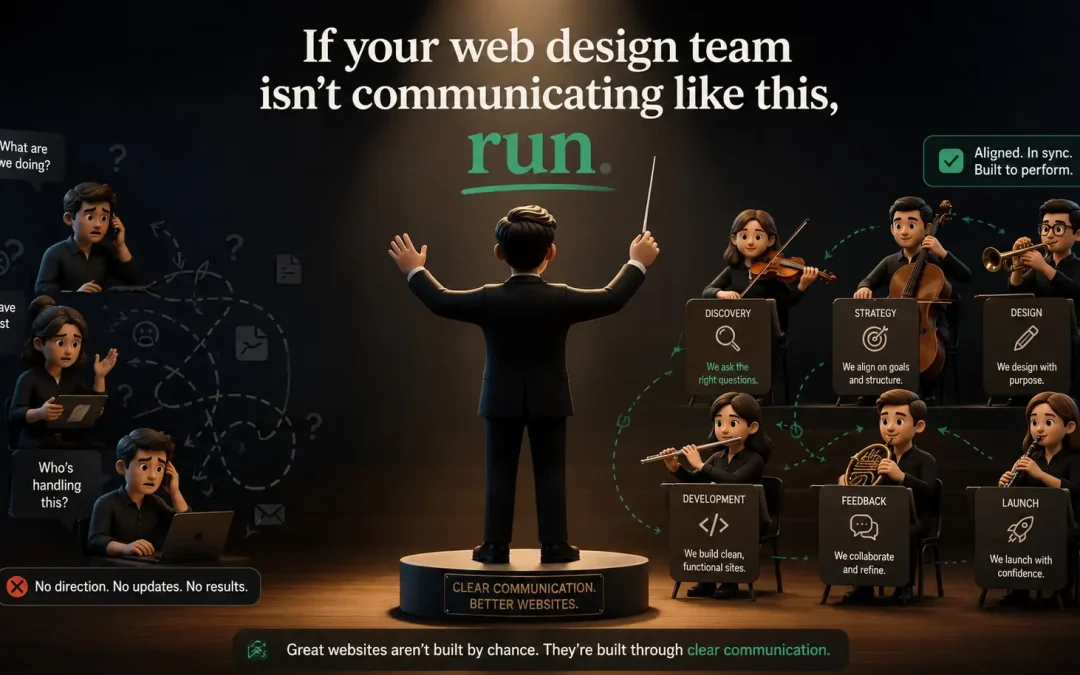
Post Summary: Silence After Payment Is a Red Flag, Not a Busy Season
If a build goes quiet after payment, with nothing shown and nothing booked, that is the signal worth acting on. Good communication gets structured at the start rather than left to chance.
One example from the post: a well-run build puts the first design meeting on the calendar roughly a week out from onboarding, and that stretch goes into creative work rather than silence. Below is the whole process, start to finish.
Two Weeks, No Mockup, No Screen Share, No Timeline
You signed up two weeks ago. You sent over your logo, your copy, the photos you wanted on the homepage. You paid the invoice the same day. And since then, nothing. No mockup. No screen share. No email with a timeline. No meeting on the calendar. And now you might be wondering what a realistic timeline is for a small business website.
But there’s nothing in your inbox.
That gap, between paying and seeing something that hopefully has ZERO surprise website fees, is where a build starts to rot. Not because the work isn’t happening, but because the communication around the work was never structured to begin with. And the signs your web design team communicates poorly don’t always look like missed calls or rude emails. Sometimes it’s just the absence of a plan you were supposed to be part of.
What a Well-Communicated Build Sounds Like
Here’s ours, start to finish, from day one. You be the judge.
The client gets onboarded. Payment information is taken. That same day, or the very latest, the next morning, a thank-you email goes out. Not a form letter. A real message confirming the project is live.
Then the next meeting gets set and here’s what you should expect from a website mockup.
Fast forward about five business days out. That gap is intentional, and we’ll get into why in a minute. But the important part is that the meeting is scheduled. There’s a date on the calendar before the first call even ends.
Five days later, we meet over screen share and present the first homepage design. That conversation gets its own section below, including what happens in the small share of cases where the design doesn’t land.
The following two weeks, we finish the build. The client chooses how they want to see it: take it live and review in real-time, or do one more screen share before anything goes public. If there’s a domain transfer involved, that gets handled the week before launch, because transfers can take up to a week and nobody wants to find that out on go-live day. We decide whether the domain goes in the client’s account or ours, we advise as consultants in that area, but it’s the client’s call. So much happens on launch day but it’s all behind the scenes.
After the site is live, we run post-launch Quality Assurance, a website audit checklist if you will where we dot our i’s and cross our t’s. We’ve been building mobile-first the entire time, but this is the final sweep, double-checking everything on every screen size. We make sure contact forms are perfect so no leads are lost. A couple of days later, we’re either on a screen share going over the finished product or the client sends us a list of final tweaks by email. And if they get busy and we don’t hear from them, we have a task set up to follow up.
That’s the process. No mysteries.
The Five-Day Gap, and What’s Happening When You’re Not Hearing From Us
Five business days between onboarding and the first design reveal might sound like a long pause. But that gap is where the creative work happens.
The creative process isn’t something like putting together some Legos that are pre-built. It’s more like imagining what the Legos are going to look like, the color, the shape, and everything, and then finding unique ways to put them together to communicate the message. A template build is the pre-built Legos. A custom build requires someone to sit with the project, look at the logo, read the copy, think about the colors, and figure out how to make it all say something specific about this business.
Sometimes you sit with a project for a day, and your mind works out the problems of how you’re going to do it while you work on other things. That’s not procrastination. That’s how it works, the approach sorts itself out in the background until something clicks.
We take your information, we get the vibe of what you’re all about, and we create something that reflects it. We use the logo, the colors, the text, and we make sure to put in all the elements that were important to the client and we run with it. Not the elements that are easiest to build. The ones that mattered.
The red flag isn’t silence during a planned gap. The red flag is a gap with no plan.
The First Design Reveal Is a Conversation, Not a Presentation
We do the homepage reveal over screen share. Not a link in an email. Not a PDF attachment. A live walkthrough where we talk through every decision, why this section is here, why that color was chosen, why the navigation is structured the way it is. If there’s an existing site, we pull it up side by side so the client can see the before and after in real time.
Then we ask the question that matters: did we hit the mark?
Not “do you approve this.” Not “sign off so we can proceed.” Did we hit the mark. That’s a different question. It invites honest feedback instead of rubber-stamping. And the goal isn’t for the client to say it’s fine. You have to love it, not just like it but love it. That’s our goal, every time.
About 98% of the time, the design keeps moving forward. The client tells us what to adjust. We tell them what we caught ourselves, because you find mistakes in your own work, live with the fresh set of eyes. If the design doesn’t land, we either implement changes or start over completely. If you like it, we roll with it. If you don’t, we fix it. It’s not pressure and it’s very simple.
A mockup sent by email with “review and approve” attached is one-directional. You’re evaluating something alone instead of being walked through it together.
The Decisions That Are Yours, Not Ours
Not every decision in a build belongs to the designer. Some of them have to come from the client, and the communication around those moments is where a lot of projects quietly stall.
We’re onboarding a chiropractic clinic right now, switching her over from an expensive provider. She had these forms that were super important to her practice, intake forms, health history, the kind of paperwork her patients fill out before a first visit. Before we came on board, it was a contact form with all these fields, and there was an email delivery issue on top of it. The whole thing was a mess.
So we suggested making PDFs, printable forms her patients could fill out by hand. Her clientele skews older, so this suited them. But then she got busy. Life happened. And that decision, digital forms versus printable PDFs, how the intake process would work on the new site, sat open until she had the bandwidth to come back to it.
The client had to make that decision. We couldn’t make it for her.
We could suggest. We could explain the tradeoffs. But it’s her practice, her patients, her workflow. A good build process surfaces those decisions early, explains the options, and doesn’t let them sit in a revision round where they get made by default. The pricing structure works the same way, every number is visible before the build starts, and every decision point is flagged before it becomes a bottleneck.
Where Build Communication Breaks Down First
If there isn’t a strong base of communication, then everything else sort of crumbles, just like in construction. The early conversations set the tone for the entire project. If the kickoff call is vague, the design brief will be vague. If the design brief is vague, the first mockup will miss. If the first mockup misses, the revision cycle doubles.
Every stage inherits the one before it.
It’s the same principle in any discipline. If you’re learning a skill and you move on to the advanced before you do the basic, you’re going to struggle. Music is a great example. If you don’t know your scales, then you’re going to have a really hard time playing in a band because you don’t know the basics. A web design build that starts with a sloppy intake call, no notes, no follow-up summary, no scheduled next step, is a build that skipped the scales.
This is why vetting the company before you sign is worth the extra effort. The way a company communicates during the sales process is the ceiling of how they’ll communicate during the build. It doesn’t improve once the project starts.
The Two-Week Mark, and What It Tells You
Two weeks into a build and we’re almost done, nine out of ten times. If you’re two weeks in and you haven’t seen a design, haven’t been on a screen share, and don’t have a next meeting on the calendar, something is wrong.
And it started earlier than you think.
Go back to the first real conversation. Was a follow-up meeting scheduled before you got off the call? If not, not right there is a red flag. It means they’re not planning in the future. They’re not structuring their day around the work. A company that can’t book a meeting during onboarding isn’t going to find more structure once the project gets complex.
Here’s the part that trips people up. A company that doesn’t schedule a follow-up meeting during the kickoff can mean one of two things. Either they’re not busy enough to understand that you have to book important meetings like that in advance so that your day doesn’t fill up, or they’re so busy that they can’t plan. Both of those scenarios are not good. Major red flags, major issues.
And if you’re sitting in that two-week gap right now, wondering whether to say something or wait, don’t wait. Reach out. Ask where things stand. Ask for a date. If the answer is vague, or if the answer is another promise without a calendar invite, start looking.
Every stage of a web design build should produce a clear next step. If you’re ever in a position where you don’t know what happens next, and nobody’s told you, that’s a team that never had a communication process to begin with.
Two weeks ago, you paid someone to build your website. You should know exactly where it stands right now. If you don’t, trust the gut. Reach out to a web design company that does communicate better than that.
Frequently Asked Questions
How often should a web design company update me during a build?
At minimum, you should know three things at all times: what was just completed, what’s being worked on now, and when the next checkpoint is. We meet over screen share at every major stage, onboarding, first design reveal, pre-launch review, and the client always has a date for the next conversation before the current one ends. If your company can’t tell you when you’ll hear from them next, that’s a structural problem, not a scheduling one.
Is it normal to not hear anything for a few days during a web design project?
A planned gap is normal. We schedule the first design meeting about five business days after onboarding, that’s time we need for the creative process. But a planned gap comes with a date on the other side of it. If nobody told you when to expect the next update, that’s not a gap. That’s a drop. There’s a difference between silence with a plan and silence without one.
What decisions during a build should the web design company never make for me?
Anything that affects how your business operates. Domain ownership, whether it sits in your account or theirs. Form structure, what your customers fill out and how that information reaches you. Content direction, what your homepage says about your business. A good company surfaces these decisions early, explains the options, and lets you choose. A bad one assumes the answer and builds around it.
What’s the difference between a company that communicates poorly and one that’s just busy?
A busy company with good communication tells you they’re busy. They give you a revised date. They acknowledge the delay before you have to ask about it. A company that communicates poorly doesn’t tell you anything, and when you ask, the answer is vague. “We’re working on it” with no deliverable and no date is not an update. It’s a placeholder. The distinction is specificity. Good communication always contains a next step.
Should I bring up communication concerns during a build or wait until it’s finished?
During. Always during. If the updates you’re getting don’t contain anything specific, say so now. Waiting until the build is finished means you’ve already lived through the problem and the company had no chance to fix it. A good company will adjust immediately. A company that gets defensive about a communication question is a company that knows its process doesn’t hold up under scrutiny.