
Post Summary: You Can Find the Price Before You Call
Our standard website pricing is a $600 setup fee and $130 a month, or $4,000 to own the site outright with $350 a year for hosting. Both numbers sit on the website design page, findable in about thirty seconds, without a form in the way.
That habit traces to a stretch on a mortgage desk, where refinance calls ran forty-five minutes to an hour and fifteen by design. Clients were walked through every debt line by line until the length of the call did the work that persuasion was supposed to do.
Below: what seeing the number first changes about the conversation that follows, and where the posted price stops applying.
What It Costs
Two options, both on the website design page and both stated in full.
The subscription is $600 to set up, then $130 a month. That covers the build, hosting, ongoing edits, and support for as long as you’re a client. No contracts. Cancel with a few days notice.
Ownership is $4,000 once, plus $350 a year for hosting. You own the site and it goes with you if you ever sell the business.
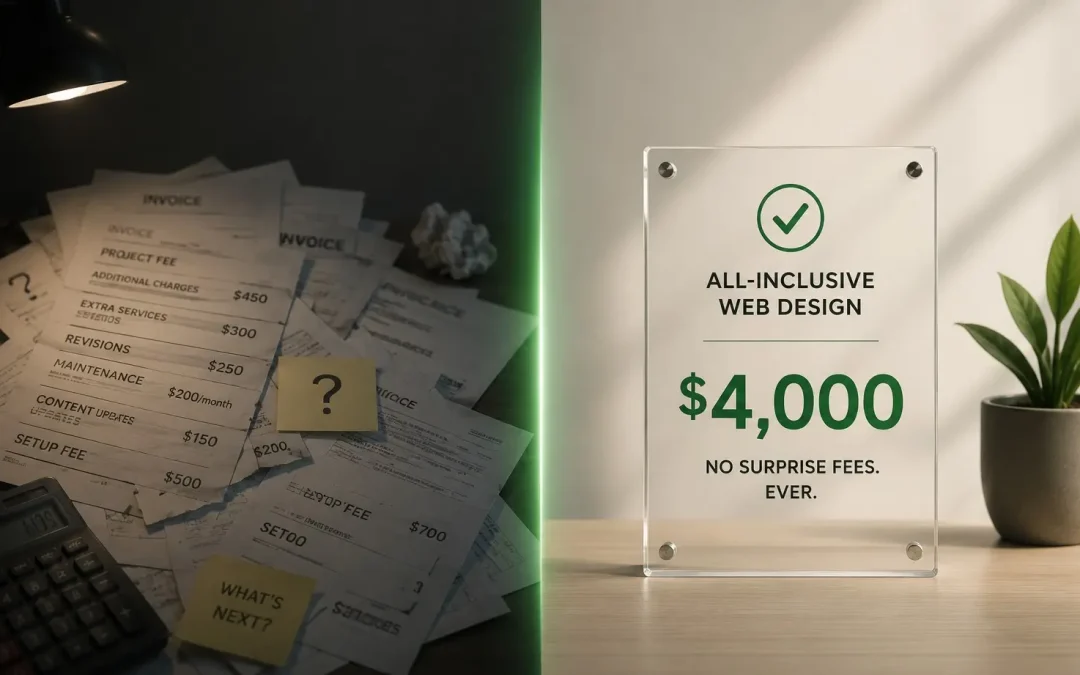
Neither number has an asterisk. There’s no invoice at the end of the build introducing line items nobody mentioned, and no separate charge for edits that should have been included.
A Mortgage Desk, and What It Taught Us
Before Yeet Websites, one of us spent time as a mortgage broker at a bank. It didn’t last long, and the reason it didn’t last is the reason our pricing sits where it does.
The refinance calls were built to run long. Forty-five minutes, an hour, an hour and fifteen. Clients would be walked through their finances in exhausting detail: every debt, row by row, line by line. By the end, most people had spent so much of themselves on the call that agreeing was the shortest way out of it.
Length was doing the work. Not the offer, not the explanation. The clock.
Car buying has the same shape. Three or four hours in a dealership for a transaction that takes about ten minutes of actual paperwork. The rest is time, and time spent is hard to walk away from.
We ran a version of that here early on, without thinking about it, because it was what everything around us looked like. Schedule a consultation. Tell us about your project. Price at the end, if at all, on a call you can’t easily leave.
Then we put the numbers on the page, and the first conversation changed shape.
What Changes When You Already Know
Seeing a price before you call does one thing reliably: it removes the conversation that was never going to work.
If the number is $130 a month and your budget is $130 a month, that’s settled before anyone picks up the phone. If it isn’t, you’ve saved yourself half a morning. Either way, nobody spends thirty minutes discovering something a web page could have told them.
What’s left after that filter is the part worth having. What the business does, what the site needs to do, which pages matter, what the customer on the other end is looking for. That conversation starts from a different place when the money question is already answered, and it sets the rhythm for how the rest of the build gets talked about.
The clients who find the pricing on their own, sit with it, and then reach out arrive differently. They aren’t calling to negotiate. They already decided the number was reasonable. What they want is to understand what it buys.
What Posted Pricing Doesn’t Settle
Worth being clear about the limit here. A number on a page isn’t the same as knowing what you’re getting.
Most small business owners haven’t bought web design before. Knowing that it’s $130 a month doesn’t tell you what a subscription includes, how it differs from ownership, or which one fits how you run things. Seeing a figure and understanding it are two separate steps, and the second one still takes a conversation.
What the posted number does is start that conversation at the right place. Instead of working up to a price, we start from one and talk about the work.
When a Project Needs a Quote Instead
The standard numbers cover a standard small business site. Plenty of work isn’t that.
A build carrying e-commerce, custom integrations, dispatch flows, or compliance documentation is a different scope, and it gets quoted per project. Same with a site that needs substantially more pages than a standard build, or one where the content has to be verified before it can go on the page.
A project outside that range gets its number before anything starts, same as the posted one. That part doesn’t change. What changes is that the number comes from the scope rather than from a page, and a bigger scope moves the schedule along with it.
Why We Kept It This Way
There’s no strategy document behind this. When any of us shops for anything online, the first move is to find the price. A form standing between a person and a number is friction most people don’t bother with.
So the site is built for people who behave that way, which is most people.
The number is on the page. Come talk to us and we’ll go through exactly what it covers.
Frequently Asked Questions
What does the $130 a month include?
Everything: the site itself, where it lives, changes as you need them, and someone to call. Nothing gets billed separately for upkeep, and no invoice arrives later with items nobody raised. If something falls outside the standard scope, we raise it before doing it rather than after.
What’s the difference between the subscription and buying outright?
On the subscription the site stays on our side, at $600 up front and $130 monthly. Buying it puts the site in your name for $4,000, with hosting at $350 annually, and it transfers with the business if you sell. No contract sits behind either one.
Is the price the same for every business?
For a standard small business site, yes. A painter’s site and a landscaper’s site look nothing alike and both take real work, and the number holds because we aren’t charging by page count. Work outside that scope, e-commerce, integrations, compliance-heavy builds, gets quoted per project.
What if I see the price and still have questions?
That’s what the call is for. Seeing the number doesn’t start a clock or commit you to anything. It just means we skip the first thirty minutes and get to the part about your business.