
Post Summary: Small Business Marketing Only Works When You Can Verify It
Small business marketing works when every dollar can be checked, not when someone promises rankings or leads you have to take on faith. That means owning your own Google Ads account instead of routing spend through an agency, logging into your own Google Search Console to see rankings and clicks, and doing the free things first: reviews, referrals, and spreading those reviews across platforms. It also means budgeting for real work instead of stretching too little money too thin: SEO starts around $750 a month, PPC needs at least $1,000, and $500 a month is usually better spent on door hangers and flyers than digital services.
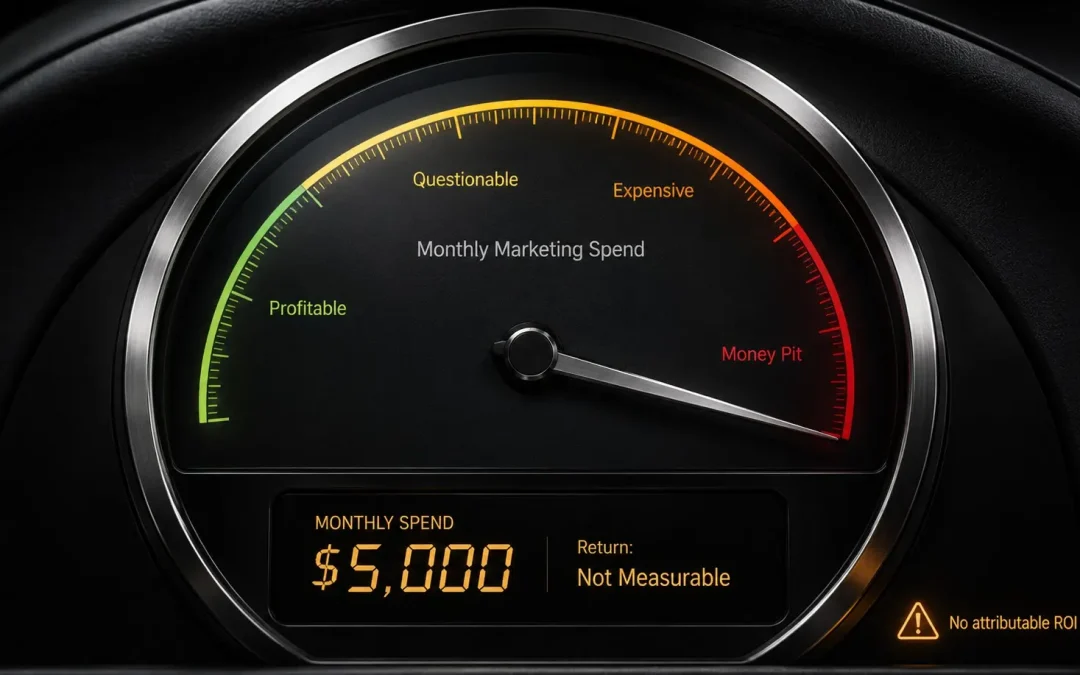
One roofing client had been paying almost $5,000 a month combined for PPC, SEO, and their website with unoptimized ad campaigns and thin, irrelevant backlinks; after switching, the campaigns were rebuilt, real backlinks were built, and the client now gets more leads while saving over $1,000 a month.
The rest of the post breaks down which marketing channels fit which industries, what to do before spending any money, and how to read your own numbers to tell whether your marketing is genuinely working.
When a $500 Ad Campaign Buys You Nothing
Most small business owners have been burned by marketing at least once. Maybe it was an agency that promised the world and delivered a monthly report full of numbers that meant nothing. Maybe it was a Facebook ad campaign that ate $500 and brought in zero calls. Maybe it was paying for search engine optimization for two years and having nothing to show for it.
We hear these stories constantly. Not because we go looking for them, because clients tell us when they switch over. And the pattern is always the same: they were paying too much, getting too little, and nobody could explain why in plain English. It’s the same pattern we see in web design, and we wrote an entire breakdown of why finding a good web designer is so hard, because the marketing side of the industry has the same problems.
This post is about what marketing should look like for a small business. Not theory. Not buzzwords. Just what works, what doesn’t, and how to tell the difference.
The Transparency Problem
The biggest issue we see isn’t bad marketing. It’s marketing you can’t verify.
We can only speak about what clients tell us when they come over from other agencies. And what we hear over and over falls into two categories.
With pay per click, the red flag is paying the agency instead of paying Google directly. If your agency handles your ad spend and you never see the Google Ads dashboard yourself, you have no way of knowing how much of your money goes to ads and how much goes to their pocket. A good setup means you own your Google Ads account, you see every dollar spent, and the agency charges a separate management fee. If they won’t do that, ask yourself why.
With SEO, the red flag is years of payments and very few links to show for it. We’ve had clients come to us after paying for SEO for years. When we look under the hood, they have a handful of backlinks, and the ones they do have aren’t relevant to their industry and are nofollow, meaning they pass zero ranking authority. That’s not SEO. That’s a subscription to nothing.
If you’re not sure how to check whether your links are relevant or dofollow, reach out. We’ll tell you what you have.
The Biggest Waste of Money in Small Business Marketing
SEO. Hands down.
Not because SEO doesn’t work, it does, and we sell it. But it’s the service where the gap between what’s promised and what’s delivered is the widest. It’s easy to sell because the pitch sounds great: “We’ll get you on page one of Google.” It’s hard to verify because most business owners don’t know how to check whether the work is being done.
The result is an industry full of companies collecting monthly checks for link building that doesn’t build anything. Irrelevant links from sites that have nothing to do with your business. Nofollow links that pass no authority. Reports that show “activity” without showing results.
Good SEO is measurable. You should be able to log into Google Search Console and see which pages are ranking, how many impressions you’re getting, how many clicks are coming through, and whether those numbers are going up or down. If your SEO provider can’t show you that, or won’t, you’re paying for a service you can’t verify. Understanding how search engines decide what to rank makes it much easier to tell whether the work is real.
Not Every Channel Works for Every Business
One of the most honest things we can tell you: it depends on your industry.
Marketing channels aren’t universally good or bad. They’re good or bad for your specific business and your specific customer. The mistake is treating them all the same.
Here’s an example. If you’re a roofer, people probably aren’t browsing Facebook looking for someone to fix their roof. Could you get a roofing client from a Facebook ad? Sure. But that’s more luck than strategy, that prospect happened to need a roof and happened to be scrolling at the right time. For high-intent services like roofing, plumbing, or emergency repairs, people go straight to Google because they need help now. That’s where your money should be.
On the other hand, if you’re a local bakery or event planner, social media makes a lot more sense. Your customers are browsing, discovering, getting inspired. Different business, different channel.
The point is that anyone who tells you “every business needs Facebook ads” or “every business needs SEO” without asking about your industry first is selling a package, not a solution.
What to Do With $500 a Month
This is a question we get a lot, and we’re going to be honest about it even though the honest answer doesn’t make us money.
Our lowest SEO package starts at $750/month. Not sure what SEO should cost for your business? Our SEO Cost Calculator can give you a realistic estimate. And $500 isn’t enough for a meaningful pay per click campaign in most industries. So if $500/month is your entire marketing budget, spending it on digital marketing services might not be the best use of that money right now. Before you spend anything, it also helps to understand what you’re being quoted for, because the line items aren’t always what they appear.
If you’re a service-based business, a contractor, a cleaner, a landscaper, door hangers and flyers in the right neighborhoods might give you a better return at that budget. Sounds old school because it is. But a well-designed flyer in the mailbox of every homeowner within 5 miles of your service area puts your name in front of people who might need you. It works.
As your business grows, your marketing budget grows with it. That’s when SEO and PPC start making sense, when you can invest enough to do them right instead of spreading $500 thin across services that need more to deliver results.
We’d rather tell you that now than take your $500 and underdeliver.
The Order of Operations
Before you spend a dollar on marketing, do these three things. They’re free and they work.
First: get reviews on your Google Business Profile. This is the single highest-impact thing most small businesses can do and it costs nothing. Ask every happy customer to leave a review. Make it easy, text them the link. Reviews build trust with potential customers and directly influence your visibility in Google’s local results.
Second: ask for referrals from existing clients. Your best customers know other people who need what you do. A simple “know anyone who could use our help?” goes a long way. Referral customers come in with built-in trust because someone they know vouched for you.
Third: diversify your reviews across platforms. Don’t just get reviews on Google. Get them on Facebook, Yelp, industry-specific directories, wherever your potential customers might be looking. This is the biggest mistake we see: all reviews in one place. Spreading them out makes your business look established everywhere, not just on Google.
These three things cost nothing and build a foundation that makes every dollar of future marketing more effective.
What Happens When the Agency Takes Too Much
A roofing company came to us paying almost $5,000 a month combined for pay per click, SEO, and their website. Five thousand dollars. Every month.
When we looked at what they were getting, the picture wasn’t pretty. The PPC campaigns weren’t optimized. The SEO links were thin. And they were locked into an overpriced website they didn’t own.
They switched to us. Paid off their website with the ownership option. We rebuilt their PPC campaigns and started building real, relevant backlinks. The result: more leads from pay per click, legitimate SEO work they can verify, and they’re saving over $1,000 every single month in total spend. If you want to understand how website pricing works and where most businesses overpay, we break it all down. And if you’re wondering whether the company you’re looking at is actually built to serve you or just process you, our web design company vs agency breakdown is worth reading before you sign anything.
That’s not a knock on every agency. There are good ones out there. But when $5,000 a month isn’t producing results proportional to $5,000 a month, something is wrong, and most business owners don’t know enough about the technical side to catch it.
What Happens When You Do the Basics Right
Here’s the flip side.
A client switched to us and went with the ownership option, paid for their site outright. Now their only ongoing cost is about $350 a year for hosting. That’s it.
They didn’t invest in SEO or PPC. They pumped up their Google Business Profile reviews. Asked every customer. Made it part of their process. And they’re slammed with business.
Hardly any money going to the website. Tons of business coming in because they ask for reviews and people give them. It’s simple. Not easy, asking consistently takes discipline, but simple.
Not every business needs a complex marketing strategy. Some businesses just need a good website, a pile of great reviews, and the discipline to keep asking. If that’s you, we’re not going to upsell you into services you don’t need.
Marketing Without the BS, What It Means in Practice
We throw that phrase around a lot, so let us be specific about what it means.
It means: here’s what it costs and here’s what you get.
That’s it. No hidden fees. No vague “strategy sessions” that pad invoices. No reports designed to look impressive instead of being useful. When you pay us for SEO, you get a clear list of what we did that month, links built, pages optimized, technical fixes made. When you pay us for PPC, you see every dollar going to Google and exactly what our management fee covers.
We don’t send fancy reports. We send easy-to-read information every month on exactly what you’re getting for the money you’re paying. If you can’t understand it, we didn’t explain it well enough, and that’s on us to fix.
How to Know If Your Marketing Is Working
This depends on where your business is starting from. If you’re established and Google already knows who you are, results come faster than if you’re launching a brand new website on a brand new domain, and there’s SEO groundwork that should happen before a site even launches to avoid starting from behind. Setting expectations based on your starting point matters, anyone who promises the same timeline for every business is guessing.
Here’s what you should be able to see:
We connect your site to Google Search Console so you can see what pages are ranking, how many impressions they’re getting, how many clicks come through, and how your average position is trending. It’s all there, transparent, verifiable, and free.
Beyond Search Console, you should be able to measure the number of monthly calls you’re getting, how many form submissions come through your website, and whether those numbers are going up over time.
If your marketing provider can’t show you these things, or if the numbers haven’t moved in months, the marketing isn’t working. Not because the channels are bad, but because the execution isn’t there.
The Bottom Line
Small business marketing doesn’t need to be complicated. It needs to be honest.
Know what you’re paying for. Verify that the work is being done. Start with the free stuff, reviews and referrals, before spending money on services. And when you do invest in SEO or PPC, make sure you can see the results yourself, not just in a report someone sends you, but in your own dashboard with your own login.
If that sounds like what you’ve been looking for, let’s talk. No charge, no pitch, just a straight answer.
Frequently Asked Questions
How much should a small business spend on marketing?
There’s no universal number. It depends on your industry, your goals, and your current situation. If you have a tight budget, start with free strategies like reviews and referrals. When you’re ready for SEO or PPC, budget at least $750/month for SEO or $1,000+/month for PPC to do it right. Anything less tends to underdeliver.
How do I know if my SEO company is doing real work?
Ask for a list of backlinks they’ve built in the last 3 months. Check if those links are from sites relevant to your industry. Check if they’re dofollow (meaning they pass ranking authority). Log into Google Search Console and see if your impressions and clicks are trending up. If they can’t show you concrete deliverables, reconsider.
Is pay per click worth it for small businesses?
For businesses with high-intent customers, people searching for a service they need right now, PPC can deliver fast results. The key is owning your own Google Ads account so you can see every dollar spent. PPC works best when paired with a solid website that converts visitors into leads.
Should I do SEO or PPC first?
If you need leads immediately, PPC delivers faster results. If you’re building for long-term growth, SEO creates an asset that compounds over time. Most established businesses benefit from both, but if your budget only covers one, choose based on urgency.
Do I need social media marketing?
It depends on your industry. If your customers browse and discover services on social platforms (restaurants, event planners, retail), social media makes sense. If your customers search Google when they need help (contractors, attorneys, medical providers), your money is better spent on search marketing.
What’s the difference between SEO and Google Ads?
Google Ads puts you at the top of search results immediately, but you pay for every click and traffic stops when your budget runs out. SEO takes longer but builds organic visibility that keeps working without ongoing ad spend. SEO is the long game. PPC is the fast lane. Both have a place depending on your goals.
How long does SEO take to show results?
It depends on your starting point. An established business with an existing website and Google presence can see meaningful movement in 3-6 months. A brand new website starting from scratch may take 6-12 months to gain traction. Be cautious of anyone promising page one rankings in 30 days.