
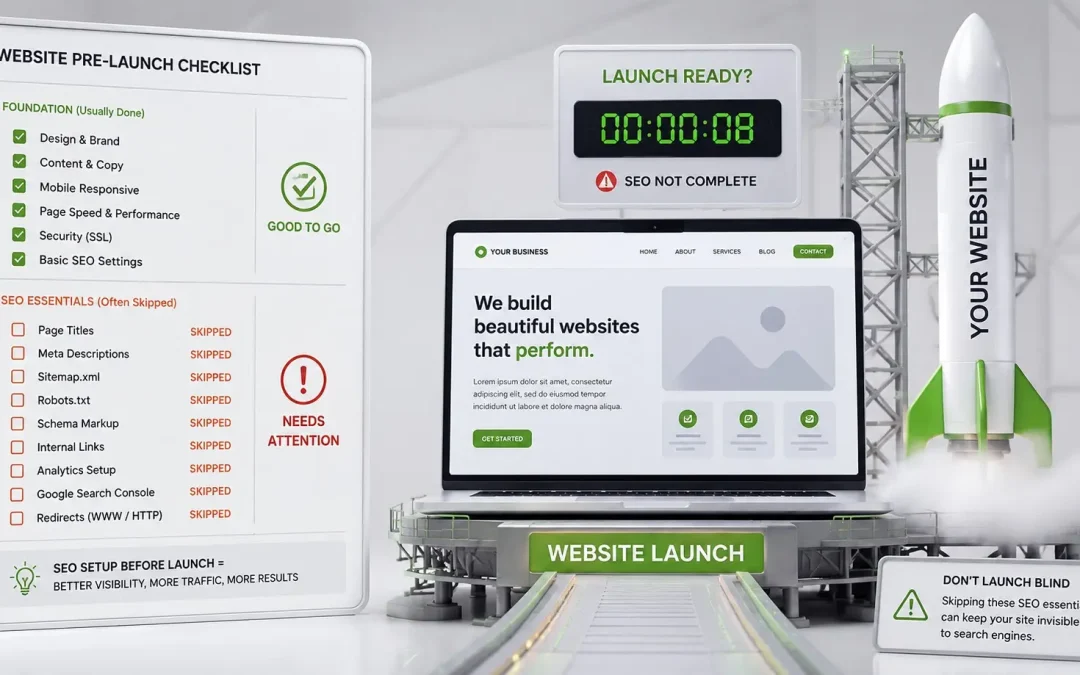
Post Summary: A Bad Foundation Can’t Be Patched
SEO isn’t something added to a finished site. It’s the structure the site is built on, which is why a site built without it usually gets rebuilt rather than patched.
A boat builder had repair, canopies, and builds stacked on one page under Services. Someone searching for canopies isn’t looking for a new boat, but it was one page carrying three different searches, so Google had no single thing to rank it for. Splitting it into three pages meant rebuilding the site, not adjusting it.
The structural pieces are heading hierarchy, page intent, URLs, and internal linking. None of it is visible from the front end, which is why a site can look finished and have nothing underneath for a search engine to read.
Two things carry most of the structural weight. Every page gets one intent that no other page on the site covers, so nothing bleeds across pages. And every page gets one H1 naming the single thing that page is about, like painting contractor in Manhattan, rather than three services sharing a title.
Google has limited resources, and the next site in line already made its structure obvious. A page that takes work to interpret loses to one that doesn’t.
Three Services, One Page, No Rankings
A boat builder came to us with a site that had been live for a while. He was paying too much for it, the headings were messed up, and three facets of his business, three things that should have been three unique pages, were all crammed onto one page under “Services.” Boat repair, canopies, and builds. All stacked together like they were the same thing.
They weren’t. Someone searching for boat canopies might not want a new boat or need their boat repaired. But the site treated all three like one offering, so Google treated the whole page like one confused signal. Nothing ranked the way it should have.
We didn’t fix that site. We rebuilt it. That’s usually how it goes when the SEO work was never part of the build. The foundation isn’t something you patch. It’s something you pour again from scratch.
What Gets Left Out of the Build
How much time do you have? Because this question alone could take an hour.
But seriously, everything. Absolutely everything. From headings to cannibalization risks, which means one page is taking out the other page’s search intent. From funneling, creating for conversion and not just pretty, to site structure, page hierarchy, and internal linking. The list is long, and on the sites we rebuild, most of it was never addressed.
The problem with buying from a web designer that doesn’t understand SEO is that you can’t do SEO with a poorly designed, poorly developed website. Design and development are different skill sets. One makes things look right. The other makes things work right, under the hood, in the code, in the structure Google reads.
You know those videos of a construction crew doing something so wrong the thing’s about to fall down, and somebody yells “Hey, George, where’d you get this guy?” That’s a website built by someone who never learned the development side. The foundation ends up bad enough that you start over rather than change it.
That’s not an exaggeration. When the foundation is wrong, when the heading structure is broken, the page intent is overlapping, the URLs are meaningless, and the content isn’t built for how search engines read a page, there’s nothing to optimize. There’s nothing to build on. You’re not behind. You’re starting from a place that actively works against you.
What Goes Wrong on Day One
The damage doesn’t wait six months to show up. It starts the moment Google crawls the site for the first time.
It’s difficult for Google to understand a site when everything is named exactly the same. Imagine there are millions of websites and billions of pages. Your competitor has a very clear structure: this is what this page is about, under that are the subheadings, under that are the paragraphs to support it. Everything lines up. Every page has a job.
And then yours has one big blob of all the same thing.
Who’s Google going to prefer? There are only so many resources, right? Google isn’t going to spend extra time trying to figure out what your page is about when the next site in line already made it obvious. You want to make it as easy as possible for Google to read your site, categorize your pages, and serve them to the right people.
When that structure isn’t there, you don’t get indexed. You don’t get ranked. You don’t get preferred. You’re just at the bottom of the list, not because your business is bad, but because your site didn’t give Google anything to work with.
And the business owner can’t see any of this. The site looks fine from the front end. The colors are right, the logo is there, the phone number works. But underneath, there’s nothing for a search engine to grab onto. If you want to understand the full picture of how SEO works for a small business, the foundation layer is where it all starts.
What a Site With Zero SEO Foundation Looks Like
We don’t fix websites. We rebuild them.
Usually the design isn’t even desirable, it’s not unique to the client. It’s a template someone dropped their logo into and called it done. But even when the design is passable, the structure underneath is almost always the same kind of mess.
With the boat builder, those three services became three pages. Now someone searching for boat repair can go to the boat repair page. Someone searching for boat canopies can go to the canopy page. Every search intent is its own page, because that’s how Google thinks. One page, one job. If the page tries to do three jobs, Google doesn’t know which one to rank it for, so it doesn’t rank it for any of them.
Once we split everything up and rebuilt the structure, it was off to the races. But that’s the thing, the fix wasn’t a tweak. It was a teardown. And all of it could have been avoided by getting the structure right before the site ever went live. Every hour we spent separating those pages and rebuilding the hierarchy was an hour that didn’t need to exist.
Why the Foundation Gets Skipped
Because it’s a little more work and a heck of a lot more knowledge. Simple as that.
To build a website with templates and drag-and-drop tools, you can teach someone to do that in three months. Maybe six months if you want them polished. Three to six months and someone with a decent design eye can produce a site that looks professional.
The SEO stuff, understanding web development, site architecture, how Google reads a page, how heading structures affect indexing, how internal links pass equity, how content cannibalization kills rankings, that’s years. Not months. Years of building, testing, watching what works and what doesn’t, and learning the difference between a site that looks good and a site that performs.
Months of training produce someone who can build a site that looks professional. Years produce someone who can build one that performs. That gap is what shows up in the sites that land on our desk.
It’s not that people don’t think about it. It’s just that they don’t know. And what they don’t know, they can’t build. So you end up with a site that photographs well and performs terribly, and nobody tells you why until someone like us takes a look. If you’re weighing how to spend your marketing budget as a small business, the foundation has to come first or everything built on top of it underperforms.
The Non-Negotiables for SEO Before Launch
If someone is about to launch a website next month, staying in the SEO lane, here’s what has to be in place.
First: every page has a unique intent and does not bleed over into the other pages’ intent. That single change does more for your odds of getting indexed than anything else on this list. No bleed through in content or intent. Each page earns its own place in Google’s index because it’s about one thing that no other page on the site is about. That alone puts you ahead of most sites we audit.
Second: make sure the headings are accurate. One H1 per page, that’s a heading one tag, the main title Google reads to understand what the page is about. The page can only be about one thing. Don’t make it about two. Don’t make it about three. Make it about one thing. Painting contractor in Manhattan, just that. Maybe they do other stuff, but that page is about that one service in that one place.
Dude, just those things and you’re way ahead of most people.
That’s not a throwaway line. The bar is that low. Most sites we look at fail on one or both of those. They have pages bleeding into each other, headings that don’t match the content, or multiple topics fighting for the same ranking. Fix those two things before you go live, and the site launches with a foundation that can support everything you build on it afterward, content, links, local SEO, all of it. Skip them, and every dollar you spend on marketing is working harder than it has to.
Frequently Asked Questions
Can I add SEO to my website after it’s already live?
You can, but it’s harder and more expensive than doing it right from the start. Adding SEO after launch usually means rebuilding page structures, rewriting content, fixing heading hierarchies, and submitting everything to Google again. Every page that launched with the wrong intent or overlapping content has to be diagnosed and rebuilt individually. It’s doable, we do it regularly, but the business owner pays in time and lost visibility that didn’t need to happen.
What’s the difference between a web designer and a web developer?
A web designer focuses on how a site looks, layout, colors, typography, visual flow. A web developer focuses on how a site works, the code underneath, the structure Google reads, the technical foundation that determines whether the site can be indexed and ranked. A site needs both. On the sites we audit, the development side is where the gaps usually are.
How do I know if my current site has SEO problems in the foundation?
Check three things: open any page and look at the heading structure, if there’s no clear H1 or if multiple headings are fighting for attention, the hierarchy is broken. Search for your business name plus a service and see if the right page shows up, if the wrong page ranks or nothing ranks, you likely have intent overlap. And check Google Search Console for pages that have been crawled but not indexed, that’s Google telling you the page didn’t earn its spot.
Does a pretty website mean it’s built well for SEO?
No. Some of the best-looking sites we’ve audited had the worst SEO foundations. The design is what the visitor sees. The foundation is what Google sees. A site can win design awards and still have broken heading structures, duplicate intent across pages, and no internal linking strategy. Pretty gets compliments. Structure gets traffic.