
Post Summary: Forty Pages Scoped, Eighteen Pages Needed
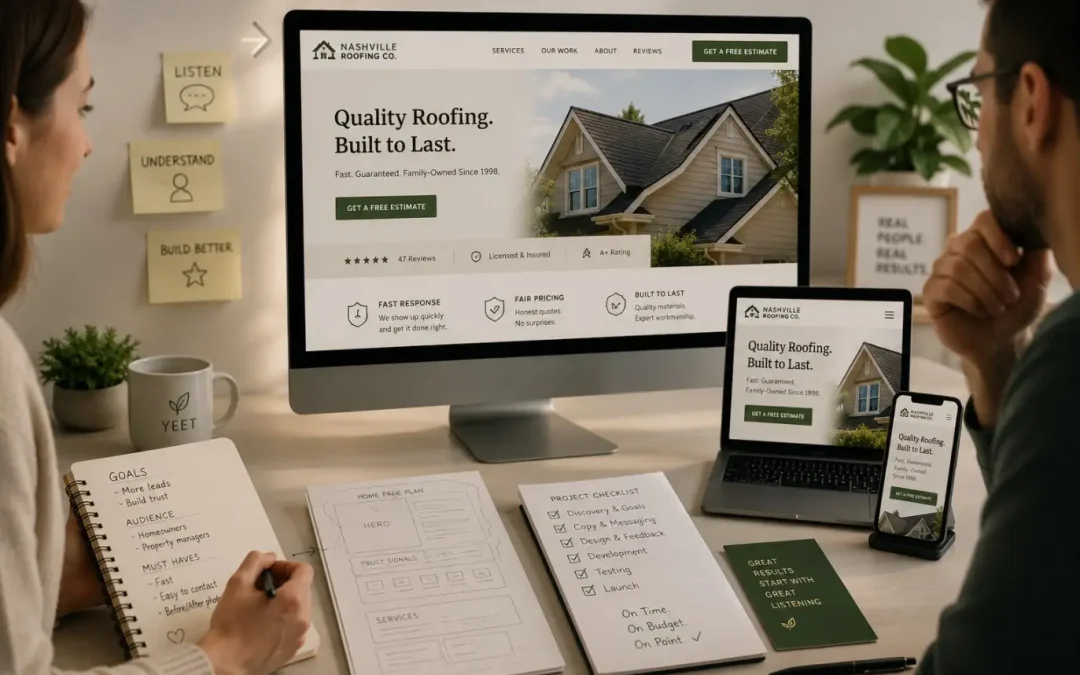
What makes a site work is someone asking questions before any design starts, not from a template or a form. Details from client conversations, an offhand phrase about tone, a business’s origin story, what customers mention most often, get captured and become the actual starting point for the design, more than a competitor’s site or a template ever could. Past personality, the baseline is speed, a layout that holds up on a phone, and an obvious way to get in touch.
One client in Michigan had spent over a month elsewhere with a 40-plus page site scoped and nothing live. The rebuild came in at 18 pages and launched 11 days after first payment. More than half the pages went, because the business had no use for them.
The rest of the post covers the non-negotiable technical baseline for any site (no single-page sites, no reused copy) and why direct access to whoever builds the site matters as much as the build itself.
Is This Good? Almost Every Client Asks the Same Thing
We’ve built over 300 websites for small business owners. And before almost every single one of those builds, the same conversation happens.
The owner shows us their current site, or the quote they got from another company, and asks some version of “is this good?” And almost every time, the answer is the same: it looks fine, but it’s not yours.
That’s the problem with most small business websites. They’re not bad in an obvious way. They’re bad in a way that’s harder to spot. They look like a template because they are one. They say nothing about the person behind the business because nobody bothered to ask. And they exist just to exist, another site in the hopper for whatever company cranked it out.
This post is about what separates a site built for your business that just takes up space on the internet from one that works for your business. And we’re going to be specific, because vague advice is what got most small business websites into trouble in the first place.
The Interview Worth Having
Here’s where it starts going wrong for most small business owners, and it happens before a single line of code gets written.
Most web design companies skip the interview. Or they send you a form. Or they have a 10-minute call where they ask what color you like and what your competitor’s site looks like. Then they disappear for three weeks and come back with something that could belong to any business in your industry. If you want to understand why that template-first approach causes problems, we break it down in our post on templates vs. custom design.
We take notes. During client conversations, you might hear us typing away in the background, those are notes going straight into our CRM. Your offhand comment about wanting your site to feel “warm but professional.” The story about how you started the business out of your garage. The fact that your customers always mention how fast you respond. All of it gets captured because all of it matters when we sit down to build. There’s a reason we ask so many questions before we start designing, the answers are the design.
When we open a new project, the first thing we do is pull up those notes. Not a template. Not your competitor’s site. Your words, your personality, your business, that’s where the design starts.
Most companies skip this step because it takes time. And time is money when you’re trying to crank out as many sites as possible. We’d rather build fewer sites that people love than more sites that nobody remembers.
Zero Personality Is the Real Problem
When a client shows us their current website, the first thing we notice is almost never a technical issue. It’s not broken fonts or bad colors. It’s the complete absence of personality.
The site looks like everyone else in their industry even though after five minutes of conversation it’s obvious they’re not like everyone else. They have a story. They have a way of talking to customers. They have something that makes people choose them over the other options. But none of that made it onto the website because nobody took the time to find it. Beyond personality, those template starting points carry real technical costs too, why templates hurt your website performance gets into the specifics of what you’re giving up.
A good small business website should feel like a conversation with the owner. If someone walks into your shop and gets a certain vibe, friendly, no-nonsense, meticulous, whatever it is, your website should deliver that same vibe before they ever meet you in person.
That doesn’t mean you need to write a novel. One of our clients gave us almost no direction. Just “I like light green.” That’s it. But after getting their photos, hearing how they talked about their work, and reading through the notes from our conversation, we built an entire site from that one color and their energy. They loved it. Not because we’re mind readers, but because we listened first and designed second.
You don’t need to know a lot about what you want. You just need to give us enough to roll with your vibe.
If your current site looks polished but isn’t generating calls, there’s probably a disconnect between how good it looks and how well it performs. We wrote about that exact problem in why your website looks great but nobody’s calling.
What Clients Think They Need vs. What They Need
The biggest misconception we hear: “I need a big company to build my website.”
We understand why people think that. Big sounds like resources, expertise, a safety net. The trade with scale is that you become one of many. Work gets assigned to whoever is free, questions go to an inbox, and the person you talk to is rarely the person building.
With a smaller company, you get the person who builds your site on the phone. You text them directly. When you have a question at 2pm on a Tuesday, you get an answer at 2pm on a Tuesday, not a ticket number and a 48-hour response window.
We had a client in Michigan who came to us after spending over a month with a big-time web design agency. They were paying a monthly fee and still didn’t have a live site. The agency had scoped out 40+ pages, way more than any small business needs. Unnecessarily complex, unnecessarily expensive, and a month in, still not launched.
We built them the right-sized site. Eighteen pages. Everything they needed, nothing they didn’t. From first payment to launch: 11 days. Their monthly cost came down to $130 as well.
That’s not because we cut corners. It’s because we right-sized the project. A small business doesn’t need 40 pages. It needs the right pages, built well, launched fast.
Best Practices Are Non-Negotiable
We refuse to compromise on certain things, even when clients ask us to. Not because we’re difficult, because we know what works and what doesn’t.
We won’t build a single-page website. They’re terrible for search engine rankings and terrible for the customer experience. Your visitors need clear navigation, dedicated pages for each service, and a logical path from “I found you” to “I’m contacting you.” One long scrolling page doesn’t give them that.
We won’t reuse copy. Every piece of text on your site needs to be written for your business. Duplicate content from a template or another site doesn’t just look lazy, Google penalizes it. Your words need to be yours.
And we won’t build anything that breaks the law or compromises another individual. That sounds obvious, but you’d be surprised how often we see sites with stolen images, copied content, or missing legal pages. We build it right from the start so you never have to worry about it.
These aren’t preferences. They’re the minimum standard for a website that deserves to exist on the internet.
What the Monthly Covers
The subscription covers the build, hosting, edits, and support, with no contract behind it. The full breakdown of what that includes and why the number sits on the page lives in the pricing post.
The Small Stuff That Isn’t Small
Here’s a story that says a lot about how we work.
A client in Nevada came to us needing a website fast. She had all her photos, good ones, high quality, but they were stuck in a PDF. Every single photo, stacked in one document. Unusable format for a website.
Other companies either would have told her to go get proper image files (which she didn’t know how to do) or charged a hefty fee to deal with it. We pulled up the snipping tool, extracted every photo one by one, compressed them, converted them to the right web format, and built her site.
She loves it. And she’s with us because nobody else would do that work without turning it into an upsell.
That’s the kind of thing that doesn’t show up on a features list. Nobody’s comparing web design companies based on “will they extract my photos from a PDF.” But it’s the difference between a company that sees you as a project and a company that sees you as a person trying to get their business online.
When the Problem Isn’t the Website, It’s the Approach
A few years ago, we called a limo driver in New York. His homepage hero image was a photo of some kids in a limousine.
When we asked about it, he said something that stuck with us: “I want to upscale my image, but no one will help me at my current place.” He was with a large web design agency. He was paying them. He knew his site didn’t match his business. And they wouldn’t help him fix it.
We upscaled his website. Gave it the look his business deserved. He’s been with us ever since.
The point isn’t that we’re better designers. The point is that we listened to what he wanted and did it. That shouldn’t be remarkable, but in this industry, it is.
Not sure if your current site is holding you back? Our website audit can show you exactly where the gaps are.
What a Good Small Business Website Comes Down To
After 300+ builds, we can boil it down to this:
A good small business website is fast. If it takes more than a few seconds to load on a phone, you’re losing visitors before they see a single word. Speed isn’t a bonus feature, it’s the foundation.
A good small business website is mobile-first. More than half your visitors are on their phone. If your site looks great on desktop but falls apart on mobile, it doesn’t look great. It looks great to you, sitting at your desk. Your customers are seeing something different.
A good small business website has clear paths to contact. Every page should make it obvious how to reach you. Phone number, contact form, text option, whatever makes sense for your business. If someone has to hunt for your phone number, they’ll call your competitor instead. And if your form itself is broken or poorly designed, it can silently kill leads you never knew you had.
A good small business website reflects the person behind it. This is the one most companies miss. Your site should sound like you, feel like you, and give visitors a reason to choose you over the identical-looking site down the street. A site built around your specific industry and customers, like we cover in does my industry need a special website, is the difference between a site that converts and one that sits there.
And a good small business website is built by someone who asked you questions before they started designing. If nobody asked, nobody listened. And if nobody listened, your website is about them, not you.
Why We Stopped Chasing Volume
For a lot of large agencies, this business seems to be about stacking clients and getting to a big number so there’s big profit. More accounts, more revenue, more growth.
We want to stack relationships. We want to get to a big number of small business owners we’ve helped, owners who call us by name, who text us when something’s off, who stay with us because the service is worth it, not because they’re locked in.
That’s why our retention rate is 98%. That number doesn’t come from contracts. It comes from picking up the phone.
If your website doesn’t feel like yours, or if you’ve been waiting too long for a company that treats your project like it matters, reach out. We’ll tell you what we think, no invoice required.
Frequently Asked Questions
Do I need to provide my own content and photos?
Photos help, and we’ll work with whatever you have, even if they’re stuck in a PDF. For written content, we handle it based on our conversations with you. The more you share about your business, the better your site will reflect who you are. You don’t need to be a writer.
What if I already have a website I don’t like?
We rebuild sites regularly. If your current site doesn’t represent your business, we’ll start fresh with a design built around you, not a template, not your competitor’s layout. Your existing domain, hosting, and any content worth keeping all carry over.
What is working with Yeet Websites like?
We listen before we design. We take notes during every conversation and build from your personality, not a template. We’re transparent about pricing, we don’t lock you into contracts, and we answer the phone when you call. We call this approach Yeetish, plain English, no jargon, no runaround.