
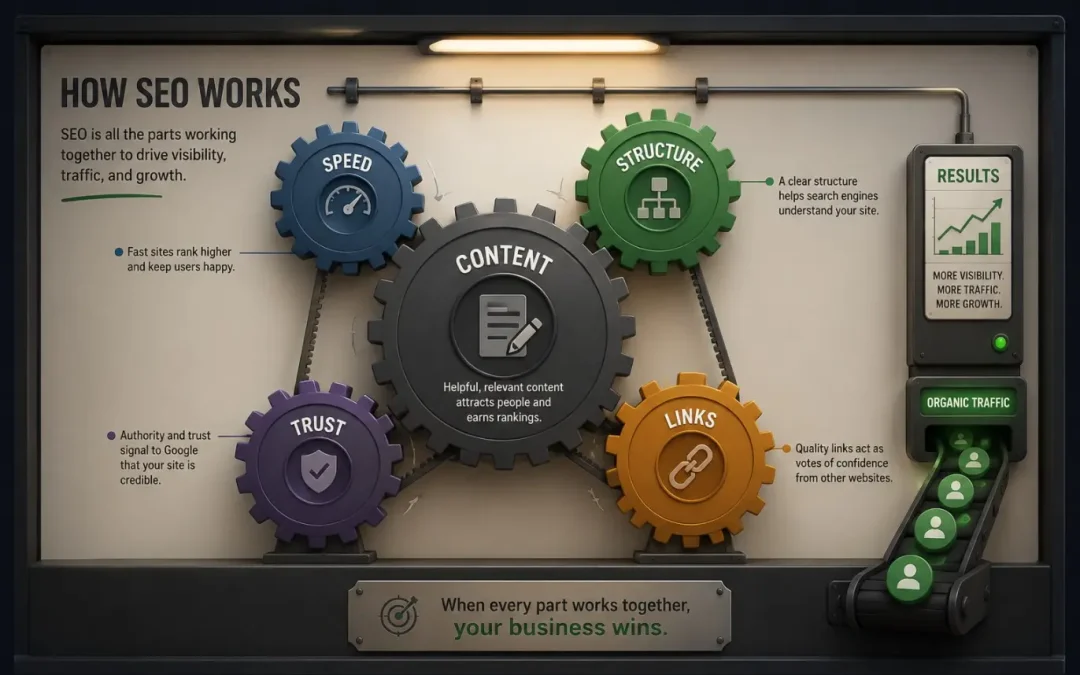
Post Summary: The Early Signal Is Not the One Everyone Watches For
The order never varies. A page has to be found, then read and filed, then shown to people, and only once it has been shown enough times do positions improve and clicks arrive. No stage skips ahead of another. In the early stretch, a page can be climbing steadily in how often it appears while still sitting on page 30 or 40, which reads as failure and is not. Three things are checkable without any technical background: whether the links and writing have anything to do with the business, whether the pages exist in the index at all, and whether the numbers move across months.
One of our own posts went from 10 appearances in search to 300, a jump of 2,900%, while the page itself was still buried where nobody scrolls. Nobody had clicked it yet. That is what the first working signal looks like.
Below: how a page travels from the fortieth position toward the first, and why improving something that has started to move usually beats writing something new.
Six Months of YouTube Videos Can Leave You Worse Off
If you know nothing about SEO right now, you’re almost in a better position than someone who thinks they know a lot about it. The point is well illustrated in the quote below.
That sounds wrong but it’s not.
The problem with knowing just enough SEO that it makes you dangerous is you’re going to get it wrong. There are so many nuances from how google decides rankings to how search engines find websites, so many interconnected pieces, so many things that look like they should work but don’t, that the person who spent six months reading blog posts and watching YouTube videos is often worse off than the person who walked in with a blank slate and a simple question: how does this thing work?
Psychologists Justin Kruger and David Dunning, in the Cornell University study that identified why people with just enough knowledge are often the most dangerously overconfident, described the mechanism:
“We argue that when people are incompetent in the strategies they adopt to achieve success and satisfaction, they suffer a dual burden: Not only do they reach erroneous conclusions and make unfortunate choices, but their incompetence robs them of the ability to realize it. Instead, like Mr. Wheeler, they are left with the mistaken impression that they are doing just fine.”
— Justin Kruger & David Dunning, Cornell University. Source: umich.edu
There’s so many nuances to the way SEO functions and the interconnected web of how things work is so complex that you might as well just be running an SEO company. If you’re that good, run an SEO company. The reason most business owners spend that much time trying to figure it out is because they’ve been burned, and they’re trying to make sure it doesn’t happen again. That instinct makes sense. But the path forward isn’t becoming an SEO expert. It’s understanding just enough to know what you’re looking at and speaking to someone who does this every day and can explain it plainly.
This post is that understanding. How SEO works when it’s working. What the real signals look like. And the handful of things you can check yourself without a technical background, so you never have to wonder whether your money is doing anything.
What to Understand Before You Spend Another Dollar on SEO
If you’ve already been through a bad experience with an SEO provider, months of invoices, nothing to show for it, vague reports full of metrics that didn’t connect you to real prospects or real volume, the instinct is to either swear off SEO entirely or to over-research the next one until you’ve paralyzed yourself.
Neither one works. Here’s what does.
Be really careful about who you hire moving forward. But careful doesn’t mean skeptical of everything. It means getting the right assurances. Not “am I going to be number one in Google in 60 days”, not those kinds of assurances. More like: have it completely clear what exactly is happening and what expectations are reasonable. What’s the process? What’s the timeline? What will you see at month one versus month four versus month eight?
If you want to make up time by conflating timelines, that’s not going to do it. Nobody can do that for you. We can’t speed up Google indexing. We can’t speed up Google ranking you faster. All we can do is do our job the best we can and give you a great product for your money.
That’s the first thing to understand: the timeline is not negotiable. Not by us, not by any company. A provider who tells you otherwise is selling you a feeling, not a result. The real version of SEO takes months. The real version involves process, check-ins, and a clear explanation of what’s being done and why. Maybe you need more frequent updates. Maybe you need a shared document showing exactly what was published and when. There are a lot of ways to structure the relationship so you don’t get burned again, but it starts with taking some personal ownership over what happened before and then taking steps to protect yourself moving forward.
Because your next one could be just as bad if you don’t ask better questions.
The Sequence, Start to Finish
SEO is not magic. It’s not a secret. And the way it works, when it’s working, follows a progression that anyone can understand if someone takes the time to explain it without jargon and SEO happens before we launch a new website.
Here’s the sequence.
First, Google has to find the page. That’s called crawling. Google sends automated programs, crawlers, across the internet constantly, following links from page to page. When you publish a new page or a new blog post, eventually a crawler finds it. Sometimes that takes hours. Sometimes it takes days. You can speed this up by submitting your sitemap through Google Search Console, but you can’t force it. Google crawls on its own schedule.
Second, the page has to be indexed. Indexing means Google has read the page, evaluated what it’s about, and added it to its database. A page that’s been crawled but not indexed doesn’t exist in search results. It’s like a book the library received but never put on the shelf. Indexing is not guaranteed, Google decides whether a page is worth adding based on quality, relevance, and whether it duplicates something already in the index.
Third, and this is where most people skip ahead, the page starts getting tested. Before anyone clicks on your page in a search result, Google shows it to people. That’s called an impression. The headline and a little snippet beneath it, that thing you see when you scroll through search results but you don’t click, that’s an impression. Your page appeared. Someone saw it. They didn’t click. But Google is watching.
That’s the mechanism. Crawl. Index. Impressions. And then the compounding begins. And all that strategy for your small business marketing has to be setup on the front end.
What the Early Numbers Look Like
When SEO is working, the first thing you see is not clicks. It’s not phone calls. It’s not a flood of traffic. The first thing you see is impressions going up.
In Google Search Console, you’ll see little signals, this post’s impressions went up 695%. That post’s impressions went up 2900%. Those numbers sound massive, but context matters. A newer post going from 10 impressions to 300 is a 2,900% increase. It’s not millions of views. Nobody has necessarily clicked on it yet. But Google is showing it to people, testing whether it belongs in that space, watching how searchers respond to it.
And here’s the part that trips people up: those early high impressions often correspond to rankings on page 30 or page 40. Rank 30. Rank 40. Deep in the results, way beyond where anyone scrolls. But the page is there. Google put it there because the content was indexed, it was relevant, and the structure around it told Google this site might know what it’s talking about.
That’s what early SEO looks like. Not a finished product. A signal that the machinery is working and often we’ll build a silo of content, a set of posts covering one area of your business, each coming from a different angle so google knows you’re an expert.
Everyone always talks about the clicks, I want all these clicks, I want all this business. But the only way to know that it’s going to work is to recognize these early precursors. If impressions are climbing and rankings are slowly moving from page 40 to page 20 to page 10, the system is doing what it’s supposed to do. If nothing is moving after months of published content, something is wrong, and that’s when you ask questions.
When Rankings Climb and Clicks Start Coming In
As the compounding continues, more content indexed, more internal links reinforcing the structure, more impressions accumulating, the rankings start to move. Page 40 becomes page 20. Page 20 becomes page 8. Then top 10. Then top 5.
And then eventually, if you wrote a really good post and you have nice supporting posts around it, it can get to number one.
When someone clicks on that result, now they’re on your site. That’s when you know things are working. Not when impressions go up, that’s the early signal. Not when rankings move, that’s the middle signal. When a person searches for something your business should rank for, finds your page, clicks on it, and stays, that’s the result.
And “stays” is measurable. In our analytics setup, we use Plausible, a privacy-focused platform, and we have it configured so that if someone scrolls past 90% of a page, that triggers an event. We can see that someone didn’t just land on the post and bounce. They read the whole thing. For our lead posts, the most important ones in the silo, we track that specifically. Did someone read 90%? Did they read 50%? It depends on the length, but the data tells us whether the content is doing its job once it gets the click.
That’s the full picture of how SEO works for a small business. Crawl, index, impressions, compounding, clicks, rankings, engagement. Each stage builds on the one before it. Skip a stage or fake a stage and the whole thing stalls.
How to Tell If Your SEO Is Working Without Being an Expert
This is the part that matters most if you’re the one writing the checks.
The person who knows nothing about SEO can absolutely protect themselves if they have an articulable process, a short list of things to check that don’t require a technical background.
Here’s the list.
First, ask what’s being delivered and whether it’s relevant to your business. If your SEO company is building backlinks, ask to see them. Take the time to look at the links. Read the article the link lives in. If it’s about your industry and it makes sense, it’s a good link. If it’s not, it’s not. It can’t be any simpler than that. You just read the article and you look at the website and make sure that it makes sense. Same. Period. Full stop.
Second, ask for an indexed pages report. If they’re publishing blog posts for you, ask this question: give me a report of the pages that are indexed versus the pages that aren’t. If they’re creating content and Google hasn’t even indexed it, that content isn’t doing anything. It’s not ranking. It’s not getting impressions. It doesn’t exist in search. An indexed pages report takes five minutes to pull from Google Search Console. If your provider can’t produce one, that tells you something.
Third, watch the progression, not the promises. Are impressions going up over time? Are rankings moving, even slowly, from deep pages toward the top 10? Is the content structured in a way that builds toward something, or is it a scattered collection of random blog posts with no architecture? You don’t need to understand the technical details of how Google’s algorithm works. You need to see a trend line moving in the right direction.
The person who thinks they know a lot about SEO might cross-reference metrics, run third-party audits, and spiral into analysis that isn’t helpful. It can be very, very simple if you slow down and just look at what’s happening. Are the posts relevant? Are they indexed? Are the numbers moving? That’s it.
If they say they’re doing a blog silo, basically a bunch of blog posts that all relate to the same subject to help boost your rankings, the question isn’t whether you understand silo architecture. The question is whether those posts are indexed and whether your impressions and rankings are trending in the right direction. If both answers are yes, the work is doing its job.
Why Improving a Post Matters More Than Publishing a New One
One of the best things you can do with SEO that almost nobody talks about is improve existing content instead of creating new content.
When something is working, impressions climbing, rankings moving, clicks starting to come in, the instinct is to keep publishing. More posts, more content, more volume. And there’s a time for that. But the highest-value move is often going back to the post that’s already gaining traction and making it better.
Add a citation that strengthens a claim. Expand a section that’s getting engagement. Update a statistic. Improve the internal linking. Add a FAQ that answers a question searchers are asking about that topic. Every one of those changes tells Google the page is being maintained, the information is current, and the site cares enough to revisit what’s already live.
When something’s working, you can improve it, you can modify it. It’s not going to hurt it, it’s only going to help it. That’s a concept most business owners never hear from their SEO provider, because the provider’s business model depends on billing for new content, not on optimizing what’s already there. But the reality is that a well-structured post that gets refined over time will outperform a post that was published and forgotten, every time.
That’s the part of SEO that doesn’t make it into the sales pitch. The ongoing work. The refinement. The willingness to look at what’s already performing and ask how it can perform better. It’s not glamorous, but it’s how rankings hold and how a page goes from top 10 to top 3.
If someone is explaining SEO to you and the entire conversation is about publishing more content, ask them what they do with content that’s already working. The answer will tell you a lot.
Frequently Asked Questions
How long does SEO take to start working?
Most businesses start seeing early signals, impressions increasing, pages getting indexed, rankings appearing deep in search results, within the first two to three months. Meaningful traffic and leads typically take six to twelve months depending on the competition and how much content is being built. The timeline is not something any provider can compress. What you can control is whether the work is being done correctly from the start.
What’s the difference between impressions and clicks in SEO?
An impression means your page appeared in someone’s search results, they saw the headline and the snippet. A click means they chose your result and landed on your page. Impressions come first and they come in higher volume. Clicks follow as your ranking improves and your result moves closer to the top of the page. Impressions going up is the earliest sign that SEO is working.
Can I check whether my pages are indexed by Google?
Yes. Google Search Console shows you exactly which pages on your site are indexed and which aren’t. If your SEO provider is publishing content and those pages aren’t showing up as indexed, the content isn’t doing anything yet. Ask for an indexed pages report, it takes minutes to pull and it tells you whether the foundation is in place.
Why do fast results get promised?
Because it’s easier to sell. A promise of “page one in 60 days” sounds better than “you’ll start seeing early impression signals in two months and meaningful ranking movement in six.” But the second version is the honest one. We can’t speed up Google indexing. We can’t speed up ranking. Any provider who says otherwise is selling a feeling, not a process. The right question isn’t how fast, it’s what are you doing and can I see the evidence.
What should I ask my SEO company to prove the work is real?
Three things. First, ask to see the actual links and content being created, read the articles yourself and check whether they’re relevant to your business. Second, ask for a report showing which pages are indexed versus which aren’t. Third, ask to see impression and ranking trends over time. You don’t need to be an expert to evaluate those three things. You just need to look and see whether what’s happening makes sense for your business.