
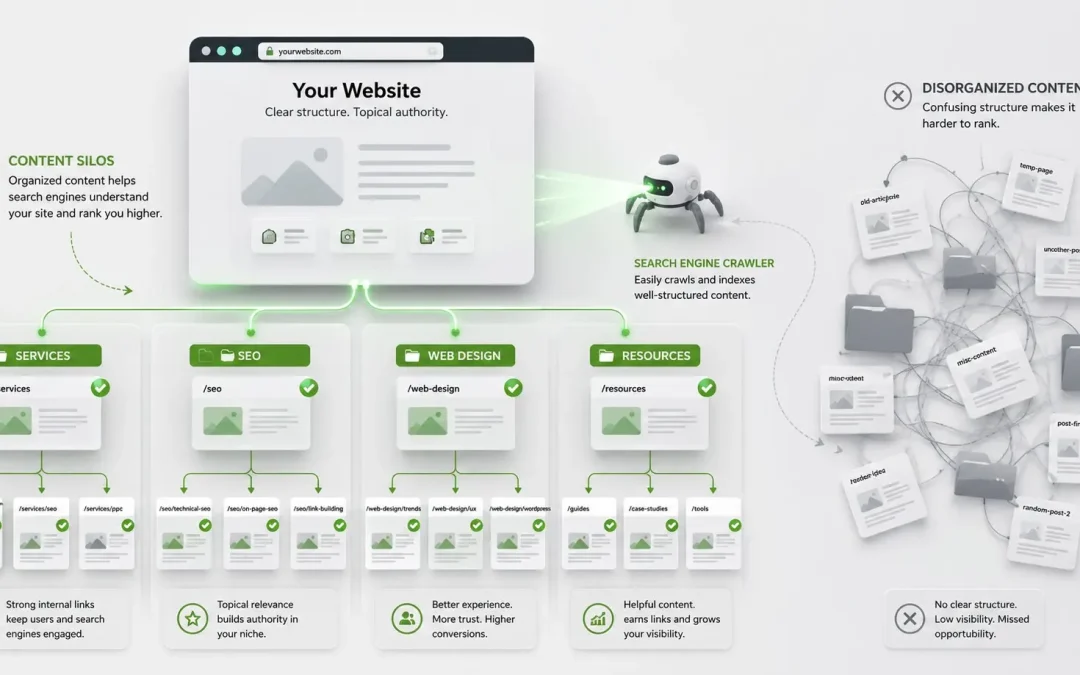
Post Summary: One Topic in the Center, Everything Else Branching Off It
A content silo is a drawing: one main topic in the center, major subtopics branching off it, supporting posts underneath those, everything linking back up. That is the whole structure, and if the person selling it to you can’t make it make sense in plain English, that tells you something about whether they can execute it.
The labels vary, pillar, cluster, hub and spoke, topic silo. What matters is that the person building it understands how the pieces connect, and that you understand it too, because the work is real: every post unique, in your voice, covering a distinct angle without stepping on the others.
Without that structure, fifteen posts about fifteen different things don’t connect and don’t build toward anything, and Google sees a pile of content with no architecture.
Even four posts can bleed into the wrong lane when the keyphrases are closely related, and two posts competing for the same phrase split the signal so neither wins cleanly. A silo defines the lanes before a single word is written, giving each post a distinct keyphrase, a distinct angle, and a distinct position in the hierarchy.
Fixing an unstructured set after the fact means auditing every post for overlap, rewriting where the lanes bleed, and remapping links that were never planned, which can run to three times the work of deleting them, setting up redirects, and starting over.
“We’re Going to Dominate This Cluster”
Someone is explaining SEO to you right now. Maybe it’s a company you hired, maybe it’s one you’re vetting, maybe it’s a friend who “knows a guy.” And somewhere in the middle of it, they say something like, we’re going to be topical authorities and we’re going to dominate this cluster of information.
You nod. You might even write it down. But in the back of your head, one honest thought: what does that even mean?
It doesn’t mean anything, not the way they said it. That’s jargon doing what jargon does. It sounds like a plan. It sounds like expertise. But it doesn’t tell you what’s happening, how it works, or why you should care. And if the person explaining it can’t make it make sense to you in plain English, that should tell you something about whether they can execute it.
A content silo is the cherry on top. Google has to have enough outside evidence that you’re worth crawling and indexing first, and once it does, the structure is what turns a collection of random pages into an organized body of knowledge on a subject you understand deeply. And it starts with something you can draw on a napkin.
What a Content Silo Looks Like When You Draw It Out
We wouldn’t call it a content silo if we were explaining it to a client. That term means nothing to most business owners, and using it just adds a layer of confusion before the conversation even starts. We’d call it something they already know, like a cluster diagram.
Do you remember diagramming things in elementary school where you had a big idea and then things branched off of it? That’s what this is.
You start with one main topic, the thing your business is known for, the thing you want Google to associate with your name. That sits in the center. Branching off from it are the major subtopics, the second-tier ideas that are clearly related to the big idea but subordinate to it. All of them point back to the center. And each of those subtopics might have its own set of supporting posts underneath, the specific questions people are searching for, the long-tail phrases, the real-world problems your clients walk in with.
That’s the hierarchy. That’s the whole thing.
The terminology doesn’t matter. You might hear “pillar,” “cluster,” “hub and spoke,” “topic silo”, all different labels for the same structure. What matters is that the person building it understands how the pieces connect to each other, and more importantly, that you understand it too. Because if you understand how it works, you get bought into the work. And the work is real, every post has to be unique, it has to be in your voice, it has to cover a distinct angle without stepping on the other posts. That requires effort. When someone breaks it down so you can see the structure, the investment makes sense. When they just say “topical authority” and expect you to trust them, you’re signing a check for something you can’t picture.
The Napkin Version, a Concrete Example
Say you’re in the concrete trades. Your main idea, the thing at the center of the napkin, is concrete. That’s what your business does. That’s what Google should think of when your domain comes up.
Off of that, you’ve got the big money makers. Driveways might be one. Patios might be another. Commercial flatwork. Decorative stamping. Each of those is a major branch, a subtopic that deserves its own cluster of supporting content.
Take driveways. Off of that branch, you might have posts about driveway resurfacing versus replacement, how long a concrete driveway lasts in your climate, what causes cracking, what expansion joints are and why they matter. Each one answers a specific question a homeowner is searching for. Each one links back up to the driveways page. And the driveways page links back up to the main concrete page.
Now multiply that across every major branch. Patios have their own set of questions. Porches have their own. Commercial jobs have their own. Every post supports the branch above it, every branch supports the center, and the whole structure tells Google one thing: this business knows concrete from top to bottom.
If you get enough of the user-intent questions that Google is fielding, the real things people type into a search bar, the structure covers your subject the way someone searching it would ask about it. Not by publishing fifty random blog posts about fifty random topics. By building a structure where everything connects.
What This Looks Like at Scale
We’re doing this ourselves right now with our web design content. Eighty-four posts across five main topics, all funneling to website design. And the organizing principle isn’t random, it’s based on the arc of the client. Because that’s what makes the most sense for us.
The five topics follow the journey a prospect takes from first contact through long-term partnership. There’s the craft of building, what goes into a site, how we approach design, what separates custom work from templates. There’s communication, how we talk to clients, why direct access to the person building your site matters, what happens when you can’t reach your web company. There’s access and availability. There’s what happens after launch. And there’s how we’re different, the structural stuff, the pricing, the no-contract model, the things that make the business work the way it does.
Every one of those eighty-four posts links back to the topic above it, and every topic connects to the main page. The entire structure is built on years of customer service experience and web design experience, real answers to the real questions clients have asked us since 2021.
That’s the part that makes it work. Eighty-four posts on one subject, written from inside the business, every single one connecting to the others in a structure that makes sense. The depth is what Google reads, not a tagline claiming it.
That’s how SEO works for a small business, not a handful of blog posts published on random Tuesdays, but a system built to show depth and expertise on one subject.
What Happens When You Skip the Structure
This reminds us of something that has nothing to do with websites, but everything to do with how throwing things at a wall works out.
Before Yeet Websites existed, the founder spent time as a financial advisor. Hired in 2007 with Edward Jones, right before the 2008 crash, so the timing was fantastic. The first training class was in St. Louis. Two hundred people in the room. Bright-eyed, ready to go, all of them convinced they were going to make it.
Six weeks later, the second session. Eighty people.
At month three or four, twenty-five. A 90% attrition rate. The people who survived looked at each other like, hey, you made it. It felt like surviving a war.
And the reason most of them didn’t make it? They just threw shit on the wall to see what sticks. No plan. No structure. No system for what they were doing or who they were targeting. Just activity for the sake of activity, hoping something would connect.
That’s what publishing blog posts without a content silo looks like. You write fifteen posts about fifteen different things. Some are decent. Some are thin. None of them connect to each other. None of them build toward anything. And Google looks at it and sees exactly what it is, a pile of content with no architecture.
Without any organization, Google’s not even going to recognize what you’re trying to do. You’d be lucky if any of those posts rank, because the whole thing just doesn’t make sense. There’s no signal telling Google that you’re an expert in anything. There’s no structure telling it which page matters most. There’s just noise.
And noise doesn’t rank.
How a Content Silo Changes What Google Sees
When a content silo is organized correctly, everything in its own lane, no overlap, no cannibalization, Google looks at your site like you know what the hell you’re doing. Because this is not easy to do.
We don’t care if it’s four posts or eighty posts. It is not easy. Even with four posts, if the keyphrases are closely related, you can absolutely bleed into the wrong lane. And then suddenly only two of your four posts are ranking and you’re sitting there thinking what the heck is going on? This sucks. Then you have to go back and rewrite, re-optimize, re-map the internal links, it’s not fun. And it happens constantly to people who build content without planning the lanes first.
Cannibalization is the technical term for it. One post eats away at another, literally cannibalizing it, because Google can’t tell which page should rank for a given search. When two posts compete for the same phrase, neither one wins cleanly. They split the signal. They dilute each other. And the result is worse than if you’d only published one of them.
A silo prevents that by defining the lanes before a single word is written. Each post has a distinct keyphrase, a distinct angle, and a distinct position in the hierarchy. The internal links between them reinforce the structure, they tell Google which page is the parent, which pages support it, and how all of it connects to the main topic at the center.
Unstructured content and a wired silo read as two different things. One looks like a business that published some blog posts. The other looks like a business that built a body of knowledge. Google can tell the difference, and so can the people searching for what you do.
That shift in how Google perceives your site is what determines whether your content moves the needle on rankings or just sits there taking up space.
Can You Fix a Mess That Already Exists?
Say you’ve got ten or fifteen blog posts already live. No structure. No internal linking strategy. No hierarchy. Just fifteen standalone pages that were published whenever someone had an idea or an SEO company told you to “post more content.”
Is it too late to organize them into a silo?
It depends on what you’re willing to do. Are you good with redoing everything, and possibly spending three times the amount of work to fix it than it would take to just delete them all, set up proper redirects, and start over?
That’s the real question. Because retroactive silo organization isn’t a quick cleanup. It means auditing every post for keyphrase overlap. It means rewriting sections where the lanes bleed into each other. It means restructuring internal links that were never planned in the first place. It means figuring out which posts can be salvaged, which ones need to be merged, and which ones need to be killed entirely. The spreadsheet alone, mapping every post’s keyphrase, intent, hierarchy position, and link targets, is more work than most people expect.
It is so much work that a lot of people just give up and leave it. And if the existing posts aren’t indexing or ranking, they’re not hurting you in the sense that Google is penalizing your site. But they’re not helping you either.
It’s mid.
The posts exist. They take up space. They don’t do anything. And every month they sit there unstructured is a month you’re not building toward authority on the subjects that matter to your business.
What the process usually looks like in practice is simpler than the DIY version: the business owner decides they’d rather have an expert handle it. They hand it off. We audit what’s there, decide what stays and what goes, build the silo architecture from scratch, and execute the content, with redirects, with lane discipline, with every post mapped before a word gets written. The business owner goes back to worrying about business stuff and not website stuff.
That’s what paying an expert to do it looks like. Not a magic trick. Just the work, done right, by someone who’s done the planning before a single post goes live.
If your content is sitting there doing nothing, it might be time to find out what a structure could do with it. Or under it. Or instead of it.
Frequently Asked Questions About Content Silos
How many posts does a content silo need to work?
There’s no magic number. A focused silo with four or five well-structured posts built around distinct keyphrases can outperform thirty random blog posts with no architecture. The structure matters more than the volume. What matters is that every post covers a unique angle, links correctly within the hierarchy, and supports the main topic without cannibalizing a sibling.
Can a content silo work for a local service business, not just national brands?
It works especially well for local service businesses. A roofer who builds a silo around roofing, with clusters on residential, commercial, storm damage, and maintenance, tells Google that business understands roofing from every angle. A homepage, a services page, and a few old blog posts give Google almost nothing to read on the subject. A silo gives it the full picture.
What’s the difference between a content silo and just having a blog?
A blog is a list of posts in reverse chronological order. A content silo is a hierarchy, a main topic supported by subtopics supported by individual posts, all internally linked to reinforce the structure. A blog tells Google you publish things. A silo tells Google you understand a subject. The difference in how Google treats those two signals is the difference between ranking on page four and ranking on page one.
How long does it take to see results from a content silo?
It depends on the competition, the domain’s existing authority, and how quickly the content gets published and indexed. For most small businesses, you’ll start seeing movement within three to six months of the silo being fully live and internally linked. The posts don’t work in isolation, the structure kicks in when everything is connected and Google has had time to crawl and evaluate the full picture.
Does Yeet Websites build content silos as part of its SEO service?
Yes. Silo architecture is part of how we approach SEO from the ground up. We don’t publish random blog posts and hope something ranks. Every post is planned, mapped, written in the business owner’s voice, and wired into a structure before it goes live. The $750 monthly SEO starting price includes the silo planning, the content creation, and the ongoing optimization. If you want to see what that looks like for your business, the cost calculator shows the tiers and what’s included at each one.