
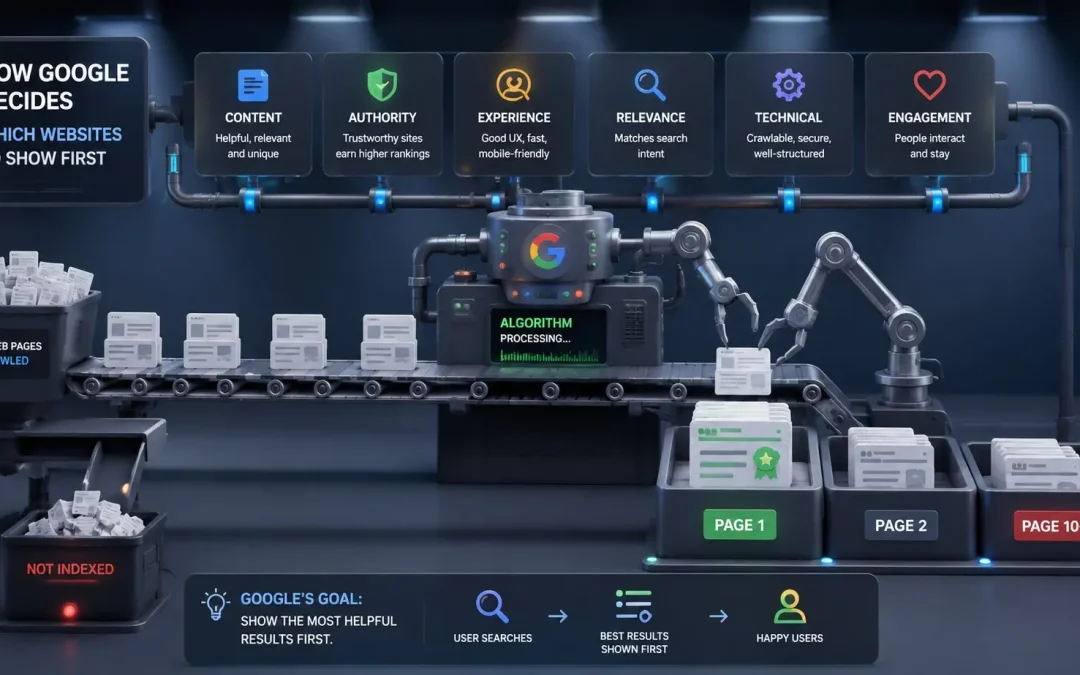
Post Summary: Google Ranks What It Can Tell Apart
Google ranks what it can distinguish and what other sites vouch for. Those two things explain most of what looks mysterious about search results.
A locksmith in Washington had years of reputation and almost no visibility. Every page had its own headings and photos, so from the owner’s chair each one looked distinct. Google reads structure and text rather than imagery, and the structure was one template repeated with a few words swapped. It picked the homepage and filtered the rest.
Authority works the same way it does with people. When a site that’s already trusted references you, that reference carries weight, and the sites with the most weight aren’t publishing about you for money. Smaller relevant sites are the realistic path, which is why the climb takes time.
A business without authority yet has a better opening: the long, specific searches nobody bothered to write about. A blog post whose heading matches the exact phrase someone typed, with a paragraph underneath that supports it and a button pointing at the service page, does work the service page can’t do alone.
Google doesn’t find you on its own. A sitemap submitted through Search Console tells it you exist, and it crawls on its own schedule. Change something after that first crawl and it may be a month before anyone looks again unless you request a recrawl.
Position one is harder to take than to hold. The strategy isn’t attacking the hill someone already owns, it’s claiming the ones nobody planted a flag on.
Years of Reputation, No Visibility
A locksmith out of Washington had been in business for years. Good reputation. Loyal customers. The kind of company that should show up when someone in their area needs a lock changed at two in the morning. But when you searched for them, nothing. Not on the first page, not on the second page. The homepage barely ranked at all, and every other page on the site might as well have been invisible.
The owner didn’t understand it. The site looked fine. Every service had its own page. There were photos, phone numbers, calls to action. From a business owner’s perspective, everything was in order.
From Google’s perspective, the pages were all the same page. It picked one and filtered out the rest.
That gap, between what a business owner sees and what Google sees, is where most ranking problems live. And how Google makes that call is less mysterious than people think. It just requires looking at your own site the way a search engine does, not the way a customer does.
The Person at the Top of the Mountain
When a business owner asks how Google decides who shows up first, the answer that makes it click usually starts with a question back: if the most respected person in your industry said something and everyone listened, would you believe it?
Of course you would. That person has earned credibility. They’re trusted. People pay attention when they talk because they’ve built authority over years of being right, being visible, and being referenced by others.
That’s exactly what Google does.
When a top-of-the-mountain website says something about someone, links to them, mentions them, publishes content that references their work, it’s trusted. That kind of endorsement puts up all kinds of great points in Google’s eyes. And the content on that page, the one being endorsed, goes to the top.
Problem is, you can’t just buy those links. They’re that valuable. You can’t go to USA Today and have them publish an article on what a great business you have. That’s not how it works. And so you have to go to lesser sites, relevant ones, reputable ones, but smaller. That’s why it takes longer. The path to authority isn’t a shortcut. It’s a climb, and the summit doesn’t have an elevator. If you want a deeper look at what that climb involves, our breakdown of how SEO works for small businesses walks through the whole process.
Which Signals Move the Needle for a Small Business
It depends on whether the site has authority yet or not. For most small businesses, especially newer ones, the answer is: you probably don’t, and that’s fine. It just changes the strategy.
If a business doesn’t have authority, we look at the long search terms. The ones that are so specific, so particular to what someone typed at 11 PM on their couch, that the big competitors haven’t bothered writing about them.
Here’s how that works in practice. Say you’re a painter. Someone might Google: I need a painter for my back bedroom that is in desperate need. That’s a long, specific search. Hardly anyone is targeting it. But if you have a blog post where the top section, the H2, the heading, uses that exact phrase, and then a paragraph right underneath supports it with relevant detail?
Google will say, wow, this person wrote about this person’s exact phrase. Let’s go ahead and serve that.
And then right below that section, you have a button. “Learn more about our painting services.” That button links to your main painter page. Now you’ve got a blog post doing the work of pulling the visitor in through a long, specific search, and handing them off to the page that converts.
The trick isn’t to have all these weird phrases on your main page. It’s to have posts that serve as support for the pages. And as long as the posts are uniquely different from each other, you can have as many as you want.
This is the trick about SEO that a lot of people don’t take advantage of.
Because you can do it on your own website. It takes a lot of work and takes a lot of time and it has to be unique. But nobody can stop you from publishing on your own domain. The other route, earning links from external sites, takes longer and is harder to control, because there are only so many painting websites that will let you put a link on their website.
What Duplicate Content Looks Like Through Google’s Eyes
Back to the locksmith in Washington. When we pulled the site up, the problem was obvious, but only if you knew what to look for.
Every single page was exactly the same. The only thing different was the background imagery. The headings were changed, and very few words in the support paragraphs were changed. But the structure, the layout, the bones of every page, identical.
Here’s what hangs up business owners who don’t know the technical side: if things are changing when you’re looking at it, different photos, some different words, then it feels like something different. You’re flipping through your own site and each page looks like its own thing. The colors shift. The hero image changes. A heading says “Residential Locksmith” instead of “Commercial Locksmith.” It feels distinct.
But Google doesn’t see images the way you do. Google reads the code, the structure, the text. And when the structure is the same template repeated with a few swapped words, Google sees it as the same page published over and over.
So Google clustered them, picked one to represent the set, and left the others out of results. The only page that ranked was the homepage, and it just barely ranked.
We had to go through and change everything, change the layout, rewrite the content, make several pages unique just to give Google a fresh set of eyes. Different structures, different depths, different approaches to each service. After that, it was off to the races for them.
They’d been around a long time. It was a shame that bad structure was the thing holding them back, not a lack of reputation or a lack of customers. The business was solid. The site was the bottleneck.
The Biggest Myth About How Google Decides Which Sites to Show
The myth we correct most often is this: that if you build a website, or make a change to one, Google will automatically find you.
Isn’t that interesting?
There are millions of websites. Millions. And when you think about it logically, it’s kind of illogical to assume Google is just going to stumble across yours. But that’s the assumption most business owners carry. You put up a site, and now you exist. You update a page, and Google sees it. That’s not how any of this works.
What happens is this: there’s a thing called a sitemap. It’s in a format called XML, but the format isn’t the point. The point is that it catalogs every page and every post on your site. Pages, like your homepage or your service pages. Posts, like blog articles. Two different types, both accounted for.
You take that sitemap, basically a map of your entire website, and you submit it to Google through a tool called Search Console. Bing has their own version. Most people do the Google one. And when you submit that sitemap, you’re alerting Google that you exist.
Then, on its own schedule, typically within less than a week, it’ll crawl your website. It goes through your pages, reads your content, and decides what to index. If there are issues, it reports them. Pages that stand on their own are the ones that make it into results. When two pages cover the same thing, Google picks one to show and leaves the other out, whether or not it stored them both.
And here’s the part that catches people: if you make a change after that first crawl, you can’t just assume Google noticed. Especially with a newer site, it might be a month before Google comes back to look at it again. You have to go in and request that it re-crawl the page you changed. If you want to understand more about how that discovery process works from the beginning, we wrote about how search engines find new websites and what happens during that first crawl.
King of the Hill: Why Position One Holds
If you want one image that makes the whole thing intuitive, picture a hill. The king of the hill is the one that ranks highest. They have the high ground. And the person that got there first? It’s harder to knock them off than it was for them to get there.
It’s a heck of a lot harder to overtake position one than to keep position one.
Same principle as being first to market in something. Your name dominates everything. Pyrex dominates an entire space, but they’re not the only company that makes glass bakeware. Tupperware, “I’m going to go put in some Tupperware and save my leftovers.” Tupperware is one out of probably hundreds of companies that make food storage containers at this point. But Tupperware is synonymous with putting your leftovers in the fridge. The brand became the category.
That’s what position one feels like in search. The site at the top gets the traffic, builds the authority, earns the links, and entrenches. If you’re king of the hill, if you’re number one, you have to really screw up to get knocked down.
Which means the strategy for everyone else isn’t to attack the hill head-on. It’s to find the hills nobody has claimed yet, the long search terms, the specific questions, the angles the king didn’t bother writing about, and plant your flag there first. Build enough of those smaller positions, and eventually you’re not challenging the king from the bottom. You’re standing on your own hill, looking across at them.
If someone told you that your website would rank just because it existed, they skipped every part of this. Understanding how Google makes these decisions starts with accepting that it doesn’t owe anyone a ranking. It rewards the sites that earn it, through structure, through content, through authority built one link at a time. The good news is that none of this is hidden.
Frequently Asked Questions
Does paying for Google Ads help my organic ranking?
No. Google Ads and organic search are completely separate systems. Running ads does not improve your organic position, and stopping ads does not hurt it. They operate on different mechanisms, ads are an auction, organic is earned through content, structure, and authority. Spending money on one does not buy progress on the other.
How long does it take for a new page to show up in Google?
After you submit your sitemap through Search Console, Google typically crawls a new site within a week. But indexing a specific page, and ranking it, can take longer. A new page on a site with some authority might index in days. A new page on a brand-new site could take weeks. And if the content overlaps with something you’ve already published, Google may not index it at all.
Can I rank for competitive terms without backlinks?
For short, high-competition terms, it’s extremely difficult without backlinks. That’s the authority piece, Google needs signals from other sites vouching for yours. But for long, specific search terms, you can rank with strong on-site content alone. That’s the strategy we use for small businesses: target the searches the big players aren’t bothering with, build content around those exact phrases, and let the results compound over time.
Why do some pages on my site rank and others don’t?
Usually it’s a uniqueness problem. If multiple pages cover similar topics with similar language and similar structure, Google picks the strongest one and ignores the rest. That’s what happened with the locksmith in Washington, every page was a near-copy, so only the homepage got any traction. Each page needs to stand on its own with distinct content, a distinct angle, and enough depth to justify its existence.
What’s the difference between crawling and indexing?
Crawling is when Google visits your page and reads it. Indexing is when Google decides the page is worth storing and showing in search results. Every indexed page has been crawled, but not every crawled page gets indexed. If Google crawls a page and finds duplicate content, thin content, or structural issues, it may crawl it and walk away without adding it to the index. You can check which pages are indexed through Google Search Console.