
Post Summary: One Starts From Your Business, One Starts From a Layout
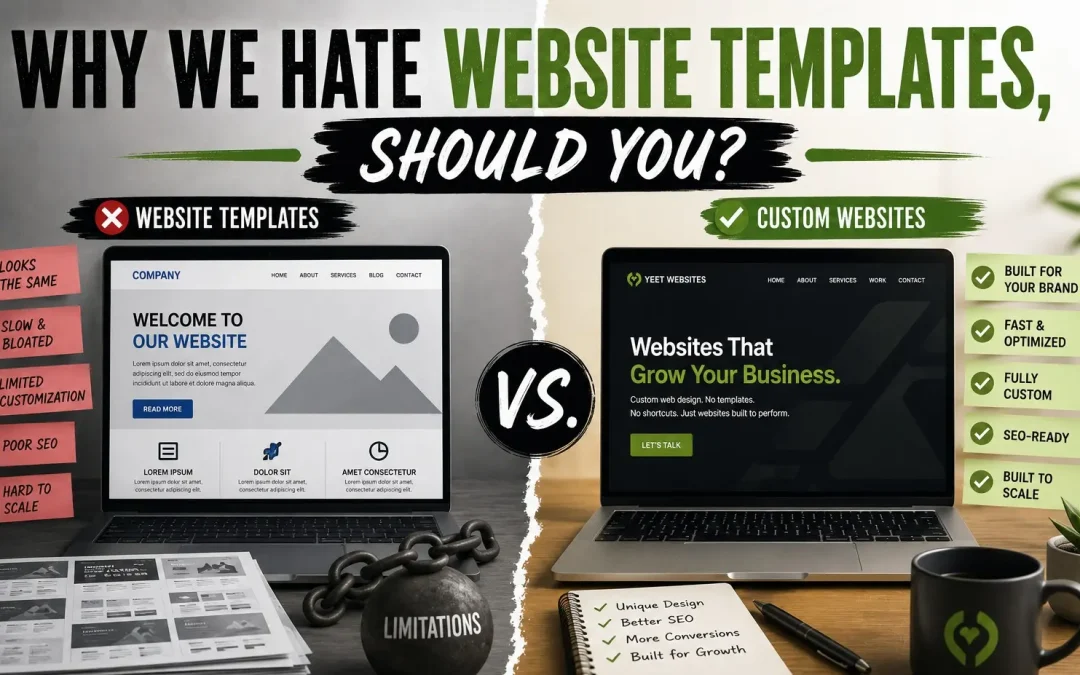
The two run in opposite directions. One begins with whatever separates a business from everyone else in its market and grows outward from there. The other begins with a layout settled before anyone knew the business existed, and everything has to be squeezed inward to fit it. That’s the source of the familiarity people pick up on without being able to place it. Same section order, same opening, same footer, across businesses with nothing in common. The footer gives it away fastest, because a kit footer looks exactly like what it is.
One treatment center in Kansas opened its homepage with a slab of text wedged beside a staff photograph, because the module handling that section could not lay it out any other way. The text went to the About page, where introductions belong. The homepage got a single clear opening instead, and the client saw the difference the moment the mockup loaded.
Below: what the cheaper option really buys, and how to recognise a template site in half a minute.
A Paint-by-Numbers Kit Explains the Whole Problem
Walk into any hardware store and you’ll find a paint-by-numbers kit. Every line is already drawn. Every section is already numbered. Your job is to match the color to the number and stay inside the boundaries someone else decided on before you sat down.
That’s a template website. The image is already created for you. The sections are already placed. The decisions about where your headline goes, how your services are organized, what the footer looks like, all of that was made by someone who has never heard of your business, serving a layout that works for nobody in particular and therefore fits nobody perfectly.
This is why we don’t use them. The website templates vs custom debate often gets framed as a budget decision, but the real issue isn’t money. It’s that a template was built for a business that doesn’t exist, and your business does.
What a Custom Build Starts With
When we start from scratch, the first thing that happens isn’t a design tool. It’s imagination.
You gather all the information you know about the customer, how they talk, what makes them different, what their competitors are doing and where the gaps are, and you hold all of that in your head before a single element gets placed. You imagine how it will assimilate into something new. Something that hasn’t existed before this business walked in the door.
We look at the big dogs in the industry. What are they doing? Where’s the gap? You find a nugget that’s unique about this particular client and you start there. That nugget becomes the thread that runs through the entire build, the color choice, the layout rhythm, the way the homepage opens. Everything expands outward from what makes them specifically them.
A template can’t do that. A template starts from the middle, from a layout decision already made, and asks your business to fit itself around it. Custom starts from your business and builds outward. Those are opposite directions, and the results look like it.
Andy Warhol took a Campbell’s soup can, one of the most ordinary objects in America, and turned it into something that had never existed before. That’s not a template move. That would never be in the imagination of a template. Even remixing something familiar into something new is a creative act. Paint by numbers is not.
The Hero Section That Wouldn’t Sit Right
We came across an addiction treatment center in Kansas. The site had problems throughout, but the one that crystallized the template issue was the hero section, the very top of the homepage, the first thing anyone sees.
There was a large block of text sitting next to a photo of the staff. It should have worked. The content was real. The photo was good. But it looked like someone had copied text from a Word document and thrown it onto the page, because that’s essentially what the template had forced them to do. The module for that section apparently couldn’t make it look right, so it just sat there, unformatted, unprofessional, out of place.
They knew something was wrong. You could tell in how they talked about the site, that low-grade discomfort people have when they sense a problem but can’t name it. They hadn’t been able to articulate it, but it was there.
We scrapped that entire section. The content belonged on the About page, that’s where staff introductions and background live, so we moved it there, where it made structural sense. The homepage hero became what it was supposed to be: a single, powerful first impression. When we showed them the mockup, the reaction was immediate. “Oh my god, this is so much better.”
That’s what template constraints produce. Not catastrophic failure, quiet, nagging wrongness that clients feel and can’t fix because the template won’t let them, and fighting the template to find another route is more work than most builds allow for. The performance cost of that wrongness compounds over time.
Faster and Cheaper, and What It Costs
Sure, templates are faster. Sure, they’re cheaper upfront. The argument makes sense on paper.
Here’s the equivalent argument for AI-written blog content. You’re a plumber in Bend, Oregon. You tell ChatGPT to write a post about why you’re the best plumber in Bend, mention your time management, add these specific details. It spits out content. Clean sentences. Reads fine. How many other plumbers in Bend, or Bend-adjacent markets, just did the exact same thing with the exact same prompt? How many are getting the same output, the same structure, the same phrasing, throwing it on their blog and calling it marketing?
It’s all the same content. ChatGPT isn’t going to give you a new spin. It’s recycled garbage dressed up as something specific. And that’s the template website problem in one image.
Your customers are going to look at your site and it’s going to look familiar, but not in a good way. Familiar the way every chain restaurant looks familiar. Familiar the way a form letter feels familiar. They’ve seen this layout before. They can’t say where. They just know it isn’t you.
Faster and cheaper gets you a site that exists. It doesn’t get you a site that works, because working requires being specific to your business, and templates are specifically designed to be nonspecific.
How You Can Tell in About Thirty Seconds
After seeing thousands of websites, pattern recognition kicks in fast. You don’t need to inspect the code or check the platform. You just look.
You’ll see the same website repeated across an entire portfolio. Slightly different words, same structure, same section flow, same footer layout. The footer is usually the giveaway. On a custom site, the footer reflects decisions someone made for this business. On a template site, the footer looks exactly like it came from a kit, because it did.
The broader tell is the absence of individual treatment. Every section on a custom site has been thought about in the context of this business. The homepage hero isn’t just a hero, it’s a specific choice about what this particular company needs a visitor to feel and do in the first five seconds. A template hero is a hero. It holds content. That’s it.
There’s no uniqueness. No individual personal treatment. You can feel it the same way you can feel when a form letter has your name mail-merged in. The bones of the thing were built for someone else, and the personalization is surface-deep. What a custom build looks like varies by industry, but that feeling of being made-for-you is consistent across all of them.
Why We Start From the Nugget Every Time
The reason we don’t use templates isn’t a philosophical position. It’s a practical one. If we started from a template, the first thing we’d have to do is fight the template, work around its decisions, override its structure, force this specific business into a layout that wasn’t designed for it.
Starting from scratch means the first decision is yours. What do you need the homepage to do? What does your customer need to feel when they land? What makes this business different from the fourteen competitors in the same market? You find the nugget that’s uniquely theirs, and you build the entire site around it, expanding outward from what makes them them, not inward from a layout that’s already decided.
That’s the work. The questions we ask before a single pixel gets placed exist because custom design requires knowing the business from the inside out. A template doesn’t need to know you. We do.
If your current site feels familiar in the wrong way, like it could belong to anyone in your industry, that’s not a minor aesthetic complaint. That’s the site failing at its most basic job. We build from scratch, every time, because your business deserves decisions made for it.
Frequently Asked Questions
What’s wrong with a template website if it looks good?
Looking good and being built for your business are different things. A template can look polished and still force your content into layout decisions made for a generic business. The problems tend to be structural, content that doesn’t fit right, sections that can’t be adapted without fighting the platform, and a final product that looks like dozens of other sites in your industry. Your customers notice, even when they can’t say why.
Isn’t custom design more expensive than a template?
Upfront, yes, custom takes more work. At Yeet, the setup is $600 and $130 a month. What you get is a site built around your business, not a layout you’re borrowing from someone else’s. A template site that doesn’t convert costs more over time than a custom site that does. Faster and cheaper only wins if the result works.
How do you figure out where to start on a custom build?
We look for the nugget, the one thing that makes this business specifically different from its competitors. That might come from a conversation about how you work, who your best customers are, what the big players in your market are doing wrong. That nugget becomes the thread the entire design is built around. It takes a conversation, not a questionnaire.
Can’t a good designer make a template look custom?
To some degree, but the constraints are real. A template’s structure is baked in. You can change colors, swap photos, rewrite copy. You can’t easily change how sections relate to each other, how the mobile layout behaves, or what the underlying code assumes about your content. At some point you stop customizing the template and start fighting it. We’d rather start from scratch than spend that energy on a workaround.