
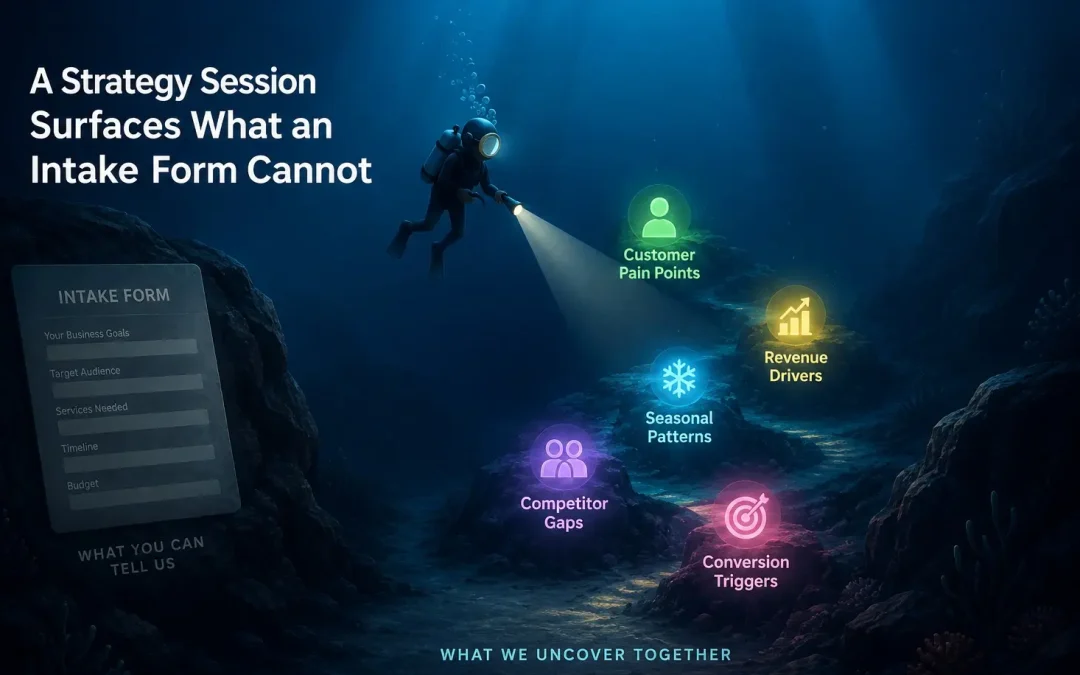
There’s a moment in every first real conversation with a new client where something shifts. It usually happens around fifteen minutes in. The short answers get longer. The rehearsed version of the business gives way to the real one. And the person sitting across from us — or on the other end of the phone — stops performing and starts talking.

That’s what a website strategy session is, at its core. It’s the conversation where we stop looking at your old site and start looking at your business. What it is. Who it serves. What it’s missing. What you’ve been trying to say that nobody’s said yet. That shift — from guarded to open — is where the website starts.

Here’s what that process looks like, and why our clients keep telling us it was nothing like they expected.

What we’re learning when we ask about your business

The first question most people expect in a strategy session is something like: “What do you want your homepage to say?” That’s not where we start.

We start earlier. We want to know about the business itself — what you do, how you do it differently, who your best clients are and why they chose you, what your current site is failing to communicate. We want to know what you’re charging and what you think your competitors are charging. We want to know what pages you’ve been wanting to add for two years that your previous company never got around to.

Those conversations cover what a website strategy session is supposed to cover: goals, gaps, and what success looks like for your specific business — not a generic template of your industry. And because we’ve done this across hundreds of businesses in dozens of industries, we know how to pull the thread.

The result isn’t a notes document. It’s the foundation of the entire build.

Why clients expect homework — and what they get instead

When someone has been through a bad website experience, they know the drill. There’s a 15-field intake form. Then a questionnaire. Then revisions that require you to write copy from scratch. Then a final product that still doesn’t quite sound like you.

So when we say “it’s a conversation,” the reaction is usually polite skepticism. They don’t believe us. They shouldn’t, probably — because most companies saying that don’t mean it.

What we mean is this: we ask the questions, we do the listening, and we do the work that follows. Yeah, it can be some work, but not as much as you think. The prep work on your end is your own business. You already know that. What you may not know is how to translate it for the web — and that’s our job, not yours.

We work through those one-off situations when they happen. The rare cases where something falls outside both our control and yours, we work through together. But 95% of the time, the process is far easier than anyone expecting a homework assignment believes going in.

We deliver on that 95%. Every time.

What the deep dive uncovered for a security company in California

A security protection and patrol company out of California came to us with a site that didn’t reflect who they were. They operated at an executive level — corporate clients, professional presentation, serious credentials. Their website looked like their competitors’. Which is to say, it looked like every other security company online.

They had two specific things they’d been trying to get done for years. One: canine services. They offered it. It wasn’t on the site. Their previous provider never could get it done.

Two: they operated in another country. They had a website there. They wanted a link to it in their menu — a link that opened a new tab to that site. The simplest possible thing. It never could happen.

These are simple things. The link especially — you put it in the menu and it opens a new tab, done. But it had been sitting unresolved through months of account managers and ticket queues.

We got both done. But the bigger shift was the branding. During the conversation, it became clear they didn’t just want those two things fixed — they wanted to be framed differently. More executive-oriented. Less generic. So we changed the whole mood, put some awesome photos on there, and it really was a complete transformation. It changed the entire look of the website and how they were represented in the market.

That’s the kind of thing that comes out of a real conversation. Not from a 15-field intake form.

The discovery that changes the build

This happens on almost every project. We’re going through the current site — looking at what’s there, what’s ranking, what’s not — and the client mentions something almost offhand. “Oh, we also do this.” Something that’s not even on the website. It’s not even possible that it was missed, but it wasn’t.

And boom, we had it.

Sometimes it’s a service nobody thought to include. Sometimes it’s a geography they cover that never made it onto a page. Sometimes it’s a credential or a process that makes them meaningfully different from every competitor — and they’ve never once mentioned it because it feels like a given to them.

That’s the realization that opens things up. The moment a business owner understands that they don’t have to look like everybody else — that their website can be as specific as their business — something shifts. They start saying “well, we also…” And those “we also” moments are where the site goes from adequate to useful.

We’re not just learning your business. We’re showing you things about your business you’ve stopped seeing because you’re inside it every day.

This is also why custom design works where templates don’t — the site we build comes from this conversation, not a layout someone else used first.

What the strategy session feels like from where you’re sitting

It feels like getting a new friend.

That’s not a sales line. It’s the closest honest description. Think about how you became friends with someone in elementary school — there wasn’t a form, there wasn’t a process, there was just a conversation that kept going because it was interesting. That’s this. The transition from “we don’t trust you” to “here’s my credit card” is a fun one, and we mean that. Sales in life has been one of our greatest joys for exactly this reason.

The original Edward Jones had a line he used when he was walking from farm to farm trying to convince people to invest their savings with him. It was something along the lines of: his greatest tragedy would be not being able to convince people enough to let him help them — when he knew he could do good by them. The word “convince” carries the weight of manipulation when used wrong. But when you’re doing true good in the world, and you know there’s no way a person can get hurt by the process — then convincing someone is the right thing to do. It’s all upside.

That’s how we feel about this conversation. We know what the other side looks like. We’ve seen the strategy sessions end in websites that finally sound like the business. We want that for every client sitting across from us.

And if you’ve been wondering why web designers ask so many questions before anything gets built, this is why. The questions aren’t administrative. They’re structural.

What to do if you’re nervous going in

We hear this sometimes. People who’ve had bad experiences come in guarded. Short answers. Flat energy. “Just tell me what you need.”

Here’s what we tell them: there are no wrong answers.

And when nervousness is in the room, we simply hand-hold more.

It’s very clear when somebody’s nervous, and a few things happen naturally. We slow the voice down. We break things down extremely simply. We stop more regularly for check-ins — does this make sense, how are you feeling about this, can I explain this better, is this clear before we move on. We keep doing that until the energy in the conversation shifts and they’ve settled in.

There’s nothing wrong with being nervous. This is a big decision for a lot of people, and we take that seriously. A website is one of the most important things a business has — maybe the most important. When we sense that somebody’s treating it that way, we respect it. We don’t rush past the discomfort. We work through it.

If you can’t articulate exactly what makes you different, that’s fine — we’ll find it together. You know your business. You may not know how to translate it for the web, and that’s fine. That’s our job.

What we need from you is the bullet points. We’ll take it from there.

Questions about the website strategy session

What does a website strategy session at Yeet Websites cover?

It covers your business — what you do, how you’re different, who your best clients are, what your current site is missing, and what you’ve been trying to get done that nobody’s executed on yet. We also look at your current site together, identify what’s working and what isn’t, and talk through what success looks like for your specific goals. By the end, we have everything we need to build something that reflects your business.

Do I need to prepare anything before the strategy session?

No. You don’t need copy, a wireframe, a list of keywords, or a detailed brief. All of that is our job. Just know your business — and you already do. We’ll ask the questions that surface the right material. If you don’t know how to answer something, we’ll help you work through it. There are no wrong answers here.

How long does the strategy session take?

It varies by business complexity, but most run 30 to 60 minutes. We’re not trying to make it efficient — we’re trying to make it useful. If there’s more to cover, we cover it. A complex service business with multiple locations or service categories might run longer. A simpler local business might wrap up faster. Either way, it ends when we have what we need.

Will the strategy session change what my website looks like?

Yes — and often significantly. The session regularly surfaces services that were never on the old site, branding angles that never got captured, credentials that set the business apart, and goals that the previous provider never addressed. We’ve overhauled entire site structures, changed brand positioning, and added whole service categories because the conversation brought them to the surface. This is where the build starts.

What happens after the strategy session?

We go to work. The notes from the session become the foundation of the build — copy direction, site structure, page priorities, and design mood all trace back to what we learned. You’ll typically see a homepage concept within a week. From there, you review, we refine, and we build forward. The session isn’t a preamble to the project. It IS the project’s starting point.

Is this different from a typical web design intake process?

Very different. Most companies send a form — 10 to 15 fields asking what colors you like and what pages you want. That process produces generic sites because it collects generic inputs. Our session is a real conversation with the person who will build your site. What we hear directly shapes what we build. There’s no handoff to a team that wasn’t on the call. The same person who does the strategy session does the design and the build.

If you’ve been sitting on a site that doesn’t sound like your business — or a provider that never got around to what you needed — the conversation is where that changes. We’ve been doing this long enough to know what good looks like. And we know how to find it in a business like yours.

Give us a shot.