
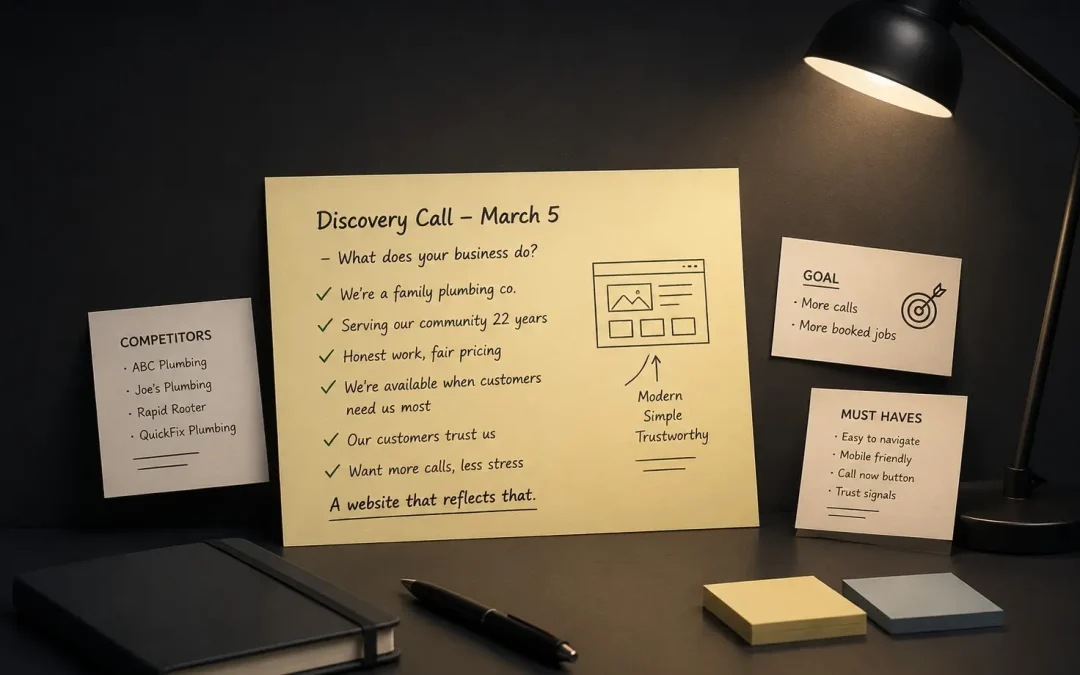
Post Summary: Why the Conversation Goes Where It Does
A client opened by saying he had no interest in the questions and just wanted what he already had, for less money. That answer turned out to be the whole brief. His old site was fast and readable, so the new one was built to be fast and readable, and the conversation ended there.
Most don’t end that quickly. What gets asked changes with the business, because the useful part is rarely the answer to any single question. It’s how an owner explains their own operation: where they hesitate, what they skip past, which part they warm up on.
Below: what those questions are listening for, why the process can feel like too much, and what happens to the answers once the design starts.
He Cared About the Result, Not the Process
A client came to us not long ago and opened the conversation with something refreshingly direct. He didn’t want a pitch. He didn’t want to hear about our process. He wanted us to understand one thing: he was paying twice what we charge, and the website wasn’t any better for it.
“Look, I just need as good as what we got for less. Can you do that?”
That’s it. That was the whole brief.
We told him we’d honor the price, that’s our price, it doesn’t move, but what if we tried to make it better too? He said: “Great, cool. Do it.” And then he went back to running his business. He frankly didn’t care about the process. He cared about the result.
We love clients like that. And we love that those conversations exist, because they tell us something important. Before we designed a single thing for him, we already understood what he valued, what had frustrated him, what he needed us to deliver, and what “success” looked like from his seat. Not because we ran him through a questionnaire. Because we listened.
That is why web designers ask so many questions. Not all of them, and not for every client. But the ones who build custom sites, the ones building something specific to your business, need to understand your business before they build anything. A template doesn’t need to know who you are. A custom site does.
Every Conversation Runs Differently
There’s no master list of intake questions at Yeet Websites. No form with twenty fields. No automated intake email that fires when you pay.
There are questions we’ve asked often enough that they come naturally, “Tell me about your website” or “What do you not like about your current site?”, but those aren’t really questions. They’re doors. What comes out the other side is different every time. One client answers with a shrug. Another one goes forty minutes and you realize their relationship with their web company has been a source of genuine frustration for years. Getting people to open up and explain what they really want, that’s the art of the game.
We built a custom site. The conversation that fed it was custom too.
That’s the same logic. Just like the difference between a custom website and a template website, our conversations are custom. A template company has a process. They have a discovery form. They have a list of fields to fill in so their designer can fill in a list of layout slots. It’s very computer-like. And frankly, those companies are going to get automated, not by us, but by the same AI that already runs the ads saying “fill in this information and get a website in 30 seconds.”
We saw one of those ads recently. The promise is fast. The problem is you get what everyone else gets. Imagine a thousand business owners all using the same AI website builder in the same week. Is it going to produce a thousand different, unique-looking websites? We don’t think it is. We think it produces maybe 10 or 20 template variations, and everyone gets one of those. You just don’t know which one your competitor already picked.
That’s the gap custom fills. And the conversation is how we get there.
From the Conversation to the First Pixel
Every question we ask has a job. Sometimes that job is obvious, “What services do you want to lead with on your homepage?” answers itself. But the questions that matter most are the ones the client doesn’t expect, and the answers that come out of them aren’t checkbox responses. They’re stories.
A client walks us through what they’ve tried before. What worked, what didn’t. What customers ask them most often. What they’re proud of that nobody seems to notice. What makes them different from the competitor two miles away. None of that ends up in a spreadsheet. It ends up in the tone of the copy, the structure of the navigation, the order in which their services are presented, the kind of photography we push them to get.
The story the client tells us in that first conversation is the story the website tells their customers. If we skip the conversation, we’re guessing, and guessing produces websites that could belong to anyone.
We’ve seen what those websites look like. Open three tabs for the same type of local service business, any industry, any city. Try to remember which is which after you’ve clicked through all three. Most people can’t. Same photos, same layout, same “We’ve been serving the community since [year]” hero text. These companies didn’t skip the conversation because they were lazy. They skipped it because their process didn’t require one. That’s the cost of building on templates, the site is done in two weeks, and it could be anyone’s site.
What We’re Listening For
The specific answer varies by client. But the thing we’re always listening for is the detail that makes the business irreducible, the one thing about how they work, who they serve, or how they got here that can’t be templated.
For a roofing contractor, it might be that he personally walks the property after every job and asks specific questions before he ever asks for a review. That process doesn’t just end up in the copy. It shapes how the site handles trust signals, how the contact form is framed, how testimonials are positioned. It makes the site look nothing like the other three roofing companies in the same zip code.
For the client who opened this post, the one who just wanted as good as what he had for less, the conversation told us he valued clarity above everything. So we made sure the site was fast to navigate, easy to read, and didn’t waste his customers’ time. The design followed the conversation, not the other way around.
That’s what we mean when we talk about building a site that reflects the actual business. It doesn’t mean more widgets. It means more understanding, earlier in the process, so the build reflects the actual business rather than a generic version of the industry it belongs to.
The questions aren’t about filling fields. They’re about earning the right to build something that looks like you.
When the Questions Start to Grate
Not every client wants a 45-minute intake conversation. Some of them have been in back-to-back meetings all day and they just need to hand this off and trust us to make it good. We get that.
We don’t hold the build hostage to an exhaustive questionnaire. We give clients a real choice: we can sit down for 30 minutes and go into the deep crevices of your business and your life, or we can make what you have better now and refine it through the build process, which do you prefer?
They all want to get back to their business.
So we do what we do. We use what we have. We ask the questions that matter and skip the ones that don’t. And then we start building, with the agreement that we’ll keep sharpening it as we go.
The frustration usually dissolves in the first round of revisions, when the client realizes we already understood what they needed without them having to explain every pixel. That’s not magic. That’s paying attention during the initial conversation and using it well.
Where the intake becomes more critical, where the deep conversation is non-negotiable, is when the client wants to do everything custom. Build from scratch, specific to their industry, their customer base, their conversion goals. Then the conversation isn’t optional. It’s the whole foundation. You can’t custom-build something you don’t fully understand.
Why It Feels Like Too Much
The word “discovery” gets used loosely. Plenty of what carries the label is a list of questions getting answered, then dropped onto the page as-is before moving to the next one. The copy that comes out the other end reads exactly like that.
Discovery has turned into a list of answered questions. That’s not discovery. That’s intake.
True discovery is uncomfortable. You ask questions that get the business owner to really think, not just recite. Not “Tell me about your last three clients.” But: what are the last three customers you worked with that changed the way you do business? What was it about those projects, or maybe just one of them, that made you realize you could do it differently?
That kind of question stops people. There’s a beat. Sometimes two. And what comes after that beat is almost always the most useful thing they say in the whole conversation. Because it surfaces the thought process of how the business owner thinks about their work, not the rehearsed version, but the real one. The one that comes out when someone asks the kind of question they weren’t expecting.
Another one: what would you do or say if a client told you they were unhappy with a service? How would you react to that?
You have to stop and think. Because the first thing most people think is: when was the last time someone even said that? And then you’re taken aback by it. That’s what a real discovery question does. It gets at how someone handles things when they don’t go as planned, which is different from what they do. That’s character. And character belongs in the website.
We’re not interrogating anyone. But we’re also not pretending that “what services do you offer?” is discovery. It isn’t.
If you want a website that’s built around your business specifically, the way it runs, what makes you different, that starts with a real conversation. No intake form, no automated questionnaire. Just a direct conversation about your business and what you need.
Which Questions Earn Their Place
We get asked occasionally how we know what to ask. The honest answer is that it comes from experience, from sitting across from enough business owners in enough different situations that you start to hear the questions underneath their answers.
When someone says “we just need a cleaner design,” that’s almost never about aesthetics. It’s usually about embarrassment. They’re uncomfortable sending people to the current site because it doesn’t reflect how good the work is. The question that surfaces that is: “If someone looked at your site for the first time without knowing anything about your business, what would they get wrong about you?”
That’s a discovery question. You can feel the difference.
When we ask about a competitor, not to compare, but to understand what the client sees as the standard they’re working against, we learn something about their positioning, their pricing psychology, their insecurities, their ambitions. None of that comes from a form. All of it informs the build.
There’s an “aha moment” that happens in most of these conversations, usually somewhere in the first 15 minutes, when the client stops giving us the rehearsed version and says the real thing. We listen for that moment. When it arrives, the rest of the conversation builds from there, and so does the site.
That’s what custom design across different businesses really means: different conversations producing different websites. Not the same template with a different logo and a different color scheme. A site built from a conversation that couldn’t have been anyone else’s.
If your web company didn’t ask hard questions, questions that made you stop and think, they were guessing. And the website will tell you that, if you look at it long enough.
Frequently Asked Questions
How long does the initial conversation with Yeet Websites take?
It depends on the client and what they want to accomplish. Some conversations are 20 minutes, a business owner who knows exactly what they need and wants to get started. Others go longer because there’s a lot of ground to cover and the business is more complex. We don’t have a fixed intake call length because we don’t have a fixed intake script. The conversation ends when we understand what we’re building and why.
Do I need to prepare anything before our first conversation?
No. The whole point of a real intake conversation is that we draw the information out, you don’t have to deliver it pre-packaged. If you have a list of competitors you’re aware of, sites you like, or specific things you want to avoid, those are useful. But we’re not going to send you a 20-field form and wait for you to fill it in. The conversation handles that. Come as you are.
What does your intake process involve?
A form collects fields that feed a layout: your services, your tagline, your preferred colors. A real intake conversation is about understanding the business. What makes you different from the competitor down the road? What do customers misunderstand about you? What’s been frustrating about your online presence? Those questions don’t have fields. They have answers that take time to surface, and they produce a better website because of it.
Can Yeet Websites build a custom site for any industry?
We’ve built custom sites for roofing, acupuncture, pest control, elder care, logistics, delivery services, restaurants, and a lot of trades in between. The industry changes what the site needs to do. The intake process stays consistent: we ask the questions, we listen to the answers, and we build something specific to what came out of that conversation. That’s what we do at Yeet Websites. One conversation at a time.
How much does a custom website cost at Yeet Websites?
Our subscription model is a $600 setup fee and $130 per month, no contracts, cancel any time. Ownership builds start at $4,000 with $350 per year for hosting, which includes 30 minutes of monthly edits. Everything is listed publicly on our pricing page. No discovery call that ends with a surprise number. You know what it costs before we start the conversation.