
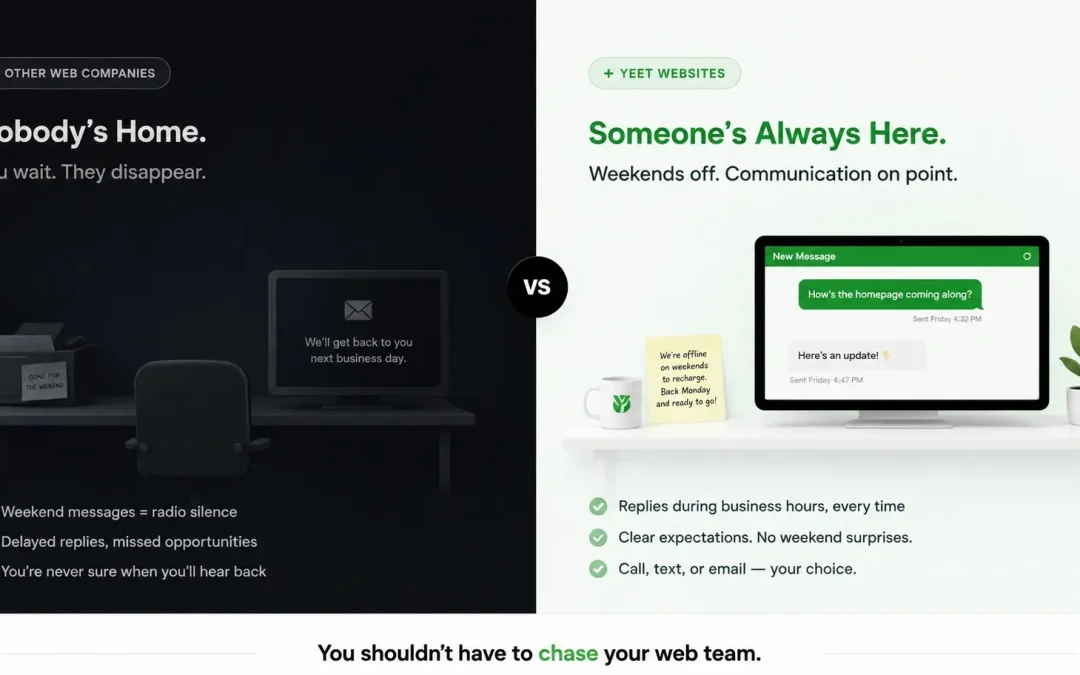
Post Summary: Silence Is What Ends These Relationships, Not Bad Work
People rarely walk away from a web company over the design or the invoice. They walk away because nobody answered. Promises made during the sale outlive the person who made them, the account moves to a support queue, and replies stretch out until they stop arriving. A poor build is repairable. Going unanswered is not.
During an unrelated rebuild, a client’s logo turned out to be carrying a trademark symbol her filing no longer supported. She had no idea. We flagged it and told her to take it off until the paperwork caught up.
Below is why responsiveness has to be the baseline rather than a selling point, and what happens on the rare occasions we’re unreachable.
The Problem Was Never the Website
If you’ve worked with a web company before and it didn’t go well, there’s a good chance the problem wasn’t the website. It was the web designer’s response time.
The design might have been fine. The price might have been fair. The initial conversations might have felt promising. But at some point, you needed something. Maybe it was an edit, an answer, a callback? And the person on the other end just… wasn’t there anymore. You called. No answer. You emailed. No response. You followed up a few days later. Still nothing. And slowly, without anyone formally ending the relationship, the company you were paying to manage your website stopped being reachable.
That’s the number one complaint we hear from clients who came from somewhere else. Not bad design. Not high prices. Not technical incompetence. Just silence. Nine out of ten times, the story is the same: they didn’t get back to me. When web company communication breaks down, everything else becomes irrelevant. And often the silence comes paired with something just as frustrating : why web designers won’t explain things even when they do respond.
The second most common complaint is closely related: they said they’d do the work, and then they didn’t. Or they did it late. Or it came back wrong and the fix never arrived. Speed, execution & follow-through. Those are the things that break a client relationship. And strangely, quality isn’t highlighted as often as you’d expect. We see the sites these clients come from, and the work isn’t always great. But that’s not what drove them to leave. What drove them to leave was the feeling that nobody was listening.
There’s psychology in that. If a company does mediocre work but communicates well, maybe they respond fast, follow through, pick up the phone, some people will say they’re passable and those people will stay. They’ll give the company a chance to improve. Heck, even if the web company has an annoying ticket system that sends you too many automated emails, they’ll give ’em a chance. They’ll chalk up the quality issues to growing pains or a bad stretch. But the moment communication breaks down, patience disappears. Because bad work can be fixed. Silence can’t. Silence tells the client that they don’t matter enough to warrant a response, and once that message is received, no amount of good design will earn back the trust.
The Trademark Symbol Nobody Was Looking For
Here’s the thing about responsiveness at our company. It’s about going above and beyond, that’s the baseline, that’s shooting par on the golf course. It’s not heroic. It’s not something we pat ourselves on the back for. It’s the standard the business was built on, and anything less than that standard is a failure, not a baseline.
But if there’s a story that defines the value, it’s this one.
One of our clients makes handmade bags. Beautiful product, real craftsmanship. When she came to us, she’d already been working with another company on her website. They were building it from scratch including a shopping cart, which is no small thing. Shopping carts are complex. There are product pages, payment integrations, shipping calculations, tax configurations, inventory management. Hats off to anyone who attempts it, because it’s genuinely difficult work.
Six weeks had gone by. Two pages were done. Two. In six weeks. A shopping cart build should take time, but six weeks for two pages isn’t thoroughness. That’s stagnation. The client was stuck in a relationship where money was being spent, time was passing, and almost nothing was getting built.
She signed up with us. We took over the entire project. Within less than a month, the site was complete. Not just the shopping cart, the full build. Product pages, service pages, a complete brand redesign. We helped her choose an open-source cart because it saves money against the platforms that charge monthly for the same thing, and then we included a training session so she could manage her own products without calling us every time she needed to add an item or adjust a price. That’s what hands-off website design looks like after the build is done.
And here’s where the “above and beyond” part comes in. Though again, to us it’s just doing the job right. While reviewing her brand materials, we noticed she was using the trademark symbol on her logo. But her trademark application had expired. She didn’t know. If she’d continued using that symbol without an active application, she could have opened herself up to legal issues. Someone could have challenged it, or worse, she could have been flagged for misrepresentation. We advised her to remove it immediately until the application was renewed.
That’s not web design. That’s not even in the scope of what she hired us for. But when you understand a client’s business, really understand it, not just the website portion of it, you catch things that a ticket system or a cold support rep never would. We catch those things because we pay attention to the whole picture, not just the pixels on the screen.
What a Same-Day Answer Looks Like
We do it all. Phone, text, email. Whatever channel works best for the situation and the client.
The nice thing about modern technology is that our work lines are text-enabled through Voice over IP. So it feels like clients have our cell phone number, they can text us, they can call, the experience is identical to texting someone’s personal phone. But it’s not our personal cell. It’s a business line that routes through the same system as our calls and emails. That separation matters for both sides, the client gets the accessibility of a cell number without the awkwardness of having someone’s personal contact, and we get to maintain boundaries without sacrificing availability.
When something is urgent, texting feels like it’s going to get a faster response than email or a phone call. There’s a psychological immediacy to it, a text feels like a tap on the shoulder, while an email feels like a letter dropped in a mailbox. But in reality, it doesn’t matter which channel you use. We respond quickly regardless. The channel changes. The speed doesn’t.
That’s a deliberate decision. We don’t prioritize one communication method over another because we don’t want clients to feel like they have to game the system to get our attention. You shouldn’t need to know a secret code or use a specific channel to reach the person managing your website. You should be able to call, text, or email, whichever feels natural in the moment, and know that you’ll hear back.
When We’re Unreachable (And How We Handle It)
It happens. We’re human. People get sick. People take vacations. People need time to recharge, and anyone who pretends otherwise is either lying or headed toward burnout. Our web designers are available Monday thru Friday although we do monitor down sites over the weekend. The important thing (we think) is we call back, every time.
When someone on the team is out, we rotate coverage so there’s always someone available. The person who handles the account is the first choice, because they know the client, they know the site, and they can resolve things without a learning curve. But if they’re unavailable, someone else steps in with enough context to handle whatever comes up.
We all take our laptops on vacation. That’s not a humble brag about work ethic, it’s just practical. If a genuine emergency comes in, the site is down, something critical is broken, a time-sensitive issue can’t wait three days, we can handle a quick edit from wherever we are. It’s not the norm. It’s the safety net. And the distinction matters because we’re not promising round-the-clock availability. We’re promising that when something is truly urgent, we’ll figure it out.
For everything that isn’t an emergency, clients are understanding. Everyone needs time off. Everyone knows that. The key is communicating it clearly, “Hey, I’ll be out Thursday and Friday. If anything comes up, here’s who to reach. If it can wait until Monday, I’ll handle it first thing.” That kind of transparency takes 30 seconds and prevents a week of anxiety on both sides. It’s the same approach we take to every end-of-day and end-of-week situation, clear communication, realistic timelines, no vanishing acts.
The difference between us and the companies clients leave isn’t that we never take time off. It’s that when we do, we tell people. We set up coverage. We make it seamless. We don’t just vanish and hope nobody notices, because at other companies, vanishing is the standard operating procedure, and that’s exactly the behavior our clients came to us to escape.
The Slow Fade, From Your Side of It
If you have lived through this, the sequence will be familiar. It is the difference between web design support and personal service, and it runs the same way almost every time.
It starts well. The person you talk to first is sharp, responsive, enthusiastic. Fast turnarounds, dedicated support, we’ll always be here for you. In the moment, none of it sounds like a stretch.
You sign. The site gets built, often by people you never meet. It goes live. And then something shifts. The person you knew is not the person answering anymore, and nobody told you that was coming. The relationship you thought you were entering was with them.
So you keep reaching out to the one you know. A text about an edit. A call about a question. At first there are replies. Then the replies come slower. Then they stop.
Now you are in limbo. You get pointed toward customer service, which is not what you signed up for. You do not want to explain your business to a stranger in a ticket queue. You want the person who already understood it, and that person is not available to you.
The requests pile up. An edit that should take a day takes a week. Then two. Then a month. You follow up once, twice, three times, and each time it is in the queue or being escalated. Eventually you stop following up, not because it got solved, but because you accepted it wouldn’t be.
That is what disappearing looks like from where you sit. It is not dramatic. Nobody sends a breakup email. Nobody says the account is no longer being serviced. The responses get slower, the excuses get vaguer, the work stops getting done, and you are still paying the whole time. Leaving is its own headache, so you stay, stuck, until something finally pushes you over the edge.
By the time people reach us, they are not shopping for design. They are looking for proof that someone will pick up the phone. That’s the bar. Not great design. Not cutting-edge SEO. Just: will you answer when I call?
We answer. Every time, and we even offer text communication if that’s what you prefer. And if we can’t, we get back to you as quick as humanly possible.
Dr. Sue Johnson, the clinical psychologist who created Emotionally Focused Therapy and spent over thirty years studying why relationships fail, described this pattern in an interview on The Knowledge Project:
“People get fixated on conflict. Distance slips by them. Therapists teach you to fight fair but the real problem isn’t how you fight. It’s that you’ve become strangers living in the same house. One couple called their pattern ‘the nothing’ – no fighting, no connection, just nothing. That’s when relationships die. Not in battle, but in silence.”
— Dr. Sue Johnson, creator of Emotionally Focused Therapy. Source: fs.blog
That shouldn’t be remarkable. Web company communication shouldn’t be a differentiator, it should be the bare minimum. But given what most business owners have been through, it is, and we take it seriously because we understand what’s behind the question. It’s not “will you respond to my email?” It’s “will you treat my business like it matters?” And the answer, from the day you sign up to the day you decide you don’t need us anymore, is yes. If you’re not sure what to expect from a web design company, start there, because communication is the foundation everything else is built on.
That’s what white glove service means. Not a logo on a website. Not a tier you pay extra for. Just the unwavering, non-negotiable commitment to being there when the people who trust us need us to be there.
Frequently Asked Questions
What’s the most common reason clients leave their previous web company?
Communication, specifically the company stopped responding. Not bad design, not high prices. The silence is what breaks the relationship. Nine out of ten clients who come to us describe the same pattern: they couldn’t get anyone to call them back.
What communication channels does Yeet Websites offer?
Phone, text, and email. Our business lines are text-enabled through VoIP, so clients get the accessibility of texting without needing our personal cell numbers. The channel doesn’t matter, the response speed is the same regardless.
What happens when you’re on vacation or out sick?
We rotate coverage so someone is always available. We take laptops on trips for genuine emergencies. For non-urgent requests, we communicate the timeline clearly and handle it first thing when we’re back.
Do you ever fix things after hours?
If the situation is urgent and we have the time, we’ve handled it after hours and sent confirmation the next morning. That’s not a policy, it’s what happens when the priority is solving the problem, not watching the clock.
Why does communication slow down after the sale?
Often the person who sold the work is not the person who does it. Once the paperwork is done, the account gets handed off to a department they never met. The rep moves on to the next prospect, and the client is left explaining their business to strangers in a ticket queue.
What keeps communication from slowing down here?
The person who builds your site is the person who handles your support. There’s no handoff. No ticket queue. No slow fade. You work with the same person from day one through every edit, every question, and every phone call for as long as you’re a client.