
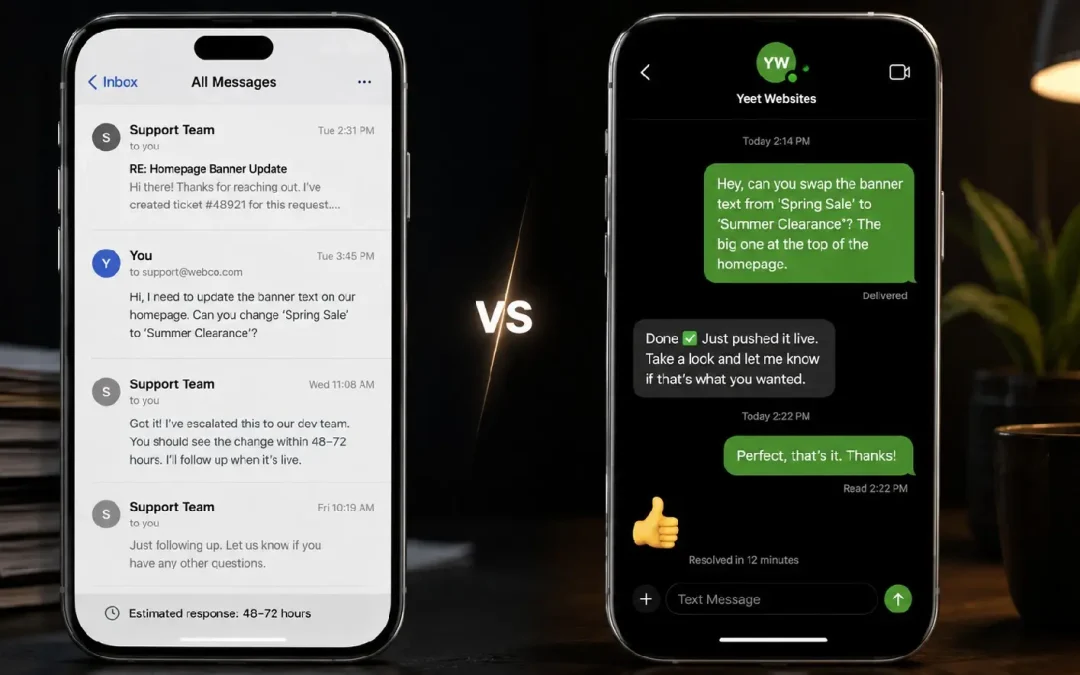
Post Summary: The Right Channel for the Right Job
Text is for the short things. Running ten minutes late, a request to jump on a call, a quick confirmation. It isn’t a place to send files, because a phone compresses a photo on the way out and the quality doesn’t come back. A hero image needs to be around 2,500 pixels wide to hold up, and email or a shared folder handles that without anyone thinking about it.
Knowing when to leave a channel matters as much as picking one. An email thread going in circles gets a phone call, not another email asking whether a call would be alright. Clarifying something complex in writing tends to land close and not exact. The call closes that gap.
The after-hours question is settled in the infrastructure, not by anyone’s restraint. Nothing rings after five, and a text at eight at night waits until the next business day.
Why Texting Is Rare in This Business
A number you can text is uncommon in web design. Your dentist has one. Your mechanic has one. Your accountant has one. The company managing your online presence usually doesn’t.
It’s not a technology problem. Voice over IP platforms have had texting capabilities for years. You go through a short verification period, prove you’re not a spammer, and you’ve got text privileges. It’s not expensive. It’s not complicated. And it comes with a built-in benefit, every text thread can be screenshotted and stored in the client’s account. It’s documentation and CYA rolled into one.
So it isn’t cost and it isn’t capability. Text access shouldn’t be unusual, and it is. However a company handles basic access is worth noticing before you hire them.
How Often Clients Really Text
We text with our clients. But probably not the way you’d expect.
Texting isn’t our primary communication channel. It’s not even close. Maybe 5 to 10 percent of our clients prefer it as their go-to, and even those clients use it selectively. For us, texting is a specific tool for specific moments, and knowing when those moments are is what makes it work.
A quick “Hey, I’m going to be 10 minutes late to our call”, text is perfect. A “Can I call you in five?”, text is ideal. A scheduling confirmation, a short update, a heads-up about something that doesn’t require a full conversation, all great uses for text.
What doesn’t work is trying to use text as a delivery mechanism. When a client needs to send us photos for their website, we need high-resolution files. Hero banner images need to be at least 2,500 pixels wide by 1,670 vertical to look crisp on modern screens. You can get away with 2,000 by 1,336, but you’ll notice the difference, the image won’t be as sharp, and on larger monitors it’ll look soft in a way that undermines the professionalism of the entire page. When those images get sent through text, the phone compresses them on the way out. The original on your phone is still fine, but the copy that reaches us isn’t, and nothing on our end puts back what the compression took. The files have to be downloaded individually. And if someone sends 40 photos via text one at a time, that’s not communication, that’s a logistical nightmare.
Email handles all of this without anyone having to think about it. It sends the full-size version automatically. And for clients who are comfortable with the technology, we’ll set up a shared Google Drive folder where they can drop everything in one place. In practice, maybe one or two out of ten clients use the Drive option. Most people prefer the simplicity of attaching files to an email, and that works perfectly.
The hierarchy is clear: talking on the phone first, email second, text for the quick stuff. Each channel has a role. The problems start when people try to force everything through one channel instead of matching the tool to the situation.
The Art of Switching Channels
This is where communication usually goes wrong. Not because they pick the wrong channel initially, but because they don’t know when to switch.
Here’s how it plays out in practice. A client emails us. We email back. That’s obvious, they chose the channel, so we match it. We’re not going to call someone who sent an email. That would feel intrusive, almost presumptuous. They communicated the way they wanted to communicate, and we respect that.
But sometimes the email chain starts to spin. Our response generates a reply. That reply reveals some confusion. We respond with clarification. They respond with more questions. And suddenly what started as a simple request is three emails deep and getting further from resolution with every message.
The instinct is to keep emailing. Another message goes out saying “Is it okay if I call you?”, which is polite, but inefficient. What if the client doesn’t check their email for two hours? What if they’re in the middle of their workday and that message sits unopened while the confusion hardens into frustration? Email isn’t text. The urgency is different. The read speed is different. The emotional temperature is different.
We just pick up the phone and call.
One phone call resolves what a long email thread won’t. And here’s the part people don’t consider: by the time you’ve gone back and forth trying to clarify something complex in writing, the edit you make from all that correspondence comes out close. Most of it right. But there’ll be a detail lost in translation, a nuance that didn’t survive the format, a “that’s not quite what I meant” nobody caught, because written words flatten tone and strip context. The call would have gotten it exactly right. Same information, better channel.
Text works the same way in the other direction. A client texts and we can tell the conversation is getting into the weeds, too many details, too many moving parts for a text thread to handle cleanly, we’ll respond with “Can I call you?” or they’ll just call us directly. Either way, the issue gets resolved faster because someone recognized that the channel wasn’t serving the conversation and made the switch.
This is a nuance, but to us it’s second nature. Web designer text communication only works when you know when to switch channels. The channel should serve the conversation. The conversation should never be forced into a channel that doesn’t fit. And the willingness to switch, to recognize when email needs to become a phone call, or when a text thread needs to become a real conversation, is what separates functional communication from the kind of back-and-forth that leaves both sides frustrated and the edit only partially right.
Where Texting Earns Its Place
There’s one context where texting goes from “useful shortcut” to “essential channel,” and that’s with our elite SEO clients.
When a client is paying top-tier pricing and we’re communicating three or four times a day for half the month, updating on campaign progress, clarifying expectations, coordinating deliverables, formal email for every touchpoint would slow everything down. These are fast-moving relationships with real money on the line, and the communication needs to match the pace.
For those clients, text becomes the connective tissue between the bigger conversations. A quick update. A question that needs a fast answer. A screenshot of a result that just came in. It’s not replacing phone calls or detailed emails, it’s filling the gaps between them so nothing falls through.
Clients paying that level of investment deserve to be communicated with accordingly. If the relationship demands that level of access and responsiveness, we provide it, because the alternative is making a premium client wait for a scheduled call to get an answer to a question that takes 15 seconds.
The Chaos Everyone Expects and Nobody Gets
The assumption most business owners make is that giving clients a number to text opens the door to chaos. Late-night messages. Weekend requests. Scope creep wrapped in casual language. The boundaries dissolve and suddenly you’re on call 24/7 for a $130/month subscription.
It doesn’t happen. And the reason is twofold: technology and standards.
On the technology side, our phones don’t ring after five o’clock. Text messages that come in at 8 PM sit there and get answered the next morning. The phone goes to voicemail. We call back promptly when we’re back on the clock. Quality of life outside of work isn’t compromised because the boundary is built into the infrastructure. There’s no willpower required. There’s no “do I answer this or not?” decision at 9 PM. The system handles it.
On the standards side, we set expectations early and clearly. Texting is another avenue for communication, and like any avenue, if it gets used in a way that doesn’t work, sending 40 photos one at a time, treating text like a project management tool, firing off requests at midnight, we redirect. “Hey, this is how we do things here. I hope it’s okay if you follow these guidelines.” We say it professionally, we say it once, and we’ve never had a client push back on it.
And there’s a specific reason for that: we don’t onboard people who are rude. Period. That’s not said casually, it’s a real filter in our process. Before someone becomes a client, we’ve had enough conversation to know what kind of person they are. If someone makes it through our onboarding, they’re someone we want to work with. And people you want to work with respect reasonable boundaries when you set them clearly.
Has texting ever caused scope creep? No. Blurred boundaries? No. Because the tool isn’t the problem, how you manage the tool is what matters. And managing communication is something we do every day across every channel. The medium changes. The standard doesn’t.
Frequently Asked Questions
Do most Yeet Websites clients communicate by text?
No. About 5 to 10 percent prefer texting as their primary channel. Most clients use phone and email for day-to-day communication. Text works best for quick exchanges, scheduling, confirmations, and short updates that don’t need a full conversation.
Why not just use text for everything?
Photos come through compressed, deliverables get hard to track, and detail doesn’t survive the format. A call closes the gap that a long thread leaves open. The right channel depends on the situation.
Do you have boundaries around texting hours?
Yes, and they’re set in the phone system rather than left to anyone’s judgment. Nothing rings after five, and anything arriving at night waits until morning.
What if a client overuses texting?
One clear conversation about how things run here has always been enough.
Why is texting so rare in web design?
Not cost. A VoIP platform with texting, call routing and after-hours handling runs less than most companies spend on hold music. What stops it is usually a worry about blurred boundaries, which is a question about how the relationship is set up rather than about the technology.