
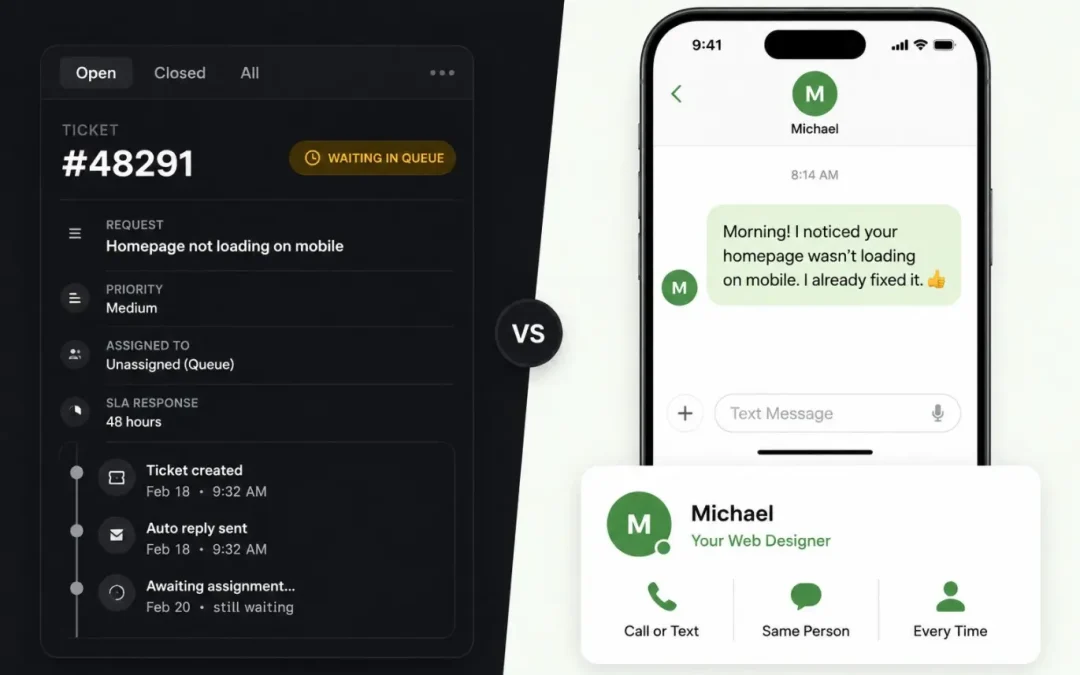
Post Summary: What Someone Catches When They Know the Business
The difference between web design “support” and real service comes down to who picks up the phone. When the person who built a site is the same person handling requests, edits that would take someone starting from scratch the better part of an hour take a fraction of that, because the plugins, custom code, and workarounds are already known instead of needing to be reverse-engineered. Agency models that split builders from support staff scale more easily for the company, but every handoff between sales, build, and support loses context the client then has to re-explain.
Knowing a client’s business well enough killed a costly idea before development started: an auto parts client wanted a web tool that diagnosed car problems from a description of the sound, and it was called off in a single conversation once it was clear no web form could capture that reliably. That conversation saved the wasted development cost entirely.
The rest of the post covers what bad support looks like when an edit goes wrong and nobody follows up, and how client context gets tracked without turning the relationship into a CRM field.
What Starting From Scratch Costs You
There’s a version of “support” that most business owners have learned to tolerate. You call a number. You explain your problem to someone who has never seen your website. They ask you to describe what you’re looking at. You try to explain where the issue is, the banner on the services page, the one with the phone number that’s wrong. They ask which services page. You say the main one. They ask if you mean the one in the header or the one in the footer. You say neither, it’s in the body, about halfway down. They put you on hold.
They come back with a suggestion that doesn’t apply to your site. You go back and forth for 30 minutes on something that should have taken two. By the end of the call, you’re not even sure the edit was done correctly, and you won’t be sure until you check it yourself.
That’s support.
Then there’s the version where you call the person who built your website, say “the phone number on the services page is wrong,” and it’s fixed before you hang up. No ticket. No explanation. No starting from scratch with someone who’s never seen your site.
That’s what it looks like when the person helping you already knows your business. And the difference between those two experiences isn’t about skill or tools, it’s about context. That difference shapes every interaction you’ll have with whoever manages your site.
Why Context Changes Everything
One of the biggest advantages of our model is that the person who builds the website is the same person who services the account. This isn’t a staffing limitation or a byproduct of being small, it’s a deliberate decision, and it’s one of the primary reasons our clients stay. It’s also a big part of what to expect from a web design company that gives a damn.
When someone comes in cold on a website they didn’t build, they have to learn everything from scratch. Which plugins are installed. How the page structure works. Whether there’s custom CSS on a specific section or a theme module that was configured a certain way to accomplish something the standard tools couldn’t handle. All of those little tricks and decisions that went into the build, the workarounds, the customizations, the things that only make sense if you were the one who did them, a new person has to reverse-engineer every one of them before they can safely touch anything.
The person who built it doesn’t have that problem. They know the plugins because they installed them. They know the nuances because they created them. They know that a certain section uses custom code because they’re the one who wrote it at 2 PM on a Tuesday three months ago when the client needed something the default layout couldn’t do. When that client calls with an edit, all of that context is already baked in. Looking things up is almost trivial because most of it lives in the web designer’s working memory, it’s part of the mental map they carry of every site they’ve built.
That’s why a change that might run someone forty-five minutes cold takes us a fraction of that. Not because we type faster or work harder, because we already understand the site. There’s no ramp-up period. No re-learning. No “let me pull up your account and see what we’re working with here.” We already know what we’re working with because we built it with our own hands.
For larger companies, the agency model separates builders from support staff because it’s easier to scale. Hire a sales team, hire a build team, hire a support team, and route clients through the pipeline. It’s efficient on paper. But easier to scale for the company doesn’t mean easier for the client. It means the client gets handed off, first from sales to the builder, then from the builder to support, and every handoff loses context. By the time the support rep is looking at the site, they’re starting from zero on a project someone else created, trying to interpret notes someone else wrote, for a client they’ve never spoken to.
What Sticks After a Bad Experience
The worst support stories we hear aren’t about slow response times or missed deadlines, although those happen too. The worst ones are about edits that got done wrong and then never got fixed.
Here’s the pattern. A client requests a text change. Simple stuff. The support rep makes the edit. It’s wrong, wrong text, wrong page, wrong formatting, something. Okay. Mistakes happen. That’s not the end of the world. Anyone can make a mistake.
But then the rep disappears.
The client follows up. No response. They follow up again. Nothing. They try a different channel. Still nothing. It’s like the person who made the mistake just hid afterward. And it isn’t a one-company story. Something goes wrong, and instead of owning it and fixing it, the complaint goes into a queue and settles there. Merged into another one. Marked resolved with nothing resolved. And the client is left wondering if anyone on the other end is paying attention at all.
Accountability seems to be gone in a lot of these situations. And when you’re a small business owner whose website is your storefront, the first thing potential customers see, the thing that’s supposed to generate calls and build trust, that kind of experience doesn’t just frustrate you. It makes you question whether paying for professional help was worth it in the first place. It erodes confidence in the entire industry. And it’s one of the reasons so many business owners show up at our door already skeptical, already guarded, already expecting to be let down.
That’s the damage bad support does. Not just to the website, to the business owner’s belief that anyone out there will treat their business the way they treat it themselves.
How We Keep Track Without Losing the Human Element
We use a CRM. We take notes, a lot of them. Anytime there’s something important about a client’s account, their preferences, their business, a conversation we had, it gets documented. Even when it seems trivial at the time, we write it down. Because what feels like a small detail today might be the exact piece of context that matters six months from now when a related question comes up or an edit needs to reference something from the original build.
That said, we’re not robots. Memory plays a role too. When you work with someone for months, you start to remember their quirks. How they communicate when they’re stressed versus when they’re relaxed. What they care about most on their site. Whether they prefer phone or email. The details of their business that don’t fit neatly into a CRM field, the personality of the owner, the vibe of their brand, the story behind why they started.
There’s a phrase we use internally: the mind is meant for processing, not storage. That’s an important thing to embrace. We’re human. We’re going to forget things occasionally. That’s exactly why the CRM exists, it catches what memory doesn’t. It’s the safety net underneath the relationship.
But it’s also okay to rely on memory for certain things, because it’s efficient. When a client calls and you already know their business, their tone, their priorities, you don’t need to pull up a file to have a productive conversation. You just talk. The way you would with anyone you know. And that efficiency, that naturalness, doesn’t survive a ticket system, because the gap comes down to one thing: ticket systems don’t build relationships. People do.
When Knowing the Business Prevents the Problem
Understanding a client’s business isn’t just about faster edits. It’s about seeing things coming before they become problems, because you understand how their customers behave, what their busy season looks like, where their competitors are positioning, and what makes their specific situation different from every other business in their category.
One of our clients runs an auto parts store. They’ve got this old-timer on staff, the kind of mechanic who can hear what’s wrong with a car just from the sound it makes. Incredible skill. And someone had this idea: what if we put that kind of diagnostic ability online? Build a tool on the website where people describe what they’re hearing, a rattle, a squeal, a knock, and get a recommendation for what part they might need.
In theory, it sounds innovative. In practice, it’s impossible. There are too many variables. A rattle from the front left on a 2004 Civic means something completely different than the same sound on a 2018 F-150. The amount of time it would take to catalog every possible sound-to-diagnosis combination would be astronomical, and even then, how do you capture audio quality accurately enough through a web form to make a reliable recommendation? You’d be building a liability machine, not a diagnostic tool.
After a quick conversation, we killed the idea before a single dollar was spent on development. Not because we didn’t respect the concept, but because we understood the business well enough to know where the idea broke down. Read as a ticket description, that request looks perfectly buildable, and the hours get billed. We said “here’s why that won’t work” and saved them from an expensive mistake.
Another client makes high-end handmade bags. Beautiful product, real craftsmanship. She wanted to expand nationwide. It’s a natural ambition, the product is good enough, so why limit it to one market?
But she hadn’t come close to selling out locally. Hadn’t even dominated her own town yet. And a nationwide marketing budget for luxury handmade goods? That’s $20,000 to $50,000 a month in ad spend alone, not including the content, the logistics, the customer service infrastructure you’d need to support a national audience. She wasn’t pulling that kind of revenue locally to fund it.
So instead of taking her money and running a national campaign that would have burned through her budget in weeks with minimal return, we redirected. Focus on your Google Business Profile. Get rocking locally first. Do the fairs, do the shows, build the reputation and the revenue in your backyard. Then if that takes off and you have the cash flow to support a national push, we’ll be ready to help you make that move.
That conversation saved her a significant amount of money, possibly the difference between her business surviving and not. And it only happened because we understood where her business was, not just where she wanted it to be. Someone seeing the account for the first time doesn’t have that. The request gets processed as received and the invoice follows. We process the situation and tell you what you need to hear, even if it means talking you out of spending money with us.
When It Stops Feeling Like an Account
We use the word “client” intentionally. It carries a level of respect that “customer” doesn’t, a sense of partnership rather than transaction. But the truth is, after a couple of months of working together, most of our clients stop feeling like clients in the formal sense. They feel like people we genuinely know.
That happens naturally when you understand where someone came from. Most of our clients arrived from a situation that wasn’t great, a company that disappeared, a website that stopped working, a support experience that left them jaded. We respect what they’ve built and the resilience it took to keep going despite the bad experiences that came before us.
Over time, you start to understand more than their business. You understand their quirks. What makes them tick. How they communicate when they’re excited about a new idea versus when they’re frustrated about something that isn’t working. You learn the rhythm of their business, when they’re slammed and need fast turnarounds, and when things are slow enough to think strategically.
All of that becomes valuable context. Not just for edits, for the relationship. When a client needs to make a decision about their site, their marketing, or whether to invest in something new, they can lean on us, because that’s what a truly hands-off website design relationship looks like. Not because we have all the answers, but because we’ve earned the trust that comes from genuinely listening over months and years, and consistently delivering on what we said we’d do.
That trust doesn’t come from a CRM note. It comes from treating every person who walks through the door like someone who deserves to be heard. And then hearing them. That’s the answer, and it’s the whole of it.
Frequently Asked Questions
Why does it matter that the person who built my website also handles support?
Because they already know your site, the plugins, the custom code, the design decisions. Anyone coming to it fresh has to reverse-engineer all of that before making a single edit. The builder handles it in a fraction of the time because the context is already there.
How do you keep track of client details?
CRM notes for everything important, plus the working memory that builds naturally from months of collaboration. The CRM is the safety net. The relationship is what makes the communication efficient.
What do people describe when support goes wrong?
The most common story isn’t about mistakes, it’s about disappearing after the mistake. An edit gets done wrong, the client follows up, and the rep goes silent. That pattern of hiding after an error is what drives people to look for something different.
Can you know every client’s business well enough to give proactive advice?
After a couple of months, yes. We’ve killed a product idea that wouldn’t have worked and redirected a client away from a national campaign she couldn’t afford, both because we understood where the business was, not just what was being requested.
How long before the relationship feels personal?
Usually a couple of months. By then we understand how the client communicates, what they care about, and what their business needs. That context compounds over time and makes every interaction more effective.