
Post Summary: Your Request Goes to the Person Who Built It
Small jobs get done while you’re still on the phone. Anything that needs longer becomes a task with a name attached, and the name belongs to whoever built the site in the first place.
A queue works, for the company running it. What it costs is that every request starts with someone who has no history with your account, and the explaining begins again each time.
Edit time is tracked on every account, and both plans carry a monthly allowance, so nothing arrives as a surprise later.
Below: why the queue exists at all, what it feels like from the client side, and whether any of this survives growth.
What Happens After You Submit a Request
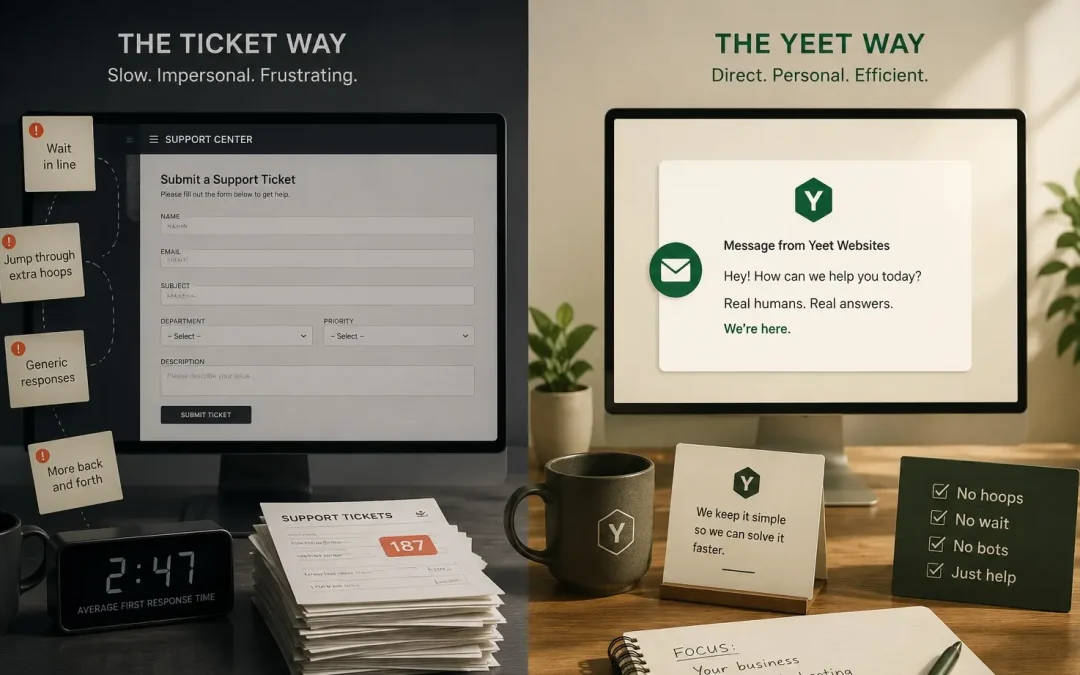
If you’ve ever worked with a web company larger than a handful of people, you’ve probably experienced the ticket system. You need your phone number updated on your website. You need a photo swapped out on the homepage. You need a typo fixed, the kind of thing that takes 90 seconds if someone just opens the page and changes it.
But instead of picking up the phone or shooting a quick text, you’re filling out a form. Selecting a category from a dropdown menu. Typing a description of something that would take ten seconds to explain out loud. Maybe attaching a screenshot because you know from experience that your description alone won’t be enough, that the person on the other end has never seen your website and won’t know what “the part near the top with the wrong number” means without visual proof.
Then you wait.
You wait for someone you’ve never met to read your ticket, interpret what you meant through whatever lens they bring to it, and, if you’re lucky, make the edit within a few business days. No phone call. No conversation. No back-and-forth to confirm they understood the request correctly before touching your live site. Just an email notification letting you know your ticket has been “resolved.”
You check the site. The edit is wrong. You submit another ticket. The cycle restarts.
That’s the system a lot of support runs on. And here’s the thing, a web company ticket system works fine for the company. It centralizes requests, tracks workloads, assigns tasks to available staff, and creates a paper trail that makes management’s life easier. But a system designed to make the company’s life easier rarely makes the client’s life easier. Usually it does the opposite.
Why the System Exists
To be fair, ticket systems aren’t inherently evil. The theory behind them makes sense on paper: if there’s a bunch of work in a bucket, you do the work in the bucket, and then the bucket’s empty. It’s a way to organize. It ensures nothing slips through the cracks when you’ve got dozens or hundreds of clients all asking for things at the same time. From an operations standpoint, it’s clean.
The problem is what gets sacrificed to achieve that cleanliness.
When you submit a ticket, your request goes to a third party you’ve never met. Someone who didn’t build your website. Someone who doesn’t know your business, doesn’t know your brand voice, doesn’t know that the photo you’re asking them to replace was a placeholder you told your original designer about three months ago. They’re starting from zero, every single time. Your history with the company, the conversations you’ve had, the decisions that shaped your site, none of that transfers to the person holding your ticket. They see a task. They execute the task. They close the ticket.
And there’s a psychological layer that most companies don’t account for. When whoever picks it up has no history with the account and no hand in building it, there’s a natural hesitancy. A reluctance to pick up the phone. They’ll send another email. They’ll open another ticket. They’ll merge tickets into other tickets. They’ll do everything except call you and say “Hey, let me take a look at this with you right now.”
We’ve experienced it firsthand, as a client, not a provider. We’ve submitted requests through ticket systems before and have never once received a phone call back. Not once. We put in calls and got emails. Opened a new ticket that got merged into the old one. The cycle just continued, each loop adding another layer of distance between us and the person supposedly helping us.
Phone calls take up time. And in a ticket system, time is the enemy, because the metric isn’t “did the client feel heard?” It’s “how many tickets did we close today?” Those are fundamentally different goals. And the client can feel the difference. It’s a breakdown in web company communication that starts with the system itself and trickles down into every interaction.
What It Feels Like on Your End
Friction. That’s the simplest word for it. But friction doesn’t fully capture what’s happening emotionally.
When your request gets routed to someone you’ve never spoken to, who works in a department you didn’t know existed, there’s an immediate wave of doubt. Who is this person? They don’t know me. They don’t know my business. They’ve never seen my website before this ticket landed in their queue. How are they going to understand what I need when they don’t even have the context of a single previous conversation?
That’s not paranoia. That’s a completely rational response to being handed off to a stranger. And the doubt compounds with every interaction. The first time, you give them the benefit of the doubt. The second time, you’re frustrated but patient. By the third or fourth time you’re re-explaining your business to yet another support rep, you start to wonder why you’re paying a professional to manage something that feels like it’s creating more work for you, not less.
Several of our clients have told us directly that the deciding factor in choosing us was the fact that the web designer does the customer service. Not the pricing. Not the portfolio. Not the website itself. The simple fact that they wouldn’t get shipped off to another department. They wouldn’t have to explain their business from scratch to someone new every time they needed something. They wanted to talk to the person who built the thing, and that desire was strong enough to be the deciding factor over everything else on the table.
That tells you something about how deeply the ticket system experience damages trust. When “you’ll talk to the same person” is enough to close a sale, it means the alternative has been bad enough to leave a mark. It’s a common enough pattern that it leaves a mark.
How We Handle It Without a Ticket System
Our process is simpler than people expect. When a client reaches out, call, text, email, we handle it. If the work takes five minutes, we do it right then and let them know it’s done. There’s no form to fill out. No category to select. No estimated response window. Just the work, done, and a quick message confirming it.
If the request needs follow-up, maybe it’s a bigger edit, or we’re waiting on content from the client, or the timing isn’t right, we create a task in the CRM. Not a ticket. A task, assigned to the person who built the site, with a reminder that makes it impossible to forget. The distinction matters. A ticket goes into a queue and gets picked up by whoever’s available. A task is assigned to the person who knows the site, knows the client, and can execute without a learning curve.
One tool that’s been surprisingly effective for staying on top of things: the email snooze. If something comes in and you’re running out the door or deep in another project, you snooze the email until Monday at 8 AM. It pops back up first thing Monday morning. You handle it. Nothing falls through the cracks because the system works with how people think, not against it.
Ninety-nine times out of a hundred, the process is: do the work, notate the account, move on. The notation matters because we track edit time carefully. Ownership clients get 30 minutes of edits per month. Subscription clients get an hour. Either way, every edit gets documented so we know where things stand, and so the client knows too. There’s no guessing about how much time is left. There’s no surprise invoice at the end of the month because edits ran over without anyone mentioning it. That same transparency carries into every invoice we send, one page, nothing hidden.
And here’s something that separates us from most companies in this industry: when a client is getting close to their edit limit and the request isn’t urgent, we tell them. “Hey, it’s the 28th. Can this wait until the first so you don’t get charged? Your edits reset in a couple of days.” There’s no reason to bill someone 50 or 100 dollars for something that could be free with three days of patience. We could charge it. Most companies would. But we think it’s better to be fair.
We think it’s okay to be fair to people. Not charge them the maximum just because we’re in a position to, but treat them the way we’d want to be treated. And people see that for exactly what it is, honest. That’s how we try to treat all of our clients, with the hope that maybe in other avenues of life, that kind of honesty gets reciprocated. There’s nothing wrong with doing the right thing and seeing what happens in the future. That’s not naïveté. That’s a business philosophy built on the belief that doing right by people compounds over time, the same way good interest compounds, quietly, reliably, and in ways you don’t always see coming.
What Happens When We Grow
The question people ask, and it’s a fair one, is: at what point do you have to switch to a ticket system? What’s the client count where this model breaks?
We don’t think it ever has to break. But it does have to evolve.
Even at 100, 200, or 500 clients, the model scales if you build it right. What would happen is we’d bring on junior designers who work under the lead web designer in small pods. Think of it like a mini project management structure, the lead is the experienced OG who built the sites, and the juniors handle edits and day-to-day client requests under that lead’s guidance.
The final quality check stays with the original designer. It wouldn’t take long, maybe a couple of minutes per edit. “What did you do here?” “We added some CSS at the page level and used this specific theme module.” “Okay. Did you make sure it’s mobile responsive?” “Yes.” “Good. Ship it.”
That exchange takes two minutes. But those two minutes protect the client from the single biggest risk of scaling: quality erosion. The junior does the work. The lead verifies the work. The client never knows the difference because the standard never dropped, it just got support behind the scenes.
The junior handles the CRM notation and the follow-up, which frees up the lead designer’s time without removing them from the loop. The client still knows that their person is overseeing everything. The relationship doesn’t change. It just gets infrastructure wrapped around it.
That’s fundamentally different from a web company ticket system, where the relationship is the first thing that gets sacrificed in the name of efficiency. In our model, we keep the relationship intact and build the operational support around it. The client never becomes a ticket number. They never get routed to a stranger. They stay a person, a person whose website was built by someone who knows them by name, who remembers their preferences, and who can spot a problem before it becomes a problem because they understand the site from the inside out.
The Moment Clients Realize It’s Different
It happens before they even sign up.
When we tell a prospect during the very first conversation, “Hey, I will build your website, and afterwards, I will handle your customer service. You just reach out to me”, you can hear it. The sigh. The slight pause. Sometimes an audible exhale of relief. They’ll say “Oh, that sounds nice” or “Oh, tell me more about that.” And we’re pretty good at picking up on those signals, the tone shift that tells you this person has been through the other thing and didn’t realize there was an alternative.
From there, they’ll usually open up about what happened. The ticket that went nowhere. The person who didn’t understand their business. The edit that took two weeks when it should have taken two minutes. The time they called and got voicemail and never heard back. They’ll walk through the whole experience, and with each detail you can hear the frustration, not anger, but something closer to resignation. Like they’d accepted that this was just how web companies worked. Part of that resignation is never getting a real explanation, which is exactly why web designers won’t explain things when something goes wrong.
And we’ll explain how our approach is different and why we set it up this way. We don’t use scripts for this part. We just tell them the truth: the web company ticket system model is broken, and we built our business around the idea that the person who creates your website should be the person who takes care of it, because nobody else will do it as well.
Most of the time, the response is some version of “Yeah, I resonate with that.” Because they’re not hearing a pitch. They’re hearing a solution to a problem they’d been living with, and they didn’t know there was another way until someone picked up the phone fast enough for them to hear it.
That’s what white glove service looks like in practice. Not a premium add-on. Not a tier you upgrade to. Just the standard way we treat the people who trust us with their business.
Frequently Asked Questions
Why do ticket systems exist?
Ticket systems centralize client requests so companies can track, assign, and manage workloads across teams. It’s efficient for the company. The trade-off is that the client becomes a number in a queue instead of a person with a relationship.
What’s wrong with ticket systems from the client’s perspective?
Your request goes to someone who didn’t build your site and doesn’t know your business. There’s no personal connection, which creates doubt, delays, and back-and-forth that wouldn’t exist if the builder handled the request directly.
How do requests get handled without one?
A task goes into the CRM with a name attached, and that name is whoever built the thing. Small jobs get done on the spot. Longer ones get a reminder against them. Edit time is tracked either way, and the builder handles it because they already know the site.
Can this model scale as Yeet Websites grows?
Yes. We’d build small pods, junior designers working under the lead who built the site. The lead stays in the quality loop and keeps the relationship. Nobody turns into a reference number.
Do you charge for every edit?
Thirty minutes a month on ownership, an hour on subscription. Near the limit with something that isn’t urgent, we’ll say so and suggest waiting until their edits reset so they don’t get charged unnecessarily.
What do clients say about not having a ticket system?
For several clients, it was the deciding factor. They’d been through the ticket experience and didn’t want to go back. Knowing the builder handles their requests is a level of continuity most companies can’t offer.