
Post Summary: What a Late Friday Call Gets You
Whatever hour it lands on, the call gets taken if someone’s there to take it. A missed Friday call comes back Monday, Tuesday at the latest. On a recent Friday after 4 PM, a client noticed their homepage’s Facebook preview image was showing a cached, outdated screenshot, the fix took about 15 minutes through Facebook’s debugger tool, done and confirmed before the end of the day.
Boundaries are structural, not a matter of willpower, the phones don’t ring after five o’clock Eastern, and calls that come in after hours get returned the next business day.
There’s a specific way to answer a call near five without setting the wrong expectation, and it comes down to the opening line: a quick acknowledgement, an honest note about the time available, and straight to the problem.
On rare occasions when a problem is genuinely urgent and the time is there, it gets fixed after hours without being asked, with a note the next morning letting the client know it’s done.
The Call That Comes Right Before You Clock Out
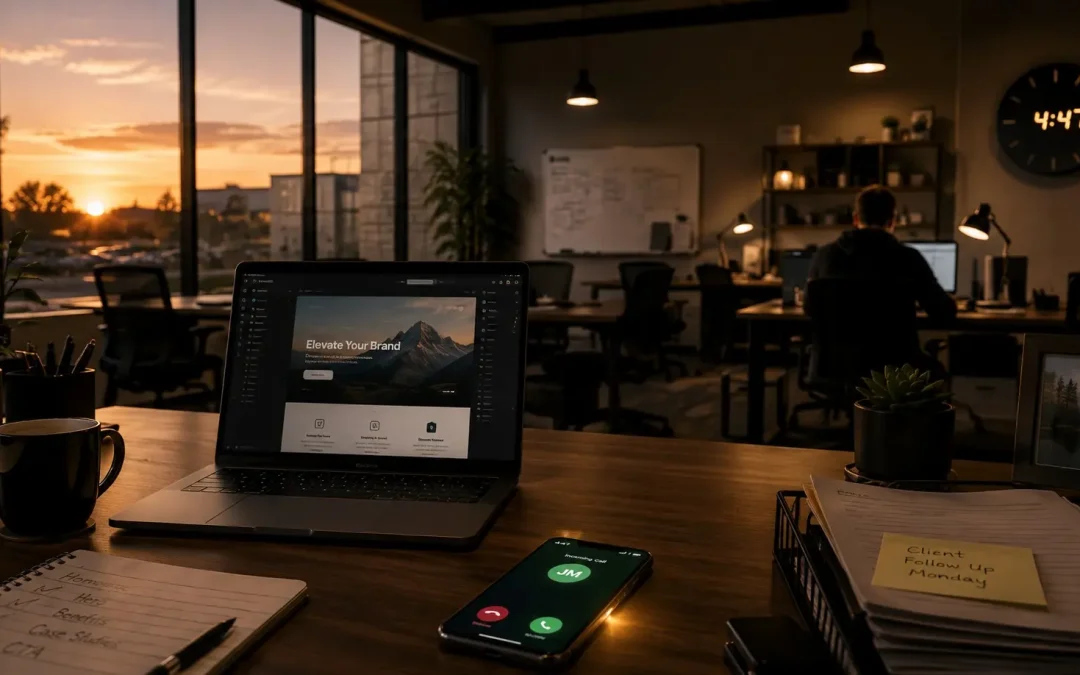
It’s 4:47 on a Friday. You’ve had a long week. You’re mentally halfway out the door. And your phone rings, it’s a client.
The easy move is voicemail. It’s basically five o’clock, the client will understand, whatever it is can wait until next week. And maybe it can. But the client doesn’t know that. The client just knows they called and nobody picked up.
We pick up if we can.
Not because we’re martyrs. Not because we don’t value our evenings. But because thirteen minutes is thirteen minutes, and a lot can get done in thirteen minutes when you know what you’re doing and you don’t waste the first five hemming and hawing about whether it’s too late in the day to help somebody. Availability is a big part of what to expect from a web design company that treats your business like it matters. And if we can’t pick up, the callback comes Monday, sometimes Tuesday.
The Facebook Preview That Wouldn’t Update
Three days ago, this past Friday, a client called after 4 PM. They run a news site. They’d posted their homepage link to Facebook and noticed the preview image was wrong. Instead of pulling the current featured image, Facebook was serving a cached version, an old screenshot that didn’t match anything on the live site. Every time someone shared the link, the wrong image showed up. For a news site, where credibility and presentation are everything, that’s not a minor annoyance. It’s a problem that affects how their audience perceives them on the biggest social platform in the world.
The fix wasn’t complicated on our end. There’s a way to go into Facebook’s debugger tool, without even logging into the client’s website, clear the cached version, re-embed the correct Open Graph data, and force Facebook to pull the updated image. We did it. Took maybe 15 minutes. Sent an email instead of calling back, “Hey, this is done”, because at that point it was a little after five and the important thing was getting it fixed, not having a conversation about getting it fixed.
The client responded: “Awesome. Thank you so much.” You could feel the surprise in the message. They weren’t expecting it to be handled that day, let alone that hour. We also walked them through how to delete the old post on their end, because Facebook doesn’t retroactively refresh cached images on posts that are already live, you have to remove the old one and repost with the corrected data. Haven’t heard back since, which in our world means everything’s working.
That’s a typical late-Friday scenario. Not an emergency in the life-or-death sense. But important to the client in the “this is making my business look bad right now” sense. And the difference between handling it at 4:30 on Friday versus 9 AM on Monday is the difference between a client who trusts you and a client who spent the entire weekend frustrated and wondering why they’re paying for a service that can’t help them when they need it.
A Client Is a Client at Any Hour
Here’s the honest answer: there’s no inconvenient time to take a client call. Whether they’re on the subscription or they’ve already paid up front with the ownership model, they’re still a client. They might need help. It might be important. So why wouldn’t we help them if we’re able to?
That said, is there ever a moment where it’s mentally difficult? Of course. You just finished an intense build. You’ve been deep in schema markup for three hours, or working on a complex design for a critical service page that has to generate leads for a client whose livelihood depends on it. Your brain is fried. And then the phone rings with a completely different client who has a complicated question that requires you to shift gears entirely.
In that moment, you have a choice. You can let it go to voicemail and tell yourself you’ll handle it later. Or you can suck it up, answer the phone, and recognize that this is the job. Not the design part. Not the code part. The service part. The part where someone trusted you with their business and you show up for them even when your brain would rather be done for the day.
We choose to answer. Every time. Because customer service isn’t a department at our company, it’s the foundation everything else is built on. And the consistency of that response is what separates real web company communication from the version most businesses experience.
For a long time, our website literally said “customer service experts.” Before that, our tagline was “dedicated to the non-techie small business owner.” We stepped away from that language eventually because we didn’t want to pigeonhole ourselves into only serving that type of client. But the standard behind it never changed. If you can help a non-techie business owner get on a Zoom call, walk them through something that seems simple to a developer but feels overwhelming to them, and do it with genuine patience, then you can handle pretty much anything. That’s the bar. That’s the baseline. Everything above it is just execution.
Boundaries Exist, But They’re Not Walls
We’re not always on. Let’s be clear about that.
If you call after five o’clock Eastern, the callback comes the next business day. We’re a boutique company. We don’t have a 24-hour call center. There’s no overnight shift monitoring a dashboard. The phones don’t ring after hours, the system is set up that way intentionally so the boundary is structural, not something that depends on willpower at 9 PM on a Tuesday.
The advantage of that setup is what happens during business hours. Because we’re not spread thin across three shifts trying to provide round-the-clock coverage, every interaction during the workday gets our full attention. And we’d put that quality of service up against nine out of ten larger companies. There’s always that one that’s excellent, and good for them. But most agencies are trading depth for breadth, and the client feels it in every interaction.
Now, here’s where it gets nuanced. If a call comes in after hours and the situation is genuinely dire, the site is down, something is broken in a way that’s costing the client money right now, we’ve been known to fix it on our own time and send an email the next morning. The client wakes up, checks their phone, and sees “Hey, this was handled last night.” They didn’t ask us to do that. We didn’t bill for it. We just saw a problem that needed solving and solved it because that’s the fastest path to the right outcome.
That’s not part of our official standards. We’d never promise it because it depends on the situation, family time is family time, and there are moments where the answer is genuinely “this waits until morning.” But when we have the time and the problem is real, we lean toward getting it done. Because the point is getting it fixed, not necessarily communicating that it’s been fixed. Sometimes the best customer service is silent, the problem disappears before the client even has time to worry about it.
How to Answer the Phone at 4:47 Without Setting Bad Expectations
There’s an art to this that most people don’t think about. The instinct when you pick up a late-afternoon call is to be casual, “Hey! What’s going on? Got any plans this weekend?” It feels friendly. It feels human. But it sets an expectation that you have all the time in the world. And when five o’clock rolls around and you suddenly need to wrap up, it feels abrupt. The client feels cut off. The warmth that seemed genuine two minutes ago now feels like it was performative.
What we do instead is frame it from the first sentence.
“Hey, saw you called. Wanted to make sure I got back to you. I’ve got a few minutes, what’s going on?”
That one sentence does three things. First, it tells the client you’re responsive, you saw the call and you called back immediately instead of waiting until Monday. Second, it sets a clear boundary, a few minutes, not an open-ended conversation. Third, it invites them to get to the point, which most people appreciate because they didn’t want to have a 30-minute call at 4:47 either.
From there, the conversation is efficient. They explain the issue. You assess it. If it’s something that can be knocked out in ten minutes, you say: “You know what, I’m going to handle this before I leave. Give me ten minutes.” They’re thrilled. You do the work. You’re done by five. Everyone wins.
If it’s bigger than ten minutes, you give a realistic timeline: “This is going to take me about an hour. I’ll have it done Monday. Does that work, or does it need to happen sooner?” Now the client has a commitment, a timeline, and the confidence that you’re not going to forget about it over the weekend.
Either way, the interaction is clean. Firm. Decisive. No hemming. No hawing. No “well, it’s almost five, so…”, because that kind of language is weak, and weak language is the last thing someone wants from the person managing their web presence. They don’t want someone who sounds uncertain about whether they can help. They want someone who makes decisions, respects boundaries, and gets the job done. Period. It’s the same reason why web designers avoid direct answers is such a common complaint, vague, noncommittal language erodes trust fast.
That’s the difference between a white glove company and a company that happens to answer the phone. One has a system for handling every situation with clarity. The other is winging it, and the client can always tell.
Frequently Asked Questions
Do you really answer calls late on a Friday afternoon?
Yes. Calls come in on Friday afternoons regularly. If we’re available, we pick up. A missed one gets returned the following business day. This past Friday we resolved a Facebook caching issue for a client after 4 PM and had it fixed before we left.
What are your actual business hours?
Standard business hours, Eastern time. After five o’clock, calls go to voicemail and come back the following workday. We don’t promise 24/7 availability, but during business hours the phone gets answered.
Will you fix something after hours if it’s urgent?
If the situation is genuinely urgent and we have the time, we’ve been known to handle it after hours and send a confirmation the next morning. That’s not an official policy, it’s just what happens when you’re client-first and the problem is real.
How do you handle late-day calls without over-committing?
The opening line does it. Naming the time available up front sets a boundary and still shows up as responsive. From there, we either handle it on the spot or give a specific timeline for when it’ll be done.
Isn’t answering calls at 4:47 on a Friday bad work-life balance?
Not when you frame it right. Thirteen minutes of focused work isn’t a sacrifice, it’s just doing the job. The key is clear communication: set the boundary, handle what you can, commit to a timeline for what you can’t, and move on.