
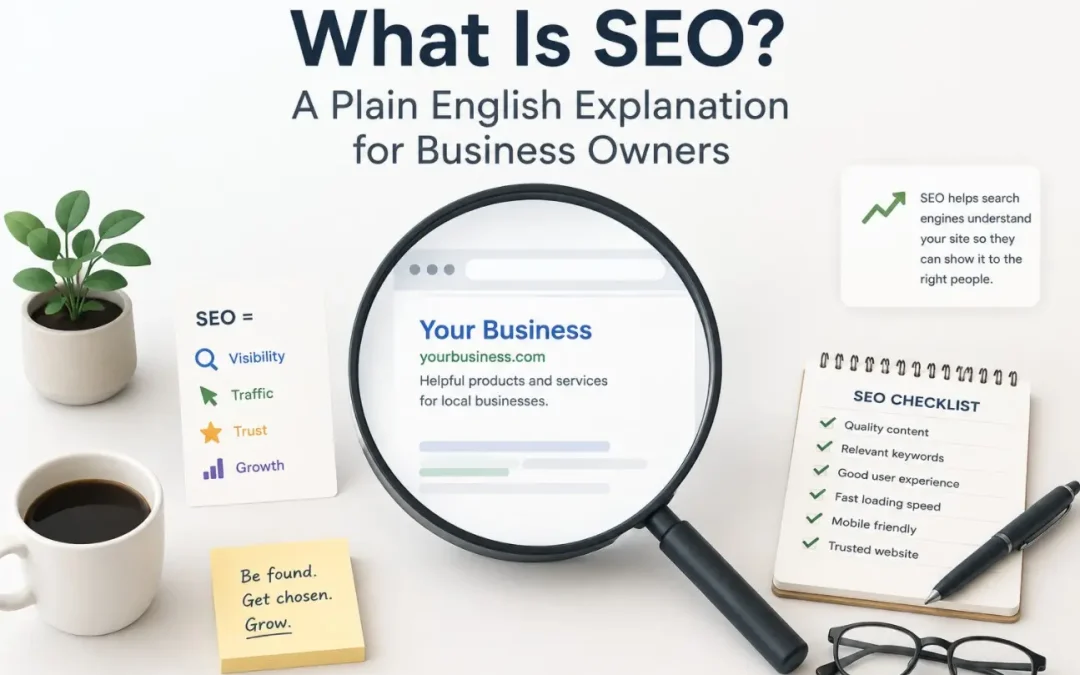
Post Summary: A Website Proves You Exist, SEO Proves You Matter
A website proves you exist. It doesn’t give Google any reason to recommend you over the 500 other businesses selling the same thing, and that gap is what SEO fills.
The framing that makes it click is a popularity contest. Links pointing at your site from credible, relevant sources are endorsements. The content on your site is the proof the endorsement was earned. A link from a plumbing trade directory means something for a plumber. A link from a random blog about cryptocurrency does not.
That relevance is the whole game, and it’s where cheap SEO fails. A Kansas plumber came to us with links from Romania and India pointing at his site, bought from a company overseas. Google’s systems got good at spotting links built to game rankings, so those links don’t count at all. He wasn’t sitting on a poisoned site. He was sitting on a site with no real endorsements, having already paid for the appearance of some.
Your website and your SEO are different jobs. The site has to be built so each page has a distinct purpose, or the pages compete with each other: if the homepage, the services page, and the about page all talk about plumbing, Google doesn’t know which to rank. The structure funnels toward the page that should rank, and SEO is the signal that tells Google which part of the structure matters for a given search.
None of it is a secret handshake. Content that’s specific to your business and answers what your customer is searching for gets ranked. Content that reads like everything else doesn’t.
Live, Listed, and Invisible
You built a website. It looks good. You paid someone, or you did it yourself on a weekend, and now it’s live. Your business name is on it, your phone number’s on it, your services are listed. It’s out there.
And nothing happens.
You Google your own business and it shows up, eventually, maybe on page two, maybe further. You Google what you do, “plumber in [your town]” or “bakery near me”, and you’re nowhere. Dozens of other businesses are. You’re not. Same lemonade, same sign, same street. But nobody’s walking over to your stand.
That’s the gap. And the thing that fills it, the thing that tells search engines your business exists and matters and deserves to show up when someone is looking for exactly what you do, is what is SEO. Not a trick. Not a hack. Not a seance. A system.
The Internet is a popularity contest
When a business owner asks us what SEO means, we don’t start with acronyms. We start with this: the Internet is like a popularity contest. The popular people get pushed to the top of the search results. That’s the whole framework.
So how do you get popular?
We write really good things about you. That’s how we tell Google how great you are. But those really good things have to come from very valuable sources, not just anyone, not just anywhere. We find sources that relate to what you do and then we get them to put your really nice things on their website. That creates a link back to your website and increases your popularity.
That’s SEO.
Search engine optimization. Three words that sound complicated but describe something simple: building your reputation online so that search engines trust you enough to recommend you. The links pointing back to your site are like endorsements. The content on your site is the proof that the endorsement is earned. When both pieces are working, relevant endorsements from credible sources, and a website that delivers what people are searching for, Google moves you up.
The concept isn’t mysterious. The execution takes time, and it takes someone who knows what “valuable sources” means in your specific industry. A link from a plumbing trade directory means something for a plumber. A link from a random blog about cryptocurrency does not. Context is everything.
What it looks like when SEO goes wrong
We had a plumber in Kansas, small-town guy, just a normal small business owner, not a nationwide plumbing company. He’d worked with a cheap SEO company out of India, and when we looked under the hood, links from Romania were pointing to his site. And India. And a handful of other countries that had nothing to do with a plumber in a Kansas town.
Think about the popularity contest for a second. That’s not even someone from a different high school talking about you, that’s like someone from a high school in Romania saying how great you are. Well, how could they possibly even know you?
Google knows that too. Its systems got good at spotting links built to game rankings, and the practical result is that those links don’t count at all. They aren’t endorsements, they’re noise, and the money that bought them bought nothing.
So the work starts by figuring out what’s really there. Occasionally a site has a manual action from Google or a genuine spam campaign pointed at it, and that gets handled directly. Far more often the honest finding is that nothing built so far is doing anything, and the foundation has to be built for the first time.
This is more common than you’d think. The best situation we could possibly get is a client who has not done SEO before, that’s like a dream, because we can just do it right from the beginning. But 90% of the time, we’re fixing other people’s mistakes.
The biggest misconception about SEO
The biggest misconception is that SEO is some kind of voodoo, like we have to do a seance with Google to get them to do something. Business owners hear the term and picture something opaque and technical and impossible to understand. They assume there’s a secret handshake or a hidden lever that only insiders can pull.
There isn’t.
It’s really very simple: if you provide content that is unique and is fulfilling the search intent of your customer, you’re going to get ranked. It’s as simple as that. If it’s generic AI-generated content like everybody else, you won’t. Google has gotten extremely good at identifying content that exists to game the system versus content that exists to help the person searching. The distinction matters more now than it ever has.
The two misconceptions run in opposite directions. One misconception is that SEO is easy, just put anything out there and you’ll rank. The other is that it’s so complicated no normal business owner could ever understand it. Both are wrong. The concept is simple. The work is specific, ongoing, and requires knowing what you’re doing. That’s where most people need help, not understanding the idea, but executing it consistently with the right strategy behind it.
Before clients even understand what SEO can do for their business, a lot of times we have to tell them where they’re at. And that’s a hard conversation, because oftentimes it’s not a great place. But it’s an honest one, and it’s the only place to start.
Your website and your SEO are two different things
This is where it clicks for most people, or where it should.
Your website by itself has to have everything about the business. It has to be focused on each page so that everything makes sense and you’re not cannibalizing, which means eating up the search intent on one page to the other. If your homepage talks about plumbing and your services page talks about plumbing and your about page also talks about plumbing, Google doesn’t know which one to rank. They’re competing with each other. The site has to be a funnel where your homepage is funneling down to your main service page, and each page has a clear, distinct purpose.
That’s the website doing its job.
For the SEO component, all we’re doing is heavily favoring that final page, the one that should rank, so that it gets extra juice. The website is the structure. SEO is the signal that tells Google which part of the structure matters most for a given search. Without the website, there’s nothing to optimize. Without SEO, the website sits there looking professional and getting no traffic.
When someone thinks buying a website should automatically get them on page one, the disconnect is usually here. They’ve built the structure, maybe a good one, but they haven’t told anyone it exists. The website is a necessary foundation. It is not, by itself, a marketing strategy. If your site isn’t showing up on Google the way you expected, this is almost always why.
The lemonade stand problem
Here’s the analogy that makes it land.
You’re in a neighborhood with 500 other neighbors. Every single one of your neighbors is selling lemonade. You’re also selling lemonade, but you just started today, and everyone else already has a lemonade stand. Same sign. Same setup. Same street.
Why would a visitor suddenly go to you?
What makes you different? What makes you unique? You can have the best lemonade in the world, but all you did is put your lemonade stand up and your sign, and everyone else has that exact same sign. So why are they going to go to you? How would they even know yours is better?
That’s what a website without SEO looks like. You exist, but nobody has a reason to find you over the other 500 businesses doing the same thing. Understanding what is SEO comes down to this: it’s the thing that tells the neighborhood, and the people driving through it, that your lemonade is worth stopping for. It’s the reviews. It’s the write-up in the local paper. It’s the friend who told a friend who told someone else. Except online, those endorsements are links from relevant, credible sources, and the neighborhood is Google’s search results.
Without SEO, you’re one more stand with a sign. With it, you’re the one people find first, because search engines have enough evidence to recommend you.
What is SEO, and what should you walk away knowing?
If you take one thing from this page, take this: SEO tells Google, or any of the other search engines, why you matter. That’s it.
Not why you exist. Not that you have a website. Why you matter. Why, out of every other business doing what you do, in your area or in your industry, the person searching should see you. That’s what SEO builds, a case, over time, made up of content that proves your expertise and endorsements from sources that confirm it.
It’s not instant. It’s not magic. It doesn’t work if your website is a mess underneath, and it doesn’t work if someone’s cutting corners with spam links from countries that have nothing to do with your business. But when it’s done right, real content, real links, real strategy, it’s the most reliable way to get your business in front of people who are looking for exactly what you offer. And if your site is live but not getting the traffic you expected, this is where the diagnosis starts.
And if someone tells you it’s more complicated than that, they’re either selling something or they don’t understand it themselves.
We keep it plain around here. If you’ve got questions about what SEO would mean for your business, whether it’s worth it, what it costs, what the timeline looks like, we’re happy to have that conversation. No pressure, no jargon, no seance required.
Frequently Asked Questions
How long does SEO take to start working?
It depends on where you’re starting. A brand-new site with no existing problems can start seeing movement in three to six months. A site where a previous provider built links that don’t count, like the Kansas plumber situation, needs the real work started from scratch, which adds time. SEO is a long game, not a light switch.
Can I do SEO myself?
You can learn the basics, but doing it well requires consistent effort and knowing what “valuable sources” means in your industry. Most business owners are better off running their business and letting someone handle it who does this every day. The concept is simple, the execution is where it gets specific.
What’s the difference between SEO and paying for Google Ads?
Google Ads puts you at the top of search results because you’re paying for that spot. The moment you stop paying, you disappear. SEO builds your organic ranking over time, it’s slower to start but doesn’t vanish when the budget runs out. Most businesses benefit from knowing which one fits their situation before spending money on either.
How do I know if my current SEO is working?
If you’re paying for SEO and you can’t point to specific pages ranking for specific search terms that your customers use, something’s off. Good SEO should be measurable, not a monthly invoice with a vague report attached. Ask your provider to show you what’s ranking and where the traffic is coming from. If they can’t answer clearly, that’s your answer.
Why does everyone say SEO content has to be “unique”?
Because Google can tell the difference. If your content says the same thing every other site in your industry says, or worse, if it’s generic AI-generated content that reads like everybody else’s, there’s no reason for Google to rank you over them. Unique doesn’t mean clever. It means specific to your business, your customers, and the questions they’re searching for. That’s what fulfills search intent, and that’s what gets ranked.