
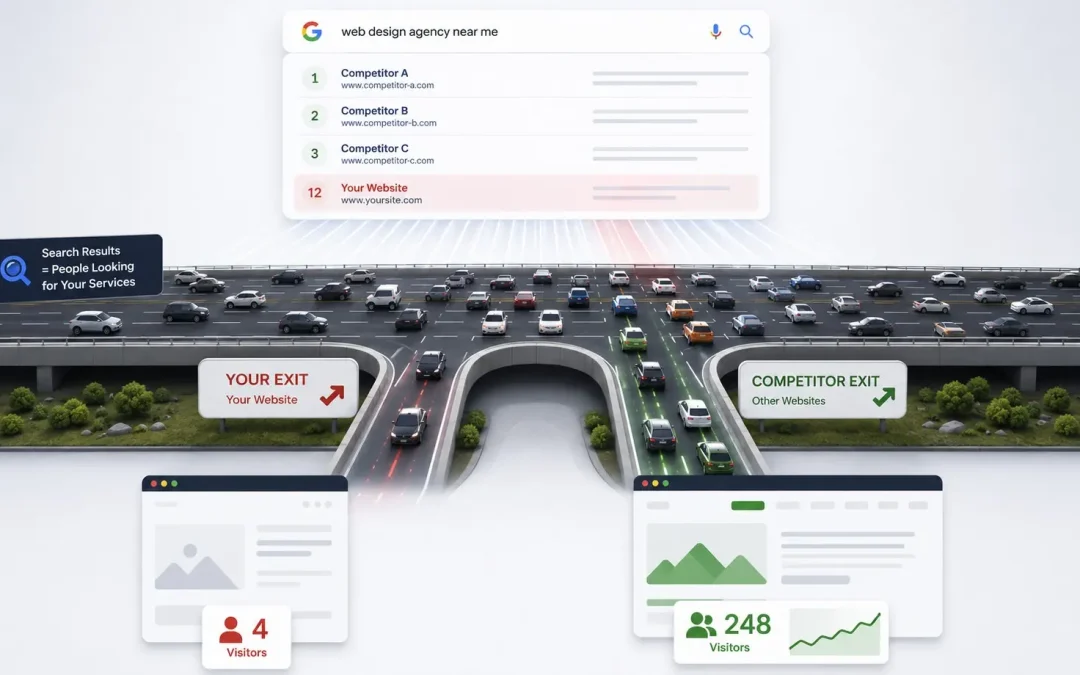
Post Summary: The Site Is the Foundation, Not the Whole Job
A site that isn’t pulling traffic usually has structural problems nobody can see and content that could belong to any business in the industry. Fixing both is necessary. In a competitive market it still isn’t sufficient.
Start with data rather than a feeling. Google Search Console is the baseline: which pages Google is serving, which search terms pull up your site, how many people click. If nobody has set that up or shown you how to check it, close that gap first.
The structure is where most of it starts. One clear focus per page, one H1, headings that follow a logical order, and no two pages competing to rank for the same thing. A page can be live and still be invisible, because a page that exists isn’t necessarily a page Google serves.
Content is the second half. If every page reads like it could belong to any company in your industry, there’s no reason to rank you over them.
An electrician in a major metro had all of this rebuilt: cannibalization cleaned up, pages indexed and focused, no SEO campaign on top. Calls started trickling in, not flooding. Against competitors who have spent years on search and paid ads, a correctly built site moves the needle without leapfrogging them. In a less competitive market the same site plus a few focused blog posts pointing at the service pages can pull real traffic, and that part costs nothing but time.
Page Two, Maybe Page Three
If your website has been live for six months and the phone hasn’t rung once, you don’t need someone to tell you something’s off. You already know. You’re Googling your own business name and maybe finding it, eventually, on page two or three. You’re Googling what you do and not finding it at all. Meanwhile, competitors with worse reviews and uglier sites are sitting right there at the top.
That’s not bad luck. Something is broken, or something was never built right in the first place.
It’s rarely one thing, and it’s rarely visible from the front. If the phone isn’t ringing at all and you’re established, figuring out why your website is not getting traffic starts under the hood.
What “no traffic” usually means
When a business owner tells us their website isn’t getting any traffic, we have to figure out what that means first, because it doesn’t always mean what it sounds like.
Sometimes it means exactly what they said. They’ve checked their analytics, they see single digits or zeros, and nothing is moving. That’s a clear problem with a specific diagnosis.
A lot of the time it’s closer to this: the phone isn’t ringing as much as they thought it would, the site is live and looks fine, and they assumed that would be enough. Either way the first step is the same, which is data instead of a feeling.
Google Search Console is the minimum. It shows which pages Google is serving, which search terms pull up your site, and how many people click through. We use Plausible on top of that for cleaner analytics. If your web company never set Search Console up, or never showed you how to check it, close that gap before anything else.
The real reasons your site isn’t performing
True zero is rare unless the site just launched. What’s common is a site that’s been live a while, looks decent, and is dramatically underperforming for no obvious reason. It usually starts with the development.
There are all these things that have to happen on the back end that you don’t see. Is every page focused on a single keyphrase? Is there one clear H1 per page? Do the headings follow a logical structure, H1, H2, H3, or are they scattered? Are two pages cannibalizing each other, competing for the same search term instead of working together? These aren’t cosmetic issues. They’re structural, and they’re invisible to anyone who isn’t looking for them.
It’s hard to count keyphrases on a site. You have to have a system for that. Most business owners don’t, and shouldn’t have to. But their web company should.
Then there’s competition. The trades are crowded, and a site launched in the last year is competing with businesses that have been building their online presence for a decade. That’s not a failure, it’s the market, and a clean design alone doesn’t break through it.
And if your site isn’t showing up on Google at all, the issue might be even more fundamental, indexing, penalties, or a technical barrier that’s keeping Google from seeing your pages in the first place.
The electrician who rebuilt and got a trickle
We worked with an electrician for quite some time, major city, heavy competition. They didn’t opt for SEO. Just wanted the site rebuilt and figured a good website would be enough to start generating calls.
When we looked at the previous site, the development was off across the board. Cannibalization problems, pages competing against each other instead of working together. Pages that were live but not indexed, which means Google wasn’t serving them at all. Just because you have a page live doesn’t mean that Google serves it or that people can even find it without being on your website. That distinction is one of the most misunderstood things in web design. A page can exist and still be invisible.
We rebuilt the site. Fixed the structure, cleaned up the cannibalization, made sure every page was indexed and focused.
They started to get calls trickling in. But it wasn’t like this wave of calls.
And that’s the honest answer for competitive markets. A correctly built site in a competitive space will get you some movement, but if every other electrician in a major metro has been investing in SEO and paid advertising for years, a new site alone isn’t going to leapfrog them. You’ve got to pay for marketing in a highly competitive space. The site is the foundation. It’s necessary. It’s just not sufficient by itself when the competition is spending.
Now, if it’s not that competitive? Different story. You get a good site and you do some really focused blog posts that explain what you’re doing and you’re linking back to the service page, and that can really help. And that’s free. The client can do that. A well-built site in a low-competition market with even a handful of targeted blog posts can start pulling traffic without a dollar spent on ads. It depends entirely on what you’re up against.
Built wrong for traffic vs. no strategy behind it
Two things go wrong here and they look different when you open the hood. One is keyphrase stuffing, where “plumber near me” gets crammed into every H2 on the page. It optimizes for the right term and no human wants to read it, and Google knows that. The other is a page with no focus at all, covering toilets and drain clog repair and every other service in one place, so nothing tells Google what the page should rank for.
You can check this yourself. Read the page. Does the supporting paragraph line up with the heading? Is there a clear from top to bottom progression of an idea down to the final CTA, something like “let’s fix your clog”? If yes, the architecture is sound and the issue is probably strategy or competition. If the page jumps around, if sections don’t connect, if you can’t tell what the page is supposed to rank for, things get really squirrely, and Google doesn’t like that. Those pages usually don’t rank.
Why is my website not getting traffic, what to check first
If you look at your analytics today and see almost nothing, single digits, maybe zero, two things need your attention before anything else.
First: the development, covered above. If it’s off, nothing built on top of it is going to perform, and no amount of content or marketing spend fixes a foundation that’s working against you.
Second: the content. Is it AI garbage, or is it your own unique content that can rank because it’s your voice, not someone else’s? Google has gotten very good at recognizing content that was generated to fill space versus content that was written to help the person reading it. If every page on your site reads like it could belong to any business in your industry, there’s no reason for Google to rank you over them. The content has to be specific to your business, your customers, and the questions they’re searching for.
Those two things, structure and content, are where most traffic problems start. If both are solid and you’re still not seeing movement, the next question is whether your site is getting traffic but not converting it into customers, which is a different problem entirely.
If you don’t know where you stand on any of this, that’s fine. Most business owners don’t, it’s not their job to. But it is their web company’s job, and if you’re not getting clear answers when you ask, talk to someone like us. We’ll be happy to help.
Frequently Asked Questions
How long should I wait before worrying about low traffic?
A brand-new site needs time, search engines have to discover, crawl, and index your pages before they can rank them. If you’re a few weeks in and seeing almost nothing, that’s normal. If you’re six months in and still flatlined, something structural is likely wrong. The timeline also depends on competition, a plumber in a major metro is going to take longer than a specialty shop in a small town.
Can a good-looking website still have traffic problems?
All the time. Design and development are two different things, and the stuff that drives traffic is mostly invisible to the business owner, because it lives in the code, the structure, and the content strategy rather than in anything you can see on the page. A pretty site with bad development is a brochure, not a lead generator.
What’s the difference between Google Search Console and Google Analytics?
Search Console shows you how Google sees your site, which pages are indexed, which search terms are bringing people in, and whether there are technical problems blocking your visibility. Analytics shows you what visitors do once they’re on your site. We use Plausible instead of Google Analytics because it’s cleaner and doesn’t carry the bloat. But Search Console is the baseline, if that isn’t set up, you’re flying blind.
Is it possible my website is getting traffic but I just don’t know it?
Yes, and it’s more common than you’d think. If you don’t have analytics installed or haven’t looked at Search Console, you’re guessing. We’ve seen business owners assume they’re getting zero traffic when they’re getting a steady trickle that could be built on. We’ve also seen the reverse, people who think they’re doing fine because the site looks good, but the numbers tell a different story. Data first, then diagnosis.
Do blog posts help with traffic?
They can, especially in less competitive markets. Focused blog posts that explain what you do and link back to your main service pages give Google more content to index and more reasons to see you as an authority. The key word is focused. A blog post that tries to cover five topics helps nobody. A blog post that answers one specific question your customers are searching for can pull traffic for years. And the client can do that part, it’s free.