
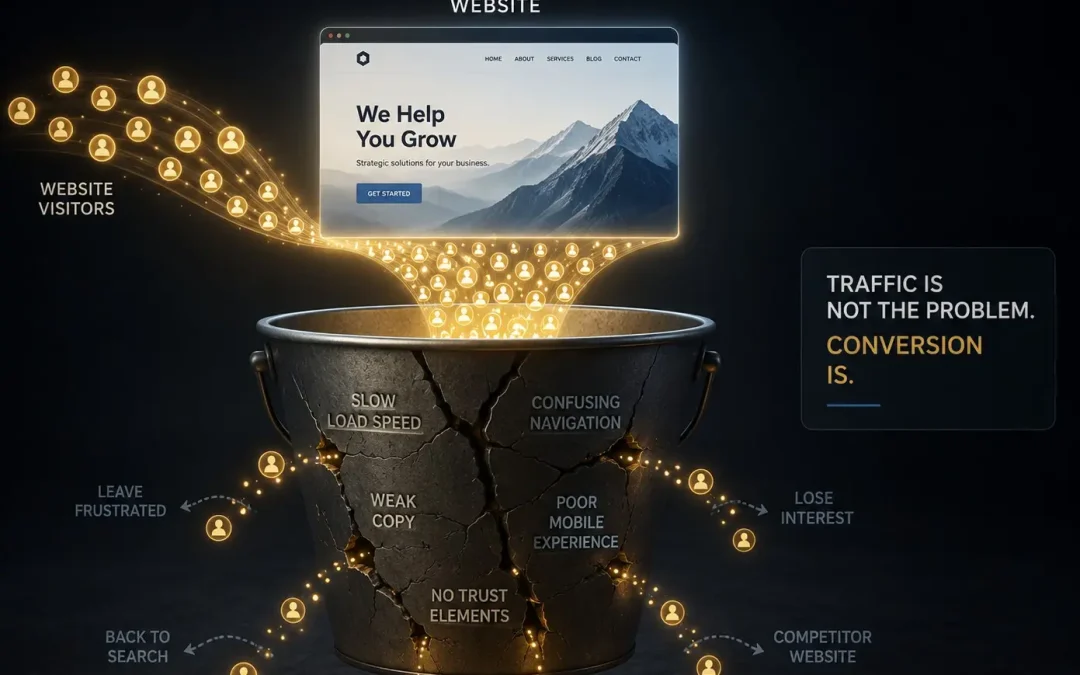
Post Summary: Traffic Without Customers Comes Down to Three Different Problems
Not getting customers from a website that’s getting traffic is almost never one thing. It splits into three separate problems that each need a different fix: a website problem, where visitors show up but weak calls to action or too few ways to reach out (like only a phone number) lose them before they convert, a visibility problem, where something like a no-index tag or a missing sitemap keeps Google from showing the site at all, and a positioning problem, where a site has been live for years without ranking properly regardless of its age. Diagnosing starts with the homepage, then service pages, then the contact page, in that order, because that’s the path a visitor actually takes.
An Arizona auto crusher client had traffic that looked solid in Google Search Console, but a previous SEO company had built foreign backlinks pointing at the site, so most of the visits were never going to convert into a local phone call. Cleaning up the bad backlinks and rebuilding legitimate authority fixed it.
The rest of the post covers what inconsistent messaging between pages does to trust, and why too many calls to action can hurt conversions as much as too few.
Where the Diagnosis Starts When the Phone Isn’t Ringing
You’re staring at your site stats and the numbers look fine. People are visiting. The homepage is getting hits, the service pages are getting clicks, and the little graph in your dashboard keeps trending in the right direction. But your phone is quiet. Your inbox is empty. The contact form hasn’t pinged in weeks.
That gap, between people showing up and people reaching out, is where most of the frustration lives. Because it feels like the hard part is over. You got the website. You got the traffic. And now you’re sitting in a waiting room you built yourself, watching people walk past the window.
If you’re wondering why am I not getting customers from a website that seems to be doing its job, the answer is almost never one thing. It’s a stack of small failures that add up to silence, and most of them were preventable.
Where we start when someone says the phone isn’t ringing
When a business owner tells us they have a website but they’re not getting customers from it, the first thing that runs through our mind is that they’re probably getting traffic but they’re getting terrible conversions. Something between the visit and the action is broken.
Where we start diagnosing, of course, is the homepage. That’s the most important page. Then we move to the service pages, then the contact page. In that order, every time. Because that’s the path a visitor takes, and if something breaks along that path, nothing downstream matters.
A lot of times there’s things missing that the owner didn’t even know about, things the web company should have handled but didn’t. Maybe there’s only a phone number and no contact form. Maybe the contact form is buried at the bottom of a page nobody scrolls to. Maybe the service pages describe what you do but never once ask the visitor to take the next step.
We have a whole slew of checks and balances that we go through. It’s not guesswork. It’s a diagnostic sequence, and the homepage is always the first stop because if it isn’t working, nothing else will either.
The late-night problem nobody thinks about
Here’s a scenario that comes up more than people realize. Someone is lying in bed at eleven o’clock at night, worried about their roof. Or their landscaping. Or a pest problem. Something that’s been nagging at them all day, and now it’s keeping them up. They grab their phone, search for a local company, land on a website, and the only option to reach out is a phone number.
No one’s going to call a business at ten o’clock at night. That’s just rude.
So what happens? They close the tab. They tell themselves they’ll call tomorrow. Tomorrow comes, they’re busy, and by afternoon they’ve forgotten the company name entirely. You had a visitor with a real problem and real urgency, and you lost them because there was no way for them to act on it in that moment.
There’s not enough options to give customers a chance to reach out. That’s one of the most common conversion killers we see, and it’s one of the easiest to fix. A contact form. An email address. A simple “tell us what you need and we’ll get back to you” that works at any hour. The visitor doesn’t need to talk to a human right now. They need a way to raise their hand. If your site doesn’t give them that, you’re losing people who were ready to become customers.
When the message doesn’t match
Traffic without conversions is almost always a trust failure. And one of the fastest ways to break trust is inconsistent messaging.
If it says one thing on the homepage but then says something different on the service page where the visitor is supposed to commit, they notice. Maybe the homepage talks about affordable solutions and the service page lists premium pricing with no explanation. Maybe the tone shifts from friendly and approachable to stiff and corporate between pages. The visitor doesn’t articulate what’s wrong. They just feel it. And their reaction, whether they’d say it out loud or not, is something like: they don’t even have their shit together.
That instinct kills conversions faster than almost anything else. Because a visitor who’s confused isn’t going to call and ask for clarification. They’re going to leave. Quietly. Without telling you why.
Bad messaging. Inconsistent messaging. These are the things we look at before we touch anything technical, because they’re the things that determine whether a visitor who lands on your site feels like they found the right place or feels like something’s off.
Too many buttons is just as bad as not enough
There’s a fine line between too many conversion buttons and not enough. Both extremes cost you customers, but they cost you in different ways.
Not enough is the one people recognize, no clear next step, no call to action, the visitor has to hunt for a way to contact you. That’s a design failure and it’s fixable in an afternoon.
Too many is the one people don’t recognize, because it feels proactive. Every section has a button. Every scroll reveals another “Call Us Now.” The sidebar has one. The header has one. The footer has three. Every second when you scroll, it’s like, “Call us now, call us now.” It looks super needy.
And needy doesn’t convert. It creates the opposite of trust. A visitor who feels pressured doesn’t feel welcomed, they feel sold to. And the instinct when you feel sold to is to leave, not to buy.
The balance is simple: make the next step obvious and easy to find, but don’t wallpaper the page with it. One clear call to action per logical section. A contact form that’s easy to reach but not shoved in the visitor’s face before they’ve had a chance to read a single sentence. The goal is confidence, not urgency. A visitor who’s ready to reach out will find the button. A visitor who isn’t ready won’t be convinced by seeing it twelve times.
If you’re wondering whether your site isn’t getting the traffic it should in the first place, that’s a different diagnosis, but the conversion side is where we start when the traffic numbers look fine and the phone is still quiet.
Why am I not getting customers, when the traffic itself is the problem
Sometimes the gap between traffic and customers isn’t about the site at all. It’s about who’s visiting.
Traffic doesn’t necessarily mean the right kind of traffic. We had a client in Arizona, an auto crusher, one of those recycling depot operations, and they were seeing exactly this. The numbers in their dashboard looked solid. Google Search Console said they were getting visits. From the surface, everything appeared to be working.
But the phone wasn’t ringing.
When we dug into it, the issue was a previous SEO company that had done them wrong by building a bunch of foreign links to the site. Backlinks from countries that had nothing to do with the business, pointing to pages that served a local market. And so they had a ton of traffic, their Google Search Console said so, but when you looked at the actual countries, when you went to that filter, it showed that very little of it was from the United States.
The traffic was BS.
Those visitors were never going to call. They were never going to drive to a recycling depot in Arizona. They were numbers on a screen that made a report look good, and that’s all they were ever going to be. It took a lot of work to fix. Cleaning up bad backlinks, rebuilding the site’s authority with legitimate sources, getting the kind of traffic that could convert into an actual phone call from an actual person in the service area.
If your site is getting visitors but not customers, one of the first things worth checking is where that traffic is coming from. Not just which pages, which locations. If the answer doesn’t match your service area, you don’t have a conversion problem. You have a visibility problem dressed up as a traffic problem.
We figure out which problem you’re facing, and what to do about it.
Website problem, visibility problem, or positioning problem
Not getting customers is typically an SEO problem. Unless the website is built poorly, of course, but if the website’s solid, then it’s an SEO problem. Either the market is too competitive, the site is too young, or the work simply hasn’t been done.
But there’s a layer underneath that people miss. The visibility problem. It’s possible that there’s something like a no-index tag on the pages, a line of code that tells Google not to show them in search results. Or maybe the sitemap was never submitted. Maybe there isn’t a sitemap at all.
Google doesn’t even know you exist this whole time.
That’s not a ranking problem. That’s a foundation problem. And it’s the kind of thing that sits quietly for months or years while the business owner wonders why nothing is working. Every day the site is live but invisible to Google is a day of wasted potential, and the fix is usually something that should have been handled at launch.
Then there’s the positioning problem, and this one stings. All that time you’ve had, maybe five years with an active domain, and you’re not positioned properly in Google’s eyes. All that time is wasted. It’s not like having a website for five years earns you credit. That’s not how it works. Google doesn’t even care. A brand new site with great content will start ranking within a couple of months if everything else is done right.
How we sort it out: we look at the worst problem first, then go down the line. Find the easy wins. Get things moving in the right direction before tackling the deeper structural issues. But we always start by figuring out which of the three problems you’re facing, because the fix for each one is completely different, and solving the wrong problem first is how businesses waste another six months.
The honest conversation before you blame the site
If you’re sitting there right now thinking your website was supposed to bring you business and it’s not, there’s an honest conversation worth having before you blame the site.
What was the expectation set in the beginning?
Was the website supposed to bring in business all by itself? Because if that’s what someone told you when they sold it to you, that’s someone who sold you a website and a pack of lies. A website doesn’t do that on its own. It never has. A website is a tool. It needs traffic, and that traffic needs to come from somewhere, SEO, advertising, referrals, social media. The website converts visitors into customers, but it doesn’t generate visitors out of thin air.
There isn’t a single avenue in the entire universe where you pay the very least and you get the very best. This is true with everything else and especially with website marketing goes, paying very little just won’t get you the results you want.
So before you blame the site, figure out exactly what you signed up for. Are you paying a hundred dollars a month and expecting to be at the top of Google? That’s not realistic and it doesn’t make sense. That’s not how the math works, not for SEO, not for web design, not for any kind of marketing that produces real results.
And if you signed up for something where someone promised you the number one spot in Google for a hundred bucks a month, that’s one of those situations where you should have known better. That’s too good to be true. It was too good to be true when they said it, and it’s too good to be true now.
The honest version isn’t comfortable. But it’s the version that leads somewhere useful, because once you understand what you’re working with, you can start making decisions that match reality instead of chasing a promise that was never real.
Frequently Asked Questions
My website gets traffic but no one contacts me, what’s the most likely cause?
It’s usually a combination of weak calls to action and not enough ways to reach out. If the only option is a phone number and someone finds you at eleven at night, they’re not calling. A contact form, an email address, or even a simple intake prompt gives visitors a way to act when they’re ready, not just when your office is open.
Can bad SEO send the wrong kind of traffic to my site?
It can and it does. Foreign backlinks, irrelevant keywords, and sloppy link-building campaigns can drive traffic from people who will never become your customers. The numbers look fine on paper, but the traffic is from the wrong locations or the wrong intent entirely. Fixing it means cleaning up the source and rebuilding with legitimate, targeted authority.
How do I know if my website is the problem or my marketing is the problem?
If people are visiting and not converting, the website is likely the issue, messaging, layout, calls to action. If people aren’t visiting at all, it’s a visibility or marketing problem. We diagnose by looking at the homepage first, then service pages, then the contact page, and checking where the breakdown happens in that path.
Should I expect my website to bring in customers without SEO?
A website without any marketing behind it is a brochure nobody picks up. It can convert visitors, but it can’t create them. SEO, paid ads, referrals, social, something has to drive people to the site. Anyone who told you the site alone would generate business sold you a pack of lies.
What’s a realistic timeline for seeing customers come in from a new website?
If SEO is part of the strategy and the work is being done right, a brand new site with solid content can start showing up in search results within a couple of months. Converting those visitors into customers depends on the site’s design, messaging, and how easy you make it to take the next step. There’s no shortcut, but there’s also no mystery. It’s work, and it compounds.