
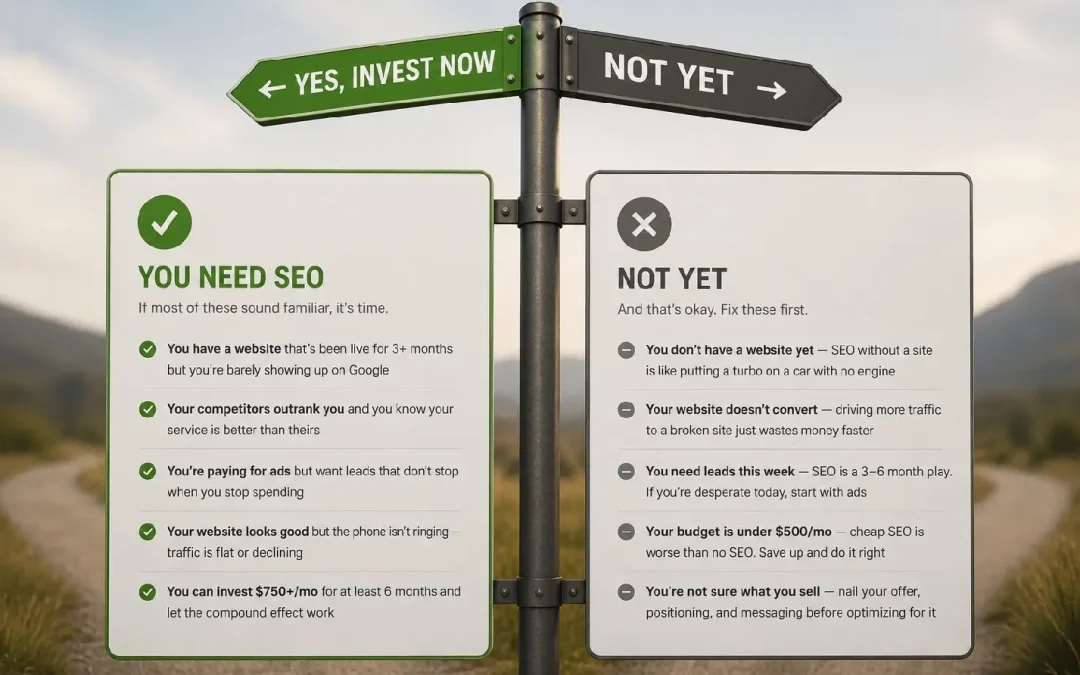
Post Summary: SEO Only Makes Sense When Three Things Line Up
Whether a small business needs SEO comes down to three things: competitive landscape, cash flow, and timeline. It makes sense for newer businesses with cash to invest who want to compress the results timeline, and for established businesses that have hit a referral ceiling and want a new channel to grow beyond it. It’s a poor fit when a business already dominates local search with little competition, or when the monthly cost would strain cash flow before results show up around the six-month mark. Service businesses in mid-sized markets, where customers Google before they call, tend to see the fastest payoff.
A tree cutting business just starting out couldn’t sustain a monthly SEO investment, so instead of signing him up, the recommendation was $200 in flyers handed out locally, and he came back to start SEO a few months later once his cash flow could support it without strain.
The rest of the post covers how budget and timeline shape which SEO approach makes sense, and the specific questions worth asking any SEO provider about how their link building actually works.
When Skipping SEO Is the Right Call
Not every small business needs SEO. That’s not a popular opinion in our industry, but it’s the truth, and we’d rather lose a sale than put you into something that doesn’t make sense for where you are right now.
The honest answer depends on three things: your competitive landscape, your cash flow, and your timeline. Get those three wrong, and SEO becomes a monthly bill that frustrates you instead of a growth engine that pays for itself. Get them right, and it’s one of the best long-term investments a small business can make. Here’s how to figure out which side you’re on.
When We Tell People to Skip SEO
A guy came to us recently who was just starting a tree cutting business. Young, hungry, barely had enough to cover the cost of a website. He wanted marketing, wanted to grow fast. But when we looked at his situation, SEO wasn’t the right move.
He didn’t have the cash flow to sustain a monthly investment for the six-plus months it takes to see real results. So instead of selling him something he couldn’t afford, we told him to spend $200 on flyers and hand them out himself.
Within two or three months, he had enough work coming in to start building real savings. When he circled back and asked if it was time for SEO, we asked about his cash position. He had a couple months banked. Our advice: keep stacking cash, grow through word of mouth, and start SEO when the cash flow feels comfortable, not stretched.
That’s what he did. And when he eventually signed up, he was in a position to sustain the investment without the anxiety of wondering whether he could afford next month’s payment.
That conversation is worth more than any sale we could have made. And it’s exactly the kind of honest marketing advice we believe in.
When SEO Is the Right Move
SEO makes sense in two scenarios, and the approach is different for each.
Newer businesses with cash to invest: If you’ve got the savings or cash flow to commit to a larger package and you need results as fast as possible, a more aggressive SEO strategy compresses the timeline. More content, more link building, more technical optimization happening simultaneously. You’re paying to accelerate.
Established businesses ready to level up: If you’ve been running for years and you’re getting steady business through referrals and word of mouth but you’ve hit a ceiling, SEO opens a new channel. You’re not desperate for leads, you want to grow beyond what your current network can provide. The middle or smaller package works here because you can afford to be patient.
In both cases, the same rule applies: quality and quantity have to be there together. You can’t just throw volume at SEO and expect results. One blog post a month with niche-relevant backlinks will move the needle over time, but only if the content is good and the links are legitimate. Quantity without quality is just spending money.
Industries Where SEO Pays Off Fast
Less competitive markets see faster results. That’s common sense, but it’s worth spelling out.
If there are five or six businesses like yours in a town of a hundred thousand people, and you’re already showing up on page two or the bottom of page one, SEO can push you into those top spots relatively quickly. You’re not climbing from nothing, you’re optimizing what’s already working.
The businesses that tend to benefit most from SEO investment are service businesses in mid-sized markets: HVAC companies, dentists, landscapers, accountants, pest control, businesses where the customer searches Google before they call anyone. If your customers are Googling what you sell, SEO puts you in front of them at the exact moment they’re ready to buy. If they’re searching and your website isn’t showing up in Google, that’s money walking to a competitor every single day.
When You’re Wasting Money on SEO
If you’re the only game in town, or one of two or three, and you’re already showing up in the map pack, you’re probably wasting money on SEO. You’ve already won the local search battle by default.
In that situation, a social media campaign might make more sense. Or if you want to expand into neighboring regions and grow your service territory, that’s a different conversation, but it’s an expansion strategy, not an SEO necessity.
The other scenario where SEO is a waste: when you can’t sustain the investment. If $750 a month is going to keep you up at night, you’re better off spending that money on direct outreach, flyers, networking events, things that generate leads without a six-month ramp-up. SEO is a long game. If you need leads tomorrow, paid advertising gets you there faster while SEO builds in the background.
The Question We Ask First
When a prospect asks “Do I need SEO?” we usually already know their business and their website, we’re deeper in the conversation by that point. But the first thing we ask is about budget.
Not because we want to sell the biggest package. Because the budget tells us whether SEO is even realistic for their situation. If someone says they’re comfortable with $500, that’s below what we can deliver meaningful results for. We’d rather tell them that upfront than take their money and underperform.
If they say $2,000 or $3,000 makes sense, the next question is timeline. How fast do you expect results? Because if the answer is “next month,” we need to have the hard conversation about why that’s not realistic, and why the investment level matters when it comes to speed.
We’ll explain what you get for your money, the time horizon for results, and the long-term advantage over paid ads. You turn off Google Ads and the leads stop immediately. You turn off SEO after two or three years of building it properly, and you’ll keep generating organic traffic for a long time before anything goes stale. That compounding return is what makes SEO worth the patience, for the right business at the right time.
The SEO Industry: Honest Take
There are a lot of great SEO companies doing the right thing and delivering real results for their clients. The difference between good and bad often comes down to how they treat the relationship after the sale, not just the technical work. You don’t hear about them much because the horror stories get more attention. But they’re out there, and they’re doing good work.
The part of the industry that needs the most education is link building. If you’re not sure what SEO involves at a basic level, the link-building side is where most of the confusion, and most of the damage, happens. The questions every business owner should ask their SEO provider:
Are my links niche-relevant? If you sell weed whackers and your links are showing up on fish tank websites, something is wrong. The link has to make sense in the context of your business.
Is the linking website established? A domain that’s six months old and exists solely to sell links is not helping you. It’s a liability. When that domain disappears, and it will, the link disappears with it.
Does the article stay on the page? Some link-building services place your link in an article that gets removed after 90 days. That’s not a permanent backlink. That’s a rental.
Does the source have authority? The linking website needs enough domain authority to signal to Google that the endorsement matters. A link from a legitimate, established website in your industry tells Google your business is credible. A link from a random blog with no traffic tells Google nothing.
If your current SEO provider can’t answer these questions clearly, that’s worth digging into. Our SEO repair guide walks through how to spot the damage and what recovery looks like.
Not sure where you stand? That’s exactly what we figure out in a conversation, no pressure, no pitch, just a straight answer about whether SEO makes sense for your business right now.
Let’s Figure Out If SEO Is Right for You
Or estimate your SEO cost first to see where you’d land.
Frequently Asked Questions
How do I know if my business needs SEO?
If your customers search Google for the services you offer and you’re not showing up on page one, you need SEO. If you’re already visible and there’s little competition, your money may be better spent elsewhere.
Can I start SEO on a small budget?
Yes, $750 a month is our starting tier, and it delivers real results over time. But you need to sustain it for at least six months to see meaningful movement. If that investment would strain your cash flow, build your savings first and start SEO when you’re comfortable.
How long before I see results from SEO?
Three to six months for measurable improvements, six to twelve months for significant results. Competitive industries take longer. The investment level also affects speed, larger packages compress the timeline because more work happens each month.
Should I do Google Ads instead of SEO?
If you need leads immediately, yes, Google Ads delivers right away. SEO is a long-term investment that compounds over time. The best strategy for many businesses is running both: ads for immediate leads while SEO builds your organic presence in the background.
What if I’m already ranking on page one?
If you’re in a low-competition market and already in the map pack, SEO might not be necessary. Consider social media or content marketing for brand awareness instead. If you’re on page one but want to dominate the top spots or expand into neighboring markets, SEO can help with that specific goal.
Is cheap SEO better than no SEO?
Not always. Bad SEO, especially bad link building, can hurt your rankings worse than doing nothing. If the budget only allows for a $200/month package from an unknown provider, you’re likely getting automated reports and spammy links. Save that money and invest it properly when you can afford quality work.