
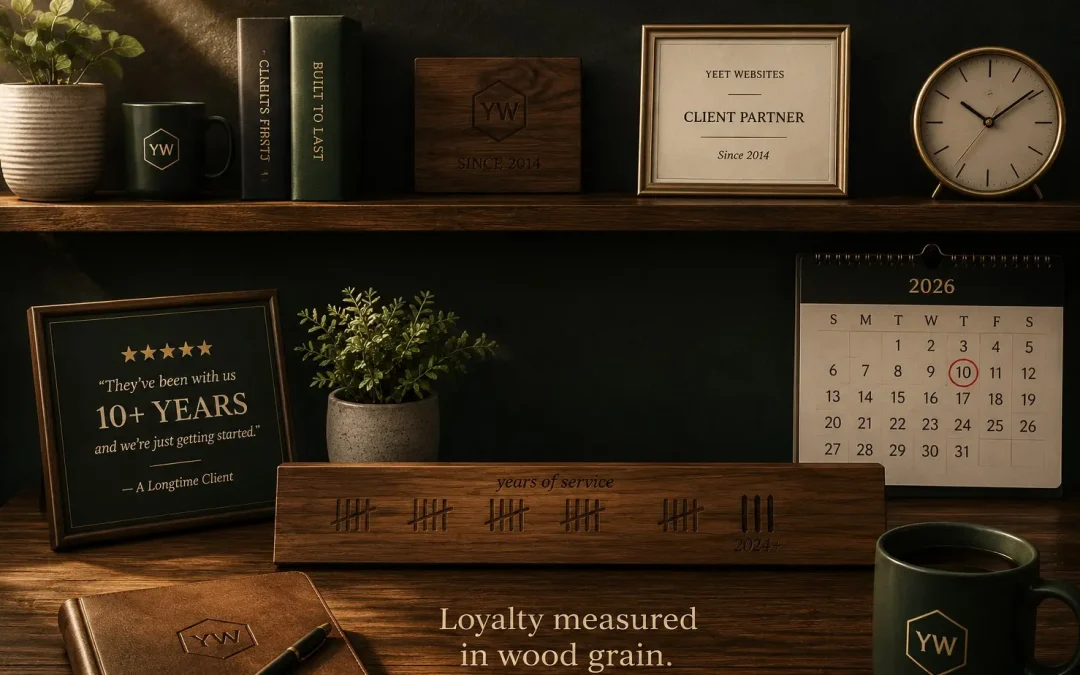
Post Summary: The Service Doesn’t Degrade
A client can leave with a single message and be gone by end of day, no cancellation fee, no notice period, so when the same clients stay for years, that choice means something. What keeps them isn’t results alone, it’s certainty, when something comes up, they know a message gets answered and an issue doesn’t sit until Monday.
That consistency comes from systems, not personality. When a client says they’ll get back with something, a task gets created 48 hours out to check whether they did, and if they didn’t, a follow-up goes out rather than letting it disappear. Detailed notes go into the CRM after every conversation, not summaries, so a client’s preferences and history carry forward instead of resetting.
The relationship in year three looks the same as year one, the same person who built the site is still the one answering messages, with more context built up over time rather than less.
A long-term client’s real experience isn’t watching a system work, it’s sending a request and going back to running their business, already knowing it will get handled.
What Happens If You Want to Leave
You don’t have to stay.
That’s not a throwaway line. There’s no contract. No termination fee. No 30-day cancellation window designed to squeeze one more payment out before you go. If a client we’ve worked with for three years wanted to leave tomorrow, they could send one message and be done by end of day. That’s the deal, and it’s been the deal since day one.
So when clients don’t leave, when the same businesses that hired us in 2021 are still here in 2026, still emailing, still texting, still sending over photo updates and asking us to swap out a homepage headline, that means something specific. Not because staying is easy. Because leaving is just as easy, and they’re choosing not to.
This post is about why. Not the business reason. The real reason why businesses stay with the same web design company when they have every opportunity not to. It’s also the reason we built our entire web design model around earning the relationship every month instead of locking people in.
It Isn’t the Website
The obvious answer would be results. Great website, more calls, better leads, business is growing. And sure, that matters. We want every site we build to perform. But if results were the only thing holding clients here, you’d expect more churn when things get quiet, when it’s a slow season, when leads are down, when the business is going through something. Clients would weigh the ROI and make a cold decision.
That’s not what happens.
The real reason is something harder to put on a pricing page. It’s that when clients need something, the next step is never in doubt. Not approximately. Not probably. They send a message and it gets answered. They ask a question and it gets a real response, not a ticket number and a two-day window. An issue comes up on a Friday afternoon and it doesn’t sit until Monday morning.
If you’re paying us a fee, it’s our job to respond as quickly as we can. If that means the same minute, if we can, we do. If that means within a couple of hours, we do. If for some reason it’s going to take longer than normal, we let you know, this is what’s going on, are you available tomorrow?
That level of communication is baked into our systems. It’s not a personality trait. It’s not something that depends on whether someone had a good morning. It’s how the whole thing is built.
And over time, that reliability compounds into something bigger than responsiveness. It becomes trust. Real trust, the kind where a client doesn’t think twice about whether their request will get handled. They’ve already seen it handled a hundred times. They just send the message.
What the Relationship Really Looks Like in Year Three
A lot of companies put everything into the beginning. The pitch is polished. The onboarding is attentive. The first few months feel like you’ve got a dedicated team working just for you. Then something shifts, and you can’t quite name it. Response times stretch. Messages get a little more generic. The person who really understood your business gets promoted or leaves, and now you’re explaining yourself to someone new.
We’ve heard this story from nearly every client who came to us after another company. Not exaggerating, it’s almost universal. The beginning was great. Then it wasn’t.
What the relationship looks like in year three at Yeet Websites? It doesn’t look any different. And that is the beauty of what we do.
The same person who built your website is the same person answering your emails. The same person who sat with you and figured out what your business is about, how you want to come across, what your customers care about, what makes you different, that person still knows all of that in year three. Probably better. Because over time you really learn what people like, what their communication styles are, what’s important to them, all these things.
If you can’t remember, we take notes.
That’s not a punchline. CRM notes go in after every conversation, not summaries, not one-liners, but actual notes. Offhand comments that might matter later. Preferences that would never come up in a questionnaire. The stuff that turns a serviceable interaction into one where the client thinks, without really analyzing it, that we just get them.
Those conversations build on top of each other. Month six isn’t starting over from month one. It’s built on everything that came before it. Month thirty is built on all of that. The relationship deepens because the knowledge deepens. And the knowledge deepens because we keep track of it. That’s also why businesses that plan for a website that lasts five years end up in a fundamentally different position than the ones chasing redesigns every eighteen months.
The Point It Stops Feeling Like a Vendor
We were asked about a specific moment, a single interaction with a long-term client where we realized the relationship had become something deeper than a service provider and a customer.
The honest answer: that’s every single client. When we talk to them, that’s how it feels.
Not in a sentimental way. In a practical way. We know their busy season. We know which pages on their site drive the most leads. We know who their main competitor is and why clients choose them over that competitor. We know whether they prefer a quick text or whether they’d rather have everything in email. We know what they’re proud of about their business and what frustrates them about it.
That kind of knowledge doesn’t happen in a transaction. It happens in a relationship, one that’s been maintained consistently, month after month, where every interaction builds on the last one.
There’s a client we’ve worked with since we opened. They pay the minimum to have a professional website online. They’re not doing SEO, not running ads, not expanding into new markets. They just need a site that looks good, works right, and gets updated when something changes. Six months can go by without a single interaction beyond the monthly subscription running automatically.
Then they text. And within the hour, it’s handled.
That’s the whole thing. They’ve stayed because they know, with complete certainty, what’s going to happen when they reach out. And they’re right every time.
The Systems Answer
Here’s a question worth asking: can you occasionally deliver excellent service without good systems? Yes. Absolutely. Some companies have a standout employee who makes clients feel like royalty. Some have a streak of good luck. Some are just attentive during the honeymoon phase because the relationship is new and the sale still feels fresh.
A broken clock is right twice a day. Every 24 hours, in the AM and the PM, that clock shows the correct time. It’s going to be right. But all those other seconds in between and before and after, it’s wrong. That’s not a clock. That’s a stopped clock that occasionally matches reality.
Systems are what make the clock accurate every second, not just twice.
If you have just a couple of systems in place, it’s really difficult to be great. You’ll have good weeks and rough weeks. Good clients and clients who slipped through the cracks. Good months and months where five things fell off the radar and nobody caught it until a client noticed.
When every system is dialed in, and the whole purpose of each component of that system is aimed at what the client gets out of it, that’s the premise of everything we do. Then you don’t have good days and bad days in terms of client service. You have the standard. Every day.
Here’s a small example of what that looks like in practice. Sometimes a client needs to get back to us. Maybe they’re pulling together some information, or they said they’d send us new photos, or we’re waiting on a decision from them. The natural thing would be to wait and hope they remember.
Instead, when that kind of interaction develops, we create a task right then and there, 48 hours from that moment: did the client get back to us? If they did, the task closes. Done. If they didn’t, that task fires and it becomes an opportunity: “Hey, you were going to reach back to me. Do you still need my help?” And what the client says, almost every time, is: “Oh yeah, thanks for getting back to me.”
That’s not luck. That’s not a charismatic employee who happened to remember. That’s a system doing exactly what it was designed to do: making sure nobody falls through the cracks.
Multiply that by every touchpoint across every client relationship, and you have an operation where things just get handled. Not sometimes. Consistently.
Why Would They Leave?
When people ask why our long-term clients don’t leave, we think they’re asking the wrong question.
The real question is: why would they?
Why would someone leave when they signed up for a particular service, they’re getting that service, and every time they need help, they get excellent customer service? If there’s an issue, it gets resolved immediately, as if they’re the most important person in the world.
That’s the key. That’s the difference between us and, and we want to be clear, we’re not saying everyone else, because there are a lot of great web design companies out there, but a lot of companies could definitely use this information and improve their services. We hope they do.
When leaving is free, when there’s no cancellation penalty, no guilt trip, no call trying to talk you out of it, staying becomes a choice that means something. Our clients aren’t here because they have to be. They’re here because we’ve earned it, month after month, interaction after interaction.
The clients still here from the beginning are the argument. Not a testimonial. Not a case study. The simple fact that they’re still here and still paying, by choice, month after month.
That’s the Yeet Websites Way. Period.
What Year Five Looks Like
There’s a version of this conversation where we list all the things we do: fast response times, proactive follow-ups, deep client notes, no contracts. That version is fine. It’s accurate. But it misses what the long-term client experiences on a Tuesday afternoon in year four when they need something small changed on their site.
They don’t experience a system. They experience certainty.
They send a message. They don’t wonder if it went to the right place. They don’t follow up two days later to make sure someone saw it. They don’t brace for a response that misunderstands what they asked. They just send it, and then they go back to running their business, because they already know what’s going to happen next.
Six months might go by without a single substantive interaction. And when they do need something, it lands in front of the same person who has known their business since they first signed. No re-onboarding. No “can you remind me what your site is for?” Just: got it, handled.
That will not happen with us. That’s a promise we’ve kept for four years and counting.
What does it say about a web company when their clients choose to stay year after year with no obligation? It says the systems are working. It says the whole purpose of every process, every follow-up task, every note taken after every call, is pointed in the right direction: how does this serve the client better?
When that’s the premise of everything you do, long-term clients aren’t a goal. They’re the natural result.
The clients who’ve been here since 2021 aren’t here because leaving is hard. They’re here because staying is easy, and because every time they’ve reached out, we’ve shown up. That relationship keeps getting better the longer it runs. That’s the only business model worth building.
Frequently Asked Questions
Why do clients stay with Yeet Websites for years when there’s no contract?
Because the service doesn’t change. The same person who built their site is still the person answering their messages in year three. When they need something, it gets handled quickly and correctly, every time. Leaving is always an option, staying is a choice they make because the relationship keeps working.
How does a web design relationship change after the first year?
It shouldn’t, and here it doesn’t. Attention that fades over time is a common enough shape. The systems here exist to keep the standard level. By year two or three, the relationship is deeper because we know the business better, not because we’re trying harder. The knowledge compounds.
What does Yeet Websites do to make sure clients don’t fall through the cracks?
We run systems, not intentions. Anything a client owes us gets a reminder against it, and if nothing arrives we follow up rather than letting it sit. We also take detailed notes after every interaction so nothing has to be re-explained. Every piece of it is built around the same test, and the test is whether the client is better off.
Is long-term client retention just about good customer service?
Customer service is the outcome. Systems are what produce it consistently. Good service happens without systems sometimes. Consistent service doesn’t. When the whole operation points the same direction, people staying stops being a target and starts being a byproduct.
What does Yeet Websites cost for ongoing website maintenance?
Our subscription plan is $130 per month after a one-time $600 setup fee. No contracts. Cancel anytime. That’s the same pricing whether you’re in month one or year four, and the service level stays the same too.