
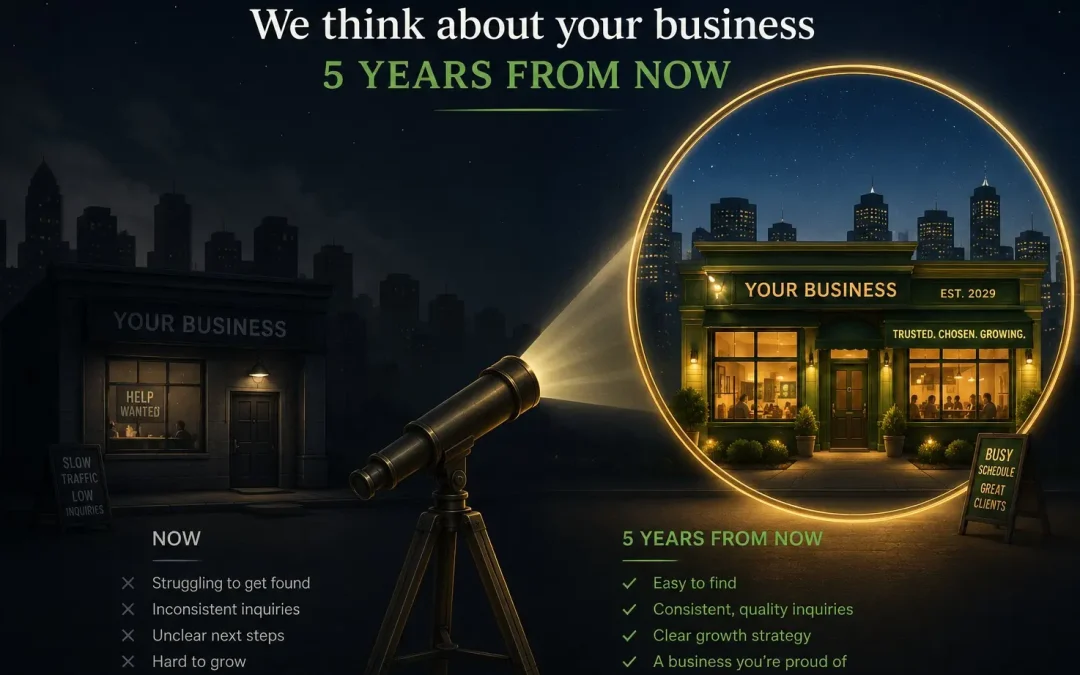
Post Summary: What Ages Badly, and What Doesn’t
Sites rarely fail dramatically. What happens is quieter: a page gets added, then another, none of them connected to anything, and by year three the thing reads as a pile rather than a site. Fixing that late usually means starting over, which is why the shape gets decided at the beginning.
The beginning starts with a question about the business rather than the website. Some owners want to grow. Others have arrived exactly where they wanted and have no interest in more. Those two need opposite things, and neither answer is the wrong one.
One limo operator in Connecticut was paying for a complicated reservation system that wasn’t working. A plain contact form wired to his inbox replaced it, and the enquiries that followed surprised everyone, with no campaign running behind them.
Below: what changes between the two kinds of build, why nobody needs a five-year plan to get a good one, and what it costs to solve only for right now.
The First Question We Ask Before We Build Anything
Before we build a single page, we ask a question that often doesn’t get asked.
Do you want to grow?
Not “what pages do you need” or “do you have a logo file.” We want to know where the business is headed, because that answer changes everything about what we build. And the responses are more varied than you’d expect. Some clients come in with a five-year growth plan, a list of services they want to add, and a vision of what the business looks like when it’s twice its current size. Those clients get one kind of website.
And then there’s the other kind.
“I don’t want to grow. The purpose of this website is not more business. I’m busier than I need to be.”
That’s a real answer we’ve heard more than once. A business owner who has found their ceiling, not because they’ve failed, but because they’ve succeeded exactly as much as they wanted to. For them, the website isn’t an acquisition engine. It’s a professional presence. It handles inquiries, represents the brand, and tells the story. That’s it.
That’s a different kind of website than “yeah, I want to grow, I want to keep evolving.” And building a website that lasts 5 years means understanding which one you’re building before you start. It also means building it on a model designed to evolve with you, not one that’s finished the day it launches.
Two Clients, Two Different Websites, Both Built to Last
The website that lasts isn’t one thing. It’s shaped by what the business needs to become.
For the client who wants to grow, longevity looks like infrastructure for evolution. Room to add services. A blog that can compound over time. A structure that accommodates SEO if that’s eventually part of the plan. Pages that connect to each other, not orphaned pages that exist in isolation with no logical relationship to the rest of the site. The content has to integrate. The architecture has to make sense not just for what the business is now, but for what it could reasonably become. That’s what building a website that grows with your business looks like before the first page goes live.
For the client who’s at capacity, longevity looks different. We build everything they need, make it clean and complete, and then focus on making sure it stays accurate and representative as time passes. The risk for this client isn’t missing growth, it’s letting the site go stale. Information that was true in year one stops being true in year three. Products change. Services expand. Photos age. A site that looked current at launch can quietly start contradicting the business it represents.
Both clients need a website that holds up. The forward-thinking decisions we make just look different depending on which direction the business is pointed.
The Orphaned Page Problem, and Why It Matters in Year Three
One of the most common ways a website ages badly isn’t dramatic. It doesn’t crash. It doesn’t break. It just starts to feel incoherent.
A page gets added because someone asked for it. Another gets added when a new service launched. A third was a promotion that ran for six weeks and then just… stayed. None of them connect to anything else in a way that makes sense. The navigation looks like it was assembled by three different people in three different years. Because it was.
We won’t create pages that just seem orphaned. That’s a principle, not a preference. Every page we build needs to make sense within the entire theme of the website, how the content integrates with each other, how it fits the larger story the site is telling. That’s critical to making sure it’s a forward-thinking website, not just a collection of URLs.
This matters more in year three than it does at launch. On launch day, every page is intentional. Three years later, without discipline about what gets added and why, a site can become a maze. Clients feel it before they can name it. The site feels off. It doesn’t quite represent the business the way it used to. The fix, at that point, is a rebuild, because patching incoherence takes more work than preventing it.
Prevention is a design philosophy. It means thinking about integration before adding anything.
The Limo Driver Who Bought a Bigger Domain
The best forward-thinking decisions don’t always look ambitious when you make them. Sometimes they look like a simple fix.
We work with a limo and taxi service out of Connecticut, high-end clients, premium service, the kind of operation where a booking going wrong isn’t just an inconvenience, it’s a lost relationship. He had a third-party booking software that was supposed to handle reservations. It was expensive, it was complicated, and it wasn’t working right. He was paying for a system that was creating problems instead of solving them.
We said: let’s try a contact form.
Not a dramatic overhaul. Not a custom-built reservation platform. A well-designed contact form with exactly the right fields, not super long, just the right amount of information, wired directly to his inbox. We built it. We tested it. It worked beautifully.
Went right into his inbox.
He dropped the dumb service that wasn’t even working. The expense went away. The complexity went away. And something else happened that we didn’t fully anticipate: he started getting form submissions at a volume that surprised us both. The site was already built right, proper heading tags, solid structure, SEO-ready from the start. Without running any active SEO campaigns, he’s getting forms after forms as if he’s doing SEO. It’s really cool.
He loves that modification we made.
The forward-thinking decision wasn’t to build something elaborate. It was to build something clean, simple, and right, and to revisit a piece that wasn’t serving him when we saw it wasn’t. That’s the work. Not just the initial build, but paying attention to what’s happening after launch and being willing to make the call when something needs to change.
Why a Site Drifts From the Truth
Here’s what doesn’t produce a website that lasts: client information pasted into a template with nothing in the process asking what’s specific about this business.
That’s how plenty of sites get made. The template exists. The client fills out a questionnaire or sits through a brief intake call. Their information gets dropped into the slots. The site launches. It looks fine on day one. By year two, it looks like exactly what it is, a template with someone’s name on it.
The deeper problem is what happens after launch. A business isn’t static. Products change. Services expand. The team grows or shifts. The market the business serves evolves. A site that was accurate at launch drifts away from the truth over time, and nothing about a launched site announces when it’s gone stale.
We always encourage clients to keep us updated. New products, new services, information that’s changed, send it over and we add it. That’s part of the relationship. But there’s an honest limit here worth naming: we cannot possibly know when something on your site has gone stale. To call out of the blue and say “hey, is your information current?”, that puts pressure on you when you might be focused on completely different parts of your business. The open lines of communication have to be established for that to work. If they are, great. If they aren’t, that’s a gap to close.
The companies that build for this quarter are the ones hoping you don’t notice the drift. We’d rather name it.
The Client Who Just Wants It to Work Now
Not every client walks in thinking about five years. Most of them are thinking about next week. They need a website, they need it to work, and the longer-term strategic conversation feels abstract when there’s a launch date on the calendar.
We don’t push hard against that. Here’s why.
If a client wants something, they want it for a reason, and maybe they don’t want to go into why. Yes, we’re the experts in web design and web development. But that doesn’t mean we know more about their business than they do. The only people who know their business are them. We can advise. We can flag things that might matter later. But at the end of the day, the buck stops with the person paying the bill.
And the honest truth is: both can be accomplished at the same time. We can make a modern-looking website that will look great in five years. A site built on clean code, solid structure, and logical content architecture doesn’t require the client to have a five-year plan. It just requires us to build it right, which we were going to do anyway.
The five-year conversation isn’t about convincing a client to want more than they’re asking for. It’s about making sure that whatever they’re asking for is built in a way that doesn’t box them in later. We plant that seed. If they want to grow into it, the foundation is there. If they don’t, nothing is wasted.
The Risk of Building for Right Now
There’s no risk as long as the business isn’t changing.
That’s the honest answer. If a business is going to look exactly the same in five years, same services, same market, same size, no growth, no evolution, then today’s website is fine. Build it clean, keep it maintained, and it’ll do its job indefinitely.
But most businesses aren’t standing still. And for those that have a five-year plan, there have to be steps in place so that it’s not like year five, oh man, we have all these changes we have to make. Those changes need to happen along the way, incrementally, so that the site is always representing the business it belongs to and not the business it used to be.
Just like a toddler grows into a teen, the website needs to grow into the monster money machine that you wanted it to be.
That’s the framing we like. Not “will this site last a decade”, that’s the wrong question. The right question is: is this site ready to grow when the business grows? Is it built in a way that makes evolution easy instead of expensive? Is the architecture forgiving enough that adding a new service doesn’t require rebuilding everything around it?
A site built for today only is a site you’ll outgrow. The work is making sure that when that moment comes, and for growing businesses, it always does, the site is ready to move with you instead of fighting you. What makes a site go stale is usually not age. It’s the gap between what the site says and what the business has become.
Frequently Asked Questions
How do you build a website that lasts 5 years without knowing where the business will be?
You build it on clean structure, logical content architecture, and no orphaned pages, and then you stay in the relationship so you can evolve it as the business changes. The foundation doesn’t depend on anyone having a plan. It depends on building it right and treating the site as a living thing rather than a finished product.
What’s the difference between a website built to grow and one built to stay the same?
A site built to grow leaves room: pages that can be added, writing that compounds, a structure that accommodates SEO, and content that integrates logically. A website built to stay is still built clean and accurate, but the focus is on keeping it current rather than expanding it. Both are legitimate. The mistake is building one when the client needs the other.
What’s the biggest risk of a website that only solves today’s problems?
If the business isn’t changing, there’s no risk. If it is, and for most businesses, it is, the risk is arriving at year five with a site that no longer represents the business and a rebuild on your hands instead of incremental updates along the way. The changes need to happen incrementally so the site grows with the business, not behind it.
How does Yeet Websites handle website updates over time?
We stay in the relationship. Updates come in through the normal channel, a text, an email, a quick call, and they get handled. We also flag things we notice. But we’re honest that we can’t always know when your information has gone stale, which is why keeping those lines of communication open matters. Our $130/month subscription keeps that relationship active and the site current.
Do I need a five-year plan before hiring a web designer?
No. Clean structure holds up whether or not a plan exists behind it, because it accommodates evolution, so if your business grows, the foundation is already there. And if it doesn’t, nothing is wasted.