
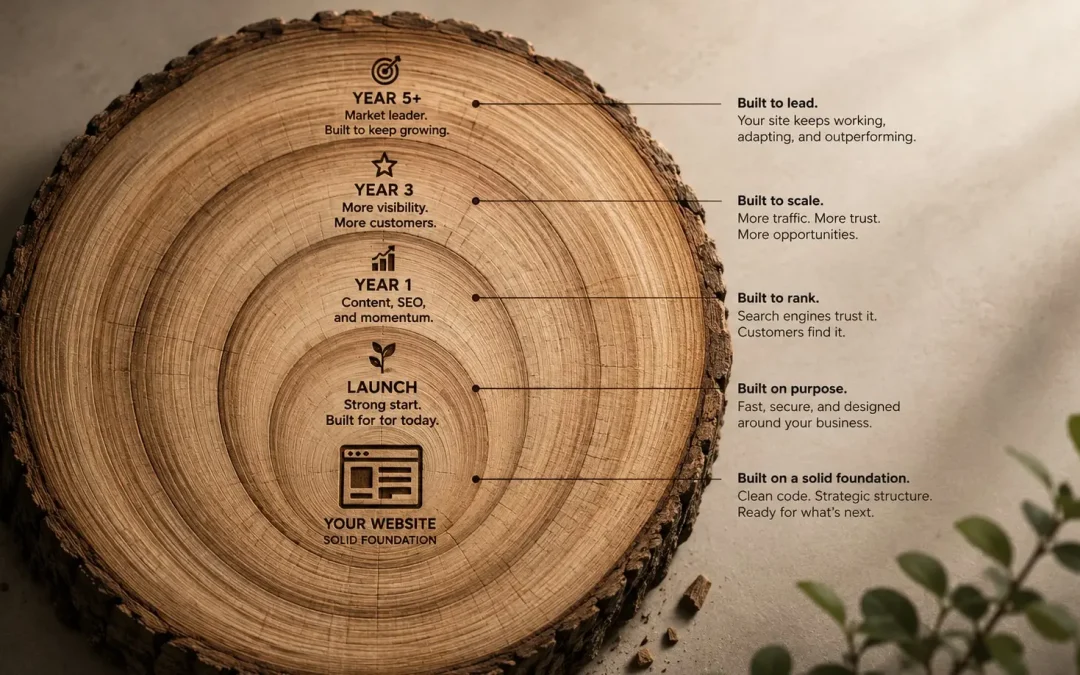
Post Summary: Your Business Will Change & The Site Should Handle It
Longevity comes down to two things settled at the start: how the headings are ordered and how the architecture is laid out. Search engines still read a page through that hierarchy, and that has held steady while everything around it shifted. A custom build absorbs the ordinary changes, added services, new sections, shifting direction, without starting over. What it does not absorb is a full rebrand or a change in positioning. Those are builds, and the monthly edit hour was never meant to cover them.
A template layout carries fixed ideas about how many services you offer and how a customer moves through them. Outgrow those and you spend your time working around a structure designed for somebody else. A custom build starts from how a particular business thinks, which is also what makes it awkward for anyone else to copy.
The rest of the post covers what to ask a web company before signing, and what a neglected, decade-old website reveals about how that relationship broke down.
Why Year Three Gets Decided on Day One
Most business owners don’t think about year three when they’re signing off on a new website. They’re thinking about launch day, how it looks, whether the phone number is right, whether the photos came out okay. Year three is somebody else’s problem.
We think about year three on day one, which is part of why the relationship keeps going.
Not because we’re planners by nature or because we have some formal five-year framework we run every client through. We think about it because the decisions you make before a single page goes live are the decisions that determine whether this website can grow with your business, or whether you’re rebuilding from scratch in two years and starting over.
There’s a version of building a website that lasts 5 years and grows with your business that sounds like marketing language. We’re going to talk about what it looks like in practice.
The Decisions Made Before Anything Goes Live
A lot of what we’re doing on day one has to do with the stuff you see. The main first words on a page, that’s called a Heading 1. The main titles throughout the page, those are Heading 2s. The decisions around those words matter far beyond how the page looks at launch.
Here’s the part that rarely comes up: what hasn’t changed is that a search engine still reads a page through its structure and order. Other stuff has changed. Algorithm updates, ranking signals, what gets rewarded and what gets penalized, that landscape shifts constantly. But the structural logic hasn’t. Google still wants a clear hierarchy. It still reads a page the way it’s organized. So getting that organization right on day one is not just a launch-day task, it’s a foundation that holds for years.
Do it right the first time and it stays right. Do it wrong and you’re either patching it later at extra cost, or living with the consequences of a page Google can’t fully read.
The second thing we’re doing on day one is building as unique as possible. Your branding, your messaging, your voice, none of it should look like the person down the street. If we’re building you something custom, then it should be custom. Not a rearranged template with your logo dropped in. Something that reflects how your business really thinks, and that individuality is the part nobody else can copy.
What Headings Tell a Search Engine
Before we get into growth and evolution, there’s a question worth asking any web company you’re considering. It’s a tell.
Ask them: are you building this with the correct heading structure so that everything is sequential and it makes sense? Is everything identified correctly?
If they look at you blankly, that’s information.
Here’s what headings are and why they matter for the long haul. A heading is the page shouting out to Google: this is an important thing, read this. The paragraph underneath explains it. That’s the relationship, the heading announces, the paragraph delivers, and they have to relate to each other. Every heading on a page has to fit that model.
Phone numbers should not have headings. A decorative label should not have a heading. The only things that get headings are the things that are announcing something worth reading. When a web company puts headings on the wrong things, or skips the structure entirely, they’re making a mess that Google reads as noise. And noise doesn’t rank.
A site built with correct heading structure in year one is a site that’s easier to grow in year three. Adding a new service section, expanding a page, building out new content, all of it slots into a foundation that was organized correctly from the start. A site built with broken structure is a site you’re fighting the whole way.
A company that can’t answer those questions has told you something too.
Which Changes Are Edits and Which Are Rebuilds
Here’s what it doesn’t mean: it doesn’t mean your website automatically accommodates any change your business makes, forever, at no additional cost. That’s not a reasonable expectation to set, and setting it that way does clients a disservice. The foundation of what we build is custom architecture, and that architecture is what makes the evolution possible.
Here’s what it means looking from a Yeetish lens.
If your business adds services, new offerings, new markets, an expansion you didn’t anticipate on launch day, those pages can be built out. Each service page can be slowly changed over time as that service evolves. That’s not a big deal at all. The custom architecture we build allows for sections to be added, ideas to be expanded, pages to be developed without tearing down everything that already exists. You’re not locked into the site you had at launch.
But there’s a line worth naming clearly: when the change is big enough that everything has to be redone, your old website is now out of date, even at three months old. A full rebrand, new positioning, completely different direction is a new build. That’s not an edit. With a subscription you get an hour of edits a month. That’s changing a few things, changing pictures, updating copy. That’s not creating a whole new website. Setting those expectations straight matters, because a client who thinks a full rebrand is covered under a monthly subscription is going to be frustrated, and a web company that lets that misunderstanding live is setting up a problem.
The custom advantage is that evolution is always possible. You don’t have to worry about getting a new template and starting over every time your business pivots. The structure moves with you. That’s what built to grow means.
Why Templates Can’t Keep Up
Templates go stale over a short period of time. That’s not an opinion, it’s what happens to every template in a market that’s fully saturated with them. They start to look the same. The design choices that felt fresh eighteen months ago become the wallpaper of the entire industry, and suddenly the same layout is showing up on three other sites in your market.
The deeper problem with templates isn’t even the visual staleness. It’s what they can’t do when your business changes. A template is built around assumptions. The layout assumes a certain number of services, a certain amount of copy, a certain type of client journey. When your business stops fitting those assumptions, the template fights you. You’re adding sections the template wasn’t built for, adjusting layouts that weren’t designed with your direction in mind, working around a structure someone else designed for someone else’s business.
John Allsopp, the web designer whose article “A Dao of Web Design” became one of the most influential pieces in the history of the industry, described this principle in A List Apart over two decades ago, and it hasn’t aged a day:
“Firstly, think about what your pages do, not what they look like. Let your design flow from the services which they will provide to your users, rather than from some overarching idea of what you want pages to look like. Let form follow function, rather than trying to take a particular design and make it ‘work.'”
— John Allsopp, co-founder of Web Directions, author of “A Dao of Web Design.” Source: alistapart.com
Custom doesn’t have that problem. A custom site is built around how your specific business thinks. And there aren’t a lot of people who think exactly like a single individual person thinks, which means a custom site built for your business is hard for a competitor to replicate, because they’d have to replicate you. That’s the long-term advantage. Not just that it looks different at launch, but that it stays different, stays relevant, and stays yours as the business moves. If you want to understand what a website built to last five years requires, that’s worth a closer look.
Three Questions to Ask Before You Sign
If you’re thinking about where your business is headed five years from now, there’s a conversation worth having before you hire a web company. Not about design. Not about features. About structure.
Ask them how they’re handling heading hierarchy. Ask them whether the architecture is built to accommodate growth, new service pages, new sections, new directions, without requiring a full rebuild every time something changes. Ask them what happens when your business evolves. Are they building with that in mind, or are they building for launch day and nothing else?
Those questions surface how a web company thinks. Some will give you a real answer. Some won’t have one. The ones who can walk you through the heading structure of your site, explain what each decision means, and show you how the architecture supports growth, those are the ones worth hiring. There’s a reason businesses stay with the same web designer for years, and it usually comes down to exactly this kind of thinking. The ones who can’t answer or don’t know what you’re asking have told you something important.
What a 2014 Copyright Notice Tells You
There are sites out there right now with copyright notices from 2012. From 2014. These are websites that have been live for over a decade, untouched, and the businesses they represent are still sending people there. Some of them even have a “link to full site” an old-school landing page that links to a separate full website. That was a thing once, and there are businesses still running it.
Part of what you’re looking at there is a customer who didn’t demand better. Part of it is a site nobody came back to. That dynamic is worth understanding, because building a website that can grow with your business requires both sides to show up. The web company has to build correctly from the start. The business owner has to engage with the site as the business evolves, ask for updates, treat the website as a living thing instead of a printed brochure that gets filed away. If you’re not sure what that ongoing relationship is supposed to look like, that’s worth understanding before you sign with anyone.
When both sides do their job, a website doesn’t become a 2014 relic. It stays current, stays useful, stays relevant, and keeps working for the business it was built for, even as that business changes.
That’s the version of built to grow that holds up.
If you want to know what that looks like for your specific business, that’s a conversation worth having.
Frequently Asked Questions
How much can I change on my website as my business grows?
That depends on what kind of change you’re talking about. Adding or updating service pages, changing copy, swapping photos, expanding sections, all of that is the normal evolution a website is built to handle. A subscription includes an hour of edits a month, which covers those kinds of changes over time. If your business changes so dramatically that everything needs to be redone, full rebrand, completely new positioning, that’s a new build, not an edit. The distinction matters, and we’d rather be clear about it upfront than have that conversation later.
What does proper heading structure do for my website?
Headings tell Google what’s important on a page and in what order. They create a hierarchy, Heading 1 for the main topic, Heading 2s for the major sections, paragraphs underneath each one explaining what the heading announced. That reading order is what a search engine follows. A page with correct, sequential headings is a page Google can follow. A page with headings on the wrong things, phone numbers, decorative labels, random callouts, is a page that reads as noise. Getting it right on day one means that foundation holds as the site grows.
Can a custom website really last five years without a full rebuild?
It can, if it was built correctly and maintained along the way. The custom architecture gives you the ability to add sections, expand pages, and evolve the site without tearing down what already works. Templates don’t give you that. They’re built around fixed assumptions, and once the business no longer matches them, the layout starts working against you. A custom site was built for how your business thinks, so it moves when your business moves. That’s not a guarantee forever, a full rebrand is still a full rebuild, but for normal business evolution, a well-built custom site should be able to grow with you.
How do I know if a web company is building for the long term?
Ask them about heading structure. Ask them what happens when you want to add a service two years from now. Ask them whether the site is built on open-source software or a proprietary platform that locks you in. The answers will tell you a lot. A web company thinking long-term can walk you through those decisions clearly. If they can’t answer or don’t understand the question, that’s a signal worth taking seriously.