
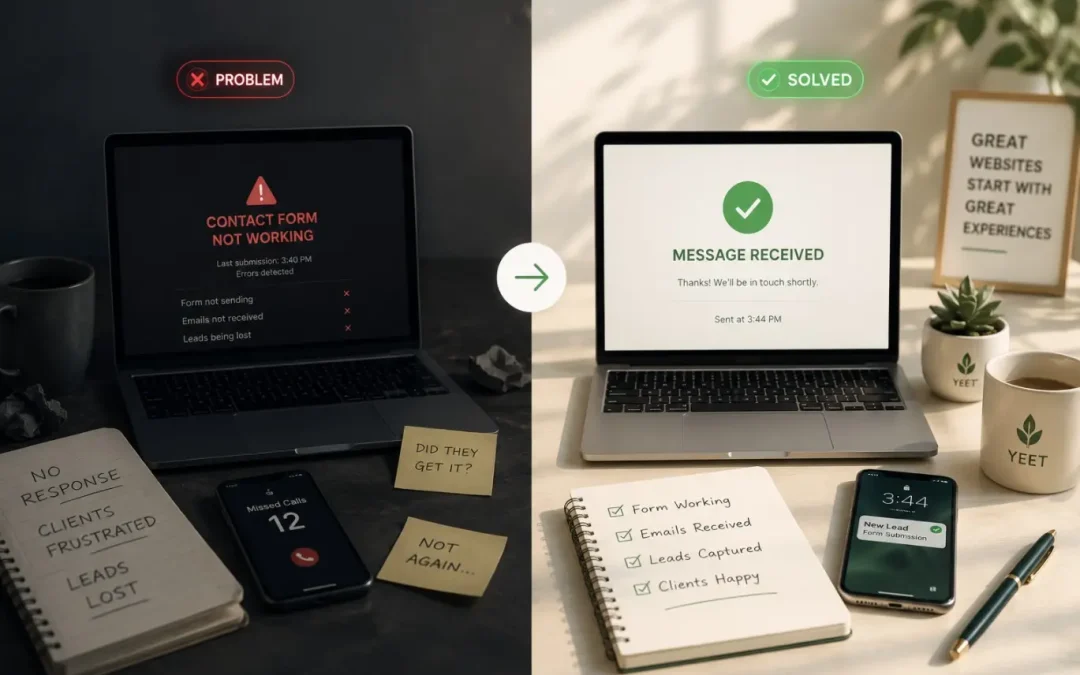
Post Summary: What Should Happen After Something Breaks on Your Site
Most people never put it to a web designer before signing. Plenty are thinking it, and saying it out loud to someone you’re about to pay can sound like you expect trouble, so it stays unspoken. The answer then arrives as an experience rather than an answer.
An HVAC build went live with one page missing its mobile sizing. The client wrote in about the text looking strange. We thanked them, fixed the page, and then read through every other page in case something similar had slipped by.
The sweep is the part that counts. Repeating a mistake someone already pointed out is the version worth avoiding.
Asked outright how we handle our own errors, the reply runs four words long. And you find out it is underway because we tell you, not because you went looking.
Why the Question Rarely Comes Up
It almost never comes up on a first call. Plenty of people are weighing it, and asking “what happens when you mess up?” out loud, to the person you’re about to hire, can land like you’re expecting disappointment before anything has started.
So it usually goes unasked. Then the answer shows up on its own schedule, in the middle of something, when it’s no longer a question you can evaluate.
We’d rather you ask it now.
One Page Went Live Without Mobile Sizing
A few months back we launched a site for an HVAC company and somehow one of the pages didn’t get mobile optimized. It hit the live site. Client noticed it, or someone told the client, and the message came in: hey, what’s going on with this? Text looks weird.
Go to look at it. All messed up. Text the wrong size for mobile.
Here’s what the client heard from us: thank you for letting us know, we’re on it. Simple simple fix. We went through and cleaned it up, then went through the entire site to make sure nothing else was wrong. Because that is embarrassing to have happen again after being told once.
We tightened things up on our end after that so it wouldn’t happen again. But the point isn’t that we had a perfect system. The point is what happened when something went wrong, a phone call, a fix, and a sweep of everything else.
Why People Stop Reporting Problems
The thing most people expect when they report a problem isn’t a fight. It’s nothing. A yes, and then no fix. The one thing you mentioned, still sitting there a week later.
That’s the kind of nothing that teaches you to stop mentioning things at all. You start deciding what’s worth the effort of bringing up, which means smaller problems never get raised and bigger ones arrive as surprises.
Which is why the question is worth asking before you sign rather than after. And when a project stalls out because nobody’s responding, the client is usually the last one to realize the relationship already ended.
What We Do When We Break Something
If a prospect asks us point-blank, what happens when you mess up?, the answer is: we will fix it.
That’s it. We will fix it. And you’ll know it’s being fixed because you’ll hear from us, not because you had to chase us down.
We make mistakes. The difference is what happens next, and you shouldn’t have to wait until something breaks to find out what kind of company you hired.
Yeetish Question
What if my web designer fails and the fix doesn’t hold?
Then we fix it again. And we go through everything else to make sure nothing was missed. The embarrassment of something breaking once is enough motivation, having it break twice after being told is the kind of thing that keeps us up at night. You won’t have to ask twice.