
Post Summary: What Carries Over When a Website Build Stalls
An Arizona handbag designer spent more than a month watching the date slide. Two pages, no way to check out, no branding, nothing capable of selling a bag. Every update pointed at the following week.
What hurt wasn’t the calendar. It was believing that everything already spent, in cash and nerve and the thrill of starting something of her own, had bought nothing.
We walked her through what could come across, what had to be built fresh, and how the end result would look. She agreed on the spot. Inside a month the shop was open, products loaded, logo redrawn, a proper address on her own domain, and she knew how to work all of it without us.
That’s the shape of most of these. The build is what stops, not the company behind it. Everything settled about your product and your identity is still settled, and that was the difficult part.
She Waited a Month for Two Pages
She’d been waiting over a month. A custom handbag business out of Arizona, her own designs, her own brand, everything riding on getting this site live. A couple of pages existed and nothing else. No shopping cart. Just a skeleton sitting there while the weeks kept passing and the promises kept coming.
“Oh, next week. Oh, next week. Oh, next week.”
That pattern tells you something on its own. By the time she found us, a referral from an existing client, she thought everything was lost.
What a Stalled Project Looks Like When You Open It
The state of things when we got in there: a free email address, a couple of half-built pages, no cart, no real brand presence. Nothing that was going to sell handbags. What existed was a start that had stopped. The reason behind that didn’t change what she was left holding.
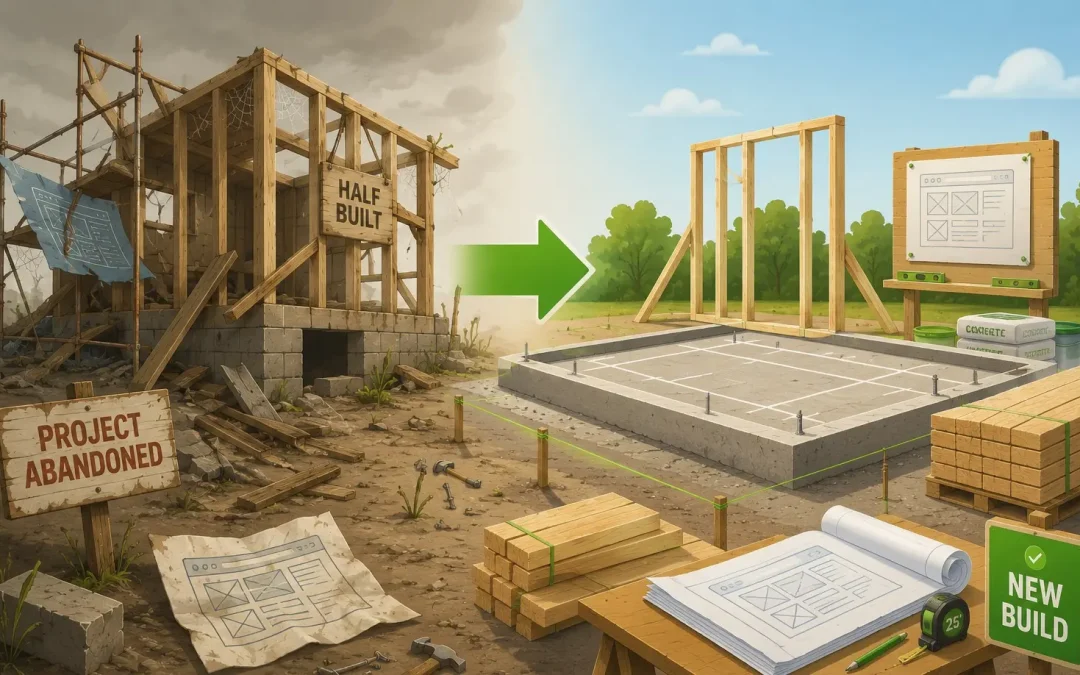
Picking up someone’s unfinished build and carrying it forward is rare. How a site is put together underneath decides what can be added to it later, so the usual answer is fresh code rather than a continuation. That doesn’t mean the work so far is wasted. Most of the time the content comes across, and often some of the design thinking does too. What gets rebuilt is what sits under it.
No movement. Broken promise after broken promise.
And the hardest part for the client wasn’t the wasted time. It was the feeling that everything she’d already put into this, the money, the energy, the excitement of launching her own thing, was gone. This is terrible. That’s the headspace people land in when things go wrong with a web designer and no one steps up to fix it.
What the Rebuild Took
From the jump, we showed her everything. What was salvageable. What we’d rebuild. What the finished version would look like. And she was ready, “Okay, let’s do this. Okay, great.” No hesitation. She’d been waiting long enough.
We ended up getting it done incredibly fast. Less than a month. Full shopping cart, full Monty, every page built, every product loaded, training her on everything so she could run it herself. We redesigned the logo, really getting her brand on point so she could sell her bags the way they deserved to be sold. Her business was still running off a personal inbox, so we set up a domain email too. Just became her web partner.
It was a lot of fun. She’s such a cool person.
We became fast friends in the process, and watching someone go from “this is terrible” to knowing exactly how to manage her own site, that’s the part of a rescue that doesn’t show up on a project checklist.
Her Business Was Never the Problem
A stalled project doesn’t mean a failed business. It means the build stalled for a while. The bags were ready. The brand was ready. The site just needed someone who’d finish the job without wasting what she’d already paid.
If you’re sitting on a half-built site right now, wondering whether it’s worth trying again, it was worth it for her. And we’ve done this enough times to know the answer is almost always the same. The project isn’t dead. It just needs someone who’ll show up and not let you down.
Yeetish Question
What if the other company barely started, is there anything to salvage?
Sometimes there is, sometimes there isn’t, and we’ll tell you straight. The content usually survives, and sometimes a fair amount of the design direction does too. What rarely survives is the code, so we typically start fresh there. In this case the real work was everything that hadn’t been done yet: shopping cart, branding, domain email, training. Even when there’s almost nothing to salvage, you’re not starting over from zero. You already know what you want. That’s the hardest part, and it’s already done.