
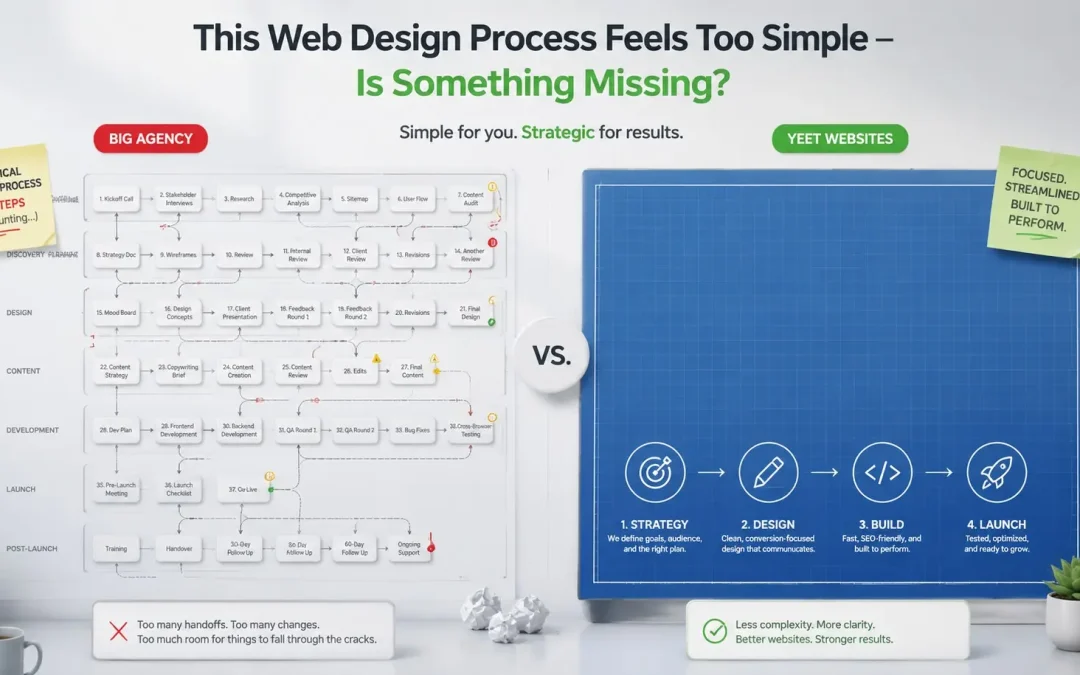
Post Summary: A Process With Nothing for You to Do Feels Like a Missing Step
Simplicity triggers suspicion, not relief. Someone who has spent a career working through complicated processes does not read a simple one as an upgrade. They read it as something that got left out.
A guy who builds outdoor structures, from a shed up to something the size of a large storage unit, sat across from us and heard the whole process. Then he stopped and asked whether we really take care of everything. We told him yeah, that’s it, we take care of everything, and he just kept looking at us.
He builds from plans, step by step by step, so when something does not have forty steps his mind goes looking for the one that is missing. He had come from a very complicated process where he kept being told he could do this or that. His position was that he does what he does and he does not want to have to deal with websites. The angst is the part we take care of, not the website.
He never made a speech about it. He just didn’t leave. That is what it looks like when a process is simple enough that the client stops thinking about it. If a process feels like something is missing, the question worth asking is which of the forty steps are there for you and which are there for the company.
A Builder Hears the Whole Process
We were sitting face to face with a guy who builds outdoor structures, everything from a shed to something the size of a large storage unit. He’d been through the whole conversation. Heard the process. And the look on his face was disbelief.
He said, “Hold on a minute, you mean you take care of everything?”
We let that sit. Frankly, it’s fun to do that sometimes, just let the client’s words sit and see if there’s anything else to say. So we’re looking at each other, face to face, and we said, “Yeah. That’s it. We take care of everything.”
He didn’t say anything else. He just kept looking at us. The look of disbelief was beautiful.
A Sequential Mind Looking for the Missing Step
He was suspicious. That’s the part people don’t expect, that simplicity triggers suspicion, not relief. When you’ve been through complicated processes your whole career, a simple one doesn’t feel like an upgrade. It feels like something got left out.
He’s a detailed kind of guy. Most builders are. You start from plans, or if you’re so good, you don’t even need plans, and you go step by step by step until the thing is done. A sequential kind of mind. So when something doesn’t have forty steps, that mind starts looking for the step that’s missing.
He was expecting more on his end. The old company, they’d say “you can do this or that.” And he didn’t like the this or that. His position was simple: “I do what I do and I don’t want to have to deal with websites.”
That’s the angst we take care of. Not the website, the angst. The feeling that you’re supposed to be involved in something you didn’t sign up to manage.
He Just Didn’t Leave
He came from a company where it was a very complicated process. And when the suspicion cleared, when it lined up with his thought process and he realized nothing was missing, he didn’t make a speech about it.
He never said, “Man, you guys are so awesome because of this, this, and that.”
He just didn’t leave.
That’s what it looks like when the process is simple enough that the client stops thinking about the process. There’s no moment where they announce it. No review. No big statement. They just stay. And the staying is the proof, quieter than a testimonial, more honest than anything they’d put in writing.
If you’re looking at a process right now and it feels like something’s missing, that feeling makes sense. Every other company taught you to expect more steps. But more steps don’t mean more care. Sometimes they just mean more of your time. And sometimes the simplest version is the one where someone looked at the forty steps and asked which ones were there for you and which ones were there for them.