
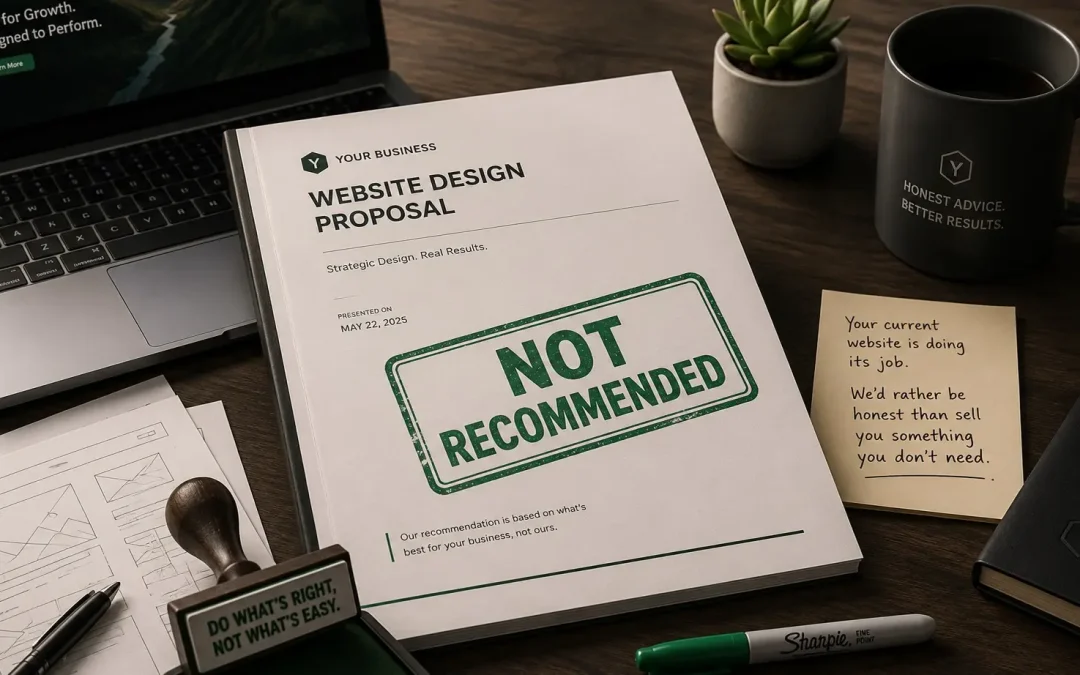
Post Summary: Turning Down a Sale Is How This Web Design Company Proves It’s Honest
A web design company that tells a prospect they don’t need to switch, even when it costs the sale, is showing you exactly how it operates when nobody’s forcing it to. This plays out two ways in practice: a tattoo parlor owner was told his current site was fine and didn’t need replacing, and a plumber who kept pushing for reassurance finally got a flat statement instead of another pitch. Neither conversation ended in a hard sell. One lost the business, the other kept it, and both people walked away trusting what they’d heard.
The plumber went back and forth for several rounds before hearing, “If I haven’t communicated to you at this point that I’m going to do right by you, there’s nothing else I can give you.” He signed up on the spot.
The rest of the post explains why honesty from a stranger triggers suspicion instead of relief, and what it takes for someone to trust it anyway.
Why a $20-a-Month Difference Wasn’t Worth Switching Over
The owner of a tattoo parlor asked us if he needed a new website. He’d gone through everything with us, his current setup, what he was paying, what he wanted. He was spending maybe $10 or $20 more a month than what we charge. The site was structurally fine. Good service on his end. Nothing broken.
So we told him he didn’t need a new website.
He was surprised. Not angry. Not relieved. Just, quiet. The kind of quiet that happens when someone hears something on a sales call that doesn’t match anything they’ve heard before. For $20 a month, it’s not worth changing unless there’s something wrong. There wasn’t. So we said so.
He didn’t sign up. We made a friend in the process, and we’ll probably never talk to that person again. That’s fine. But that person knows, he knows, that honest salespeople exist. And that’s worth something.
If you’ve been on the other end of a call like that, you know what the quiet feels like. You’re not sure what just happened. You’re waiting for the catch. Here’s what’s going on underneath it, and why that reaction makes complete sense.
They Think There’s a Problem
When we’re straight with someone about what they need and what they don’t, when we lay the whole thing out and nothing is hidden, the most common reaction isn’t relief. It’s suspicion.
They’re waiting for the part where it stops making sense. The part where the nice-sounding explanation turns into a contract clause or an upcharge they didn’t see coming. They’ve been through this before. Every time someone sounded this clear, something was missing.
There is no catch. But telling someone that and having them believe it are two completely different things.
Emotionally, it is hard for them to digest. Not intellectually, the math makes sense. They can see the breakdown, the transparency, the line items. But emotionally? They’ve been hearing whatever it takes to close the deal their entire life. Every company they’ve ever talked to told them what they needed to hear in order to sign. And now someone’s telling them something that sounds too good, and emotionally they just don’t trust that what I’m saying is true.
And that sucks.
Not because it’s an obstacle. Because it means every sales call they’ve ever been on trained them to expect a lie. That’s the real damage, not the bad website they got, not the overcharge. The damage is that a stranger can’t tell them the truth anymore without triggering a defense mechanism they didn’t even know they built.
The Moment It Breaks
A plumber went back and forth with us for several rounds. He asked for more stuff. We delivered. He asked again. We went above and beyond explaining our simple process. And at some point, the back-and-forth stopped being about information and started being about trust, he wasn’t asking because he needed more answers. He was asking because he didn’t believe the ones he already had.
So we said it plain.
If I haven’t communicated to you at this point that I’m going to do right by you, there’s nothing else I can give you.
Quiet again. That same quiet from the tattoo parlor, the pause where someone is recalibrating what just happened. No pitch after it. No discount. No “let me throw this in.” Just the truth, sitting there.
He said, “You’re right.” And he signed up right then and there.
That’s what the moment looks like when someone decides to trust what they’re hearing instead of what they’ve been trained to expect. It’s not dramatic. It’s not a big emotional scene. It’s a quiet shift, the same quiet that made the tattoo parlor owner pause, the same quiet that sits under the pricing conversation when the number is lower than it should be.
It is so rare that honesty costs deals. And who cares if it does? If honesty costs a deal, that means that deal wasn’t a deal, and it wasn’t in someone else’s best interest. The tattoo parlor owner didn’t need a new website. The plumber needed to hear something real. Both of them got it.
If you’re sitting on the other end of a call right now, waiting for the catch, there isn’t one. But we get why you’re looking.