
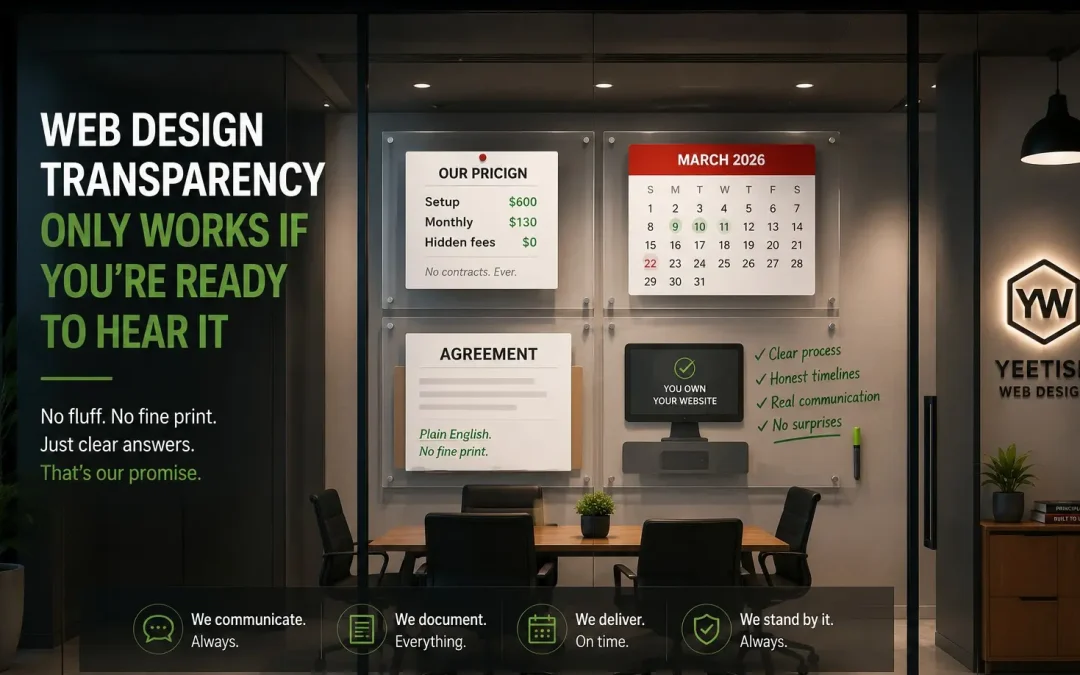
Post Summary: Showing Pricing Up Front Doesn’t Win Everyone
Laying out the numbers, the steps, and the way out before anyone commits does not settle the question. It sorts people. Some arrive with the answer already decided by whatever happened last time, and nothing shown to them moves it. One stump grinding company saw the whole thing and stayed where they were. A hair salon owner recognized what she was looking at immediately and came over.
She put it in one line: “I don’t mind being overcharged. I mind being lied to.” What she had been missing was not a better price. It was an explanation she could follow.
Below: how to tell the real thing from the performance of it, and why that shows up before any money changes hands.
Prospects Are Trained to Look for the Catch
The first thing you hear is the pause. Then it comes, “All right, what’s the catch?” Or some version of it. “This is obviously too good to be true.” “Where do you upcharge?” We hear these on calls all the time. It’s hard to imagine things can be this simple, and that’s why we created yeetish, our way of communicating.
Someone asking where the catch is has been trained to look for one, which is what our version of too honest keeps running into.
Not because the skepticism is fun to fight, but because of where that instinct comes from. For some reason when something is cheaper it doesn’t feel right. They’ve been through something. And the fact that our process, pricing visible, no contracts, plain language, creates confusion instead of comfort tells you everything about what they came from.
The Company That Saw Everything and Said No
We talked to a landscaping company a while back. Focused on stump grinding, that kind of thing. Good business, real people, and they needed help with their site. We walked them through everything, what it costs, how it works, what happens if they want to leave.
They didn’t buy it.
Not the pricing, not the process, not the “no contracts” part. None of it. Whatever had happened before had already settled the question, and by the time they got to us the distrust was baked in. It didn’t matter what we showed them. Sometimes you cannot overcome the distrust that people have.
We looked that lead up again recently and they’re still with the same company they had before. We know what they’re paying, because they told us. It’s a lot. The site has problems that are visible from the outside. You can’t win them all.
It’s a bummer when you know you can really help someone. But that’s the thing about fear, the bad thing I know is better than the maybe-good thing I don’t. That’s not a business problem. That’s a human one. And sometimes you just can’t get past it.
The Hair Salon That Named It
Then there’s the other side. A hair salon owner came to us after one company and then another, each giving her a different answer to the same question. She knew exactly what was happening, she just couldn’t prove it.
“I don’t like it when they do that. And I know when they’re doing it. I just can’t put my finger on exactly what it is they’re doing and saying.”
Think about that for a second. She realized she was being tricked, but she didn’t know how. That’s kind of a scary thing if you think about it, someone knows the ground is shifting under them and they can’t point to the crack.
Mike Myatt, a leadership advisor to Fortune 500 CEOs and the founder of N2Growth, calls this “sales by confusion”:
“At one time or another we’ve all fallen prey to a sales presentation that was so impressively sophisticated we incorrectly drew the conclusion, ‘they must really know their stuff.’ Regrettably, we all know how that story ends. Remember, if someone can’t explain the benefits to you in plain English, then the benefits probably don’t exist. The best sales professionals communicate in clear and succinct statements, which are factually based, and add value. They are never vague or ambiguous.”
— Mike Myatt, Founder & Chairman, N2Growth. Source: n2growth.com
The explanations never resolved into anything she could hold on to. What she told us was the clearest version of it we’ve heard:
“I don’t mind being overcharged. I mind being lied to.”
That’s the line. That’s what a prospect sounds like when they’ve been in a relationship built on confusion long enough to name the real problem. She didn’t come to us because we were cheaper. She came because she could understand what we were saying. Which is exactly why our web design process is too simple. The old KISS acronym. It’s how LIFE should be.
If that sounds familiar, we’re not hard to find.
There’s a Limit to What Can Be Shown
If you’re reading this and you’re not sure whether we’re the real deal or if a boutique web designer can be reliable, fair. We can show you the work. We can show you the pricing. We can show you the contracts, which is a short conversation because there aren’t any.
But at some point, the only thing left is to move forward and see exactly why being a client is better than a customer. We have clients here, not customers. We can’t prove trust in advance. Nobody can. What we can do is make sure nothing is hidden before you decide.
That landscaping company is still out there paying too much for a site that isn’t working. The hair salon owner is with us. The difference wasn’t the offer. It was whether the person on the other end was ready to believe something could be this simple.
Frequently Asked Questions
How do I know a web design company is being transparent and not just performing transparency?
You look at what they show you before you’ve signed anything. Real transparency doesn’t start after the sale, it’s the thing that makes the sale uncomfortable. If you can see the pricing, the process, and the exit terms before you commit, and none of it is buried in fine print or explained in circles, that’s not a performance. It’s the difference between fear based and confidence based. Fear and confidence are two different ways to run a client relationship. We aim for the second.