
Post Summary: Below a Certain Number There Isn’t Enough Work in the Month
Expect somewhere between $750 and $3,000 a month for content, links, and strategy that are genuinely being produced. The floor exists because fewer hours than that cannot move anything. The ceiling exists because past it you are funding scale or overhead rather than better output. Three tiers cover the span: local strategy and a post a month at the bottom, regional reach and competitive analysis in the middle, weekly content and deeper link work at the top.
One analysis found every backlink for a client tracing to the same network of manufactured sites, while the calls he attributed to search were arriving through a paid campaign nobody had separated out for him. That arrangement ran him $48,000 a year.
Below: the three situations where we say it isn’t the right spend, why a higher link count can leave you worse off, and what separates link work that holds up from the kind that collapses.
It Was Costing Him $48,000 a Year
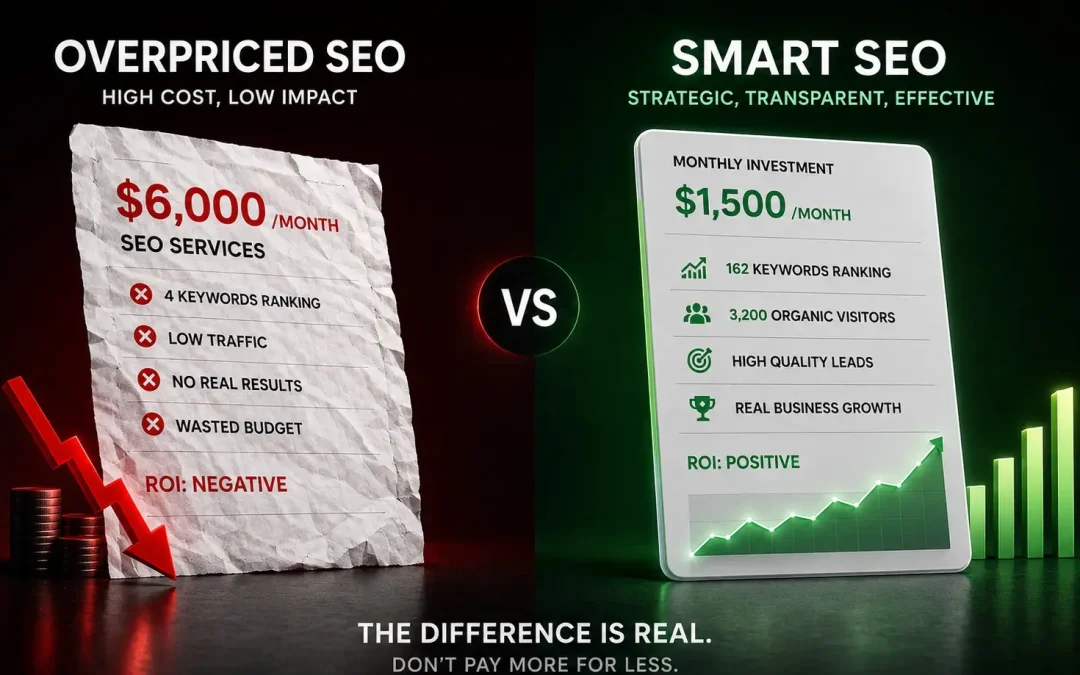
A business owner told us he was paying close to $4,000 a month for SEO. For that money, he was getting exactly four keywords. That’s a case where it’s very good to question whether SEO is worth it for your small business. When we ran an analysis on the links his agency was building, every single one came from a PBN, a private blog network, which is essentially a collection of fake websites created solely to manipulate search rankings.
The calls were coming in, though. He thought the SEO was working. But when we dug deeper, the calls were coming from Google Ads, not organic search. Paid ads were running alongside the SEO work, and nothing in the reporting separated the two. The arrangement was costing him $48,000 a year.
That story is why we built our SEO pricing the way we did, transparent, tiered, and built around what we can deliver without cutting corners.
What SEO Should Cost
There’s no universal answer, but there is a realistic range. For small businesses working with a company that does the work properly, real content, real links, real strategy, you’re looking at $750 to $3,000 a month depending on how aggressive you want to be and how competitive your market is.
Below $750, it’s nearly impossible to deliver meaningful results. Above $3,000, you’re typically paying for enterprise-level campaigns or bloated agency overhead. The sweet spot for most small businesses falls somewhere in between.
| Feature | Starter, $750/mo | Growth, $1,500/mo | Domination, $2,750/mo |
|---|---|---|---|
| SEO Strategy | Local | Local + Regional | Local + Regional (Comprehensive) |
| Blog Content | 1 post/month | 2 posts/month | Weekly posts |
| Link Building | Niche-relevant links | Strategic niche links | Advanced PR outreach + high-authority placements |
| Google Business Profile | Updated + monitored | Enhanced management + posting | Premium optimization |
| Technical SEO | — | Content optimization | Full audits + fixes + conversion optimization |
| Competitive Analysis | — | ✓ | ✓ + Quarterly strategy sessions |
| Reports | Monthly | Monthly | Monthly + priority support |
| Contracts | None, cancel anytime | None, cancel anytime | None, cancel anytime |
Every link we build across all three tiers is niche-relevant. If you’re a plumber, you’re not getting a link from a boat website just because it has a high domain authority. Quality over quantity, links that help, not hurt.
Want to see where your investment would land? Our SEO cost calculator gives you a ballpark based on your industry and goals.
Why We Set the Floor at $750
We tried to make it accessible enough that most businesses can afford it, but high enough that we know we can make a difference. At $750, results take longer than at $2,750, that’s just the math of how much work gets done each month. But $750 of real SEO is infinitely better than nothing, and a lot of business owners can’t do this themselves. Understanding what SEO involves for a small business, the content, the links, the technical work, makes it easier to see why the floor exists where it does.
What we can’t do below that number is deliver any reasonable expectation of success. And that’s the standard we hold ourselves to, if we can’t move the needle, we won’t take your money. At $200 a month there isn’t room for much beyond an automated report and a few directory submissions. That’s a recurring charge more than a service.
When We Tell People SEO Isn’t Worth It
Not every business needs SEO right now, and we’ll tell you that upfront. There are three situations where we have that conversation:
The first is budget. If you can’t afford the minimum and sustain it for at least six months, the money is better spent elsewhere. SEO is a long game, and underfunding it means you’ll pay for months without seeing enough return to justify the investment.
The second is expectations. If you’re in a brutally competitive industry, lawyers, plumbers in major metros, and you have a brand-new website expecting page-one results in month one, that’s not realistic. We’ll have the hard conversation about timelines, and if that’s not received well, we part ways on good terms. Unrealistic expectations are a recipe for frustration on both sides.
The third is when advertising makes more sense. Some businesses need leads tomorrow, not six months from now. In those cases, paid advertising gets you in front of people immediately while SEO builds in the background. We’d rather point you in the right direction than sell you something that doesn’t match your timeline.
Why More Links Is the Wrong Goal
The count is not what matters. Where each one comes from is.
A link works when the site giving it has something to do with yours. A plumbing company with links from a fashion blog and a cryptocurrency forum has a higher number and a worse profile, because the pattern reads as manipulation rather than reputation. Bad links do more damage than no links at all.
What gets optimized for, when the goal is volume, is the authority score of the source rather than its relevance, because the score is the part that shows up on a report.
The Nobel Committee described this exact dynamic when awarding the 2001 Prize in Economics to researchers who proved what happens in markets where the buyer can’t evaluate quality:
“Akerlof showed that informational asymmetries can give rise to adverse selection on markets. Due to imperfect information on the part of lenders or prospective car buyers, borrowers with weak repayment prospects or sellers of low-quality cars crowd out everyone else from the market.”
— The Nobel Committee, 2001 Prize in Economic Sciences. Source: nobelprize.org
Sources matter more than volume for a practical reason: cheap links come from places built to sell them. Private blog networks are collections of sites created for that purpose, and search engines devalue them in batches, which takes every site linked from them down together. The same goes for bulk packages, five hundred links for twenty dollars, where the domains are months old and will be gone within the year.
The approach that holds up is slow, deliberate, and boring. Relevant links from real sites in your industry, built over time. That’s what every tier above is doing. If you can’t get a straight answer about where your links come from and why those sources fit your business, that’s the question worth pressing on.
What Good SEO Work Looks Like
Good SEO isn’t flashy. You won’t see dramatic overnight results, because the process doesn’t produce them. What you will see is a steady climb, better rankings for terms that matter to your business, more organic traffic from people who are searching for what you sell, and eventually more calls and form submissions from people who found you on Google without you paying for an ad.
The work behind that looks like content that answers real questions your customers are asking, technical fixes that help Google understand and trust your site, and links from relevant sources that tell Google your business is legitimate and respected in your space.
It’s not magic. It’s consistent, skilled work done over months. And it’s worth paying for, as long as you know what you’re paying for.
If you’re not sure whether the spend is producing anything, reach out and we’ll tell you where you stand. Once you know what the right investment looks like, the next step is finding a provider who backs it up with real work, or just reach out and we’ll give you a straight answer about where you stand.
Frequently Asked Questions
How much should a small business pay for SEO per month?
Somewhere between $750 and $3,000 a month, set by how competitive the market is and how fast you want to move. Under $750 there aren’t enough hours in the month to show for it. Over $3,000 you’re usually paying for size rather than sharper work.
Why is SEO so expensive?
Because it requires skilled human work done consistently over months. Content has to be written, links have to be earned from real websites, technical issues have to be identified and fixed, and strategy has to adapt as your market changes. Cheap SEO cuts corners on all of these, usually by automating what should be manual and buying links from sources that will eventually hurt your site.
How long does SEO take to show results?
Most businesses start seeing measurable improvements in three to six months, with significant results at six to twelve months. Competitive industries take longer. A 30-day promise to page one usually means either terms nobody searches or tactics that backfire.
Can I do SEO myself instead of paying someone?
You can handle basics, claiming your Google Business Profile, writing blog posts, keeping your site updated. But technical SEO, link building, competitive analysis, and ongoing strategy require expertise and tools most business owners don’t have time to learn. If you have 10-15 hours a week to dedicate to it, you can make progress. Most business owners don’t.
What’s the difference between cheap SEO and quality SEO?
Cheap SEO gives you automated reports, directory submissions, and links from irrelevant or spammy sites. Quality SEO gives you hand-written content targeting real search terms, niche-relevant links from legitimate websites, and a strategy that adapts to your competitive landscape. The difference shows up in your rankings, your traffic quality, and whether the work helps or hurts long-term.
How do I know if my current SEO company is doing a good job?
Ask them three questions: Where are my links coming from? What keywords am I ranking for that I wasn’t before? Can you show me the actual work you did this month? If they can’t give you clear, specific answers to all three, you have a problem. Good SEO providers show their work, transparently and consistently.
Do you require SEO contracts?
No. All three of our SEO tiers are month-to-month with no contracts. If we’re not delivering value, you can cancel anytime. We keep clients by earning their business every month, not by locking them in.