
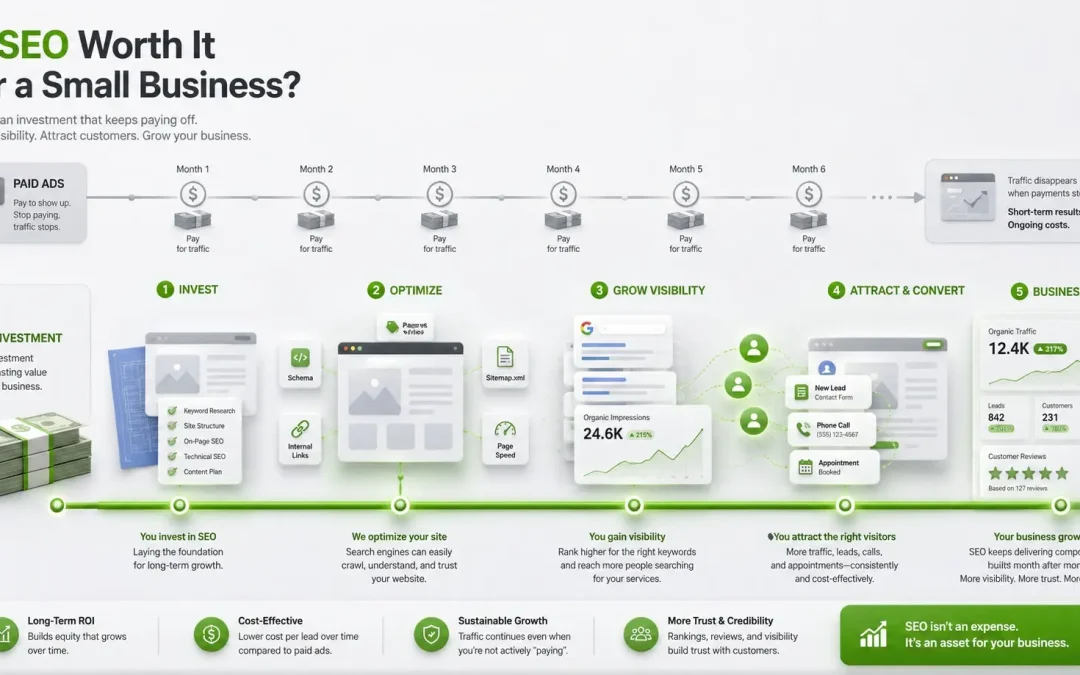
Post Summary: The Question Is Whether You’ll Let Competitors Fill the Space You Leave Empty
SEO is worth your money if you’re in a market and you want to grow. AI is about to make the field crowded, because content that used to take a week takes an afternoon, and the barrier to entry just dropped. If you have good quality stuff you will crush them, because Google recognizes it and volume without substance doesn’t hold. If you have nothing, even low quality stuff is better than nothing.
Walking away is the right call when you don’t want to grow. Full pipeline, business where you want it, not chasing new clients, save the money.
The catch is timing. SEO doesn’t switch off the way Google Ads does, but it slows down, authority fades, rankings drift, and the competitors who kept going end up in the spots you used to own. Wait six months and people start catching up. Wait a year and you’re likely left in the dust.
Whether the spend makes sense comes down to what a client is worth to you. Not the first invoice: a $200 leak call turns into an $850 backup 18 months later, and a $495 HVAC tune-up turns into a $20,000 system the next summer. The entry-level package is $750 a month, so one client a month worth five grand doesn’t need a calculator, while garage cleanouts at two or three hundred a job with low search intent and two or three jobs a month doesn’t pencil.
Four questions settle it. Brand play or money play. What a client is worth over 24 months. How many new clients per month it takes to cover the cost. And whether standing still in your market means falling behind.
Someone Told You SEO Is the Move
You’re sitting on a decision. You’ve got a website, maybe it’s decent, maybe it needs work, and someone’s told you that SEO is the move. That it’ll bring in leads, grow your business, put you on the map. And maybe that’s true. But you’ve also heard the other side. The six-month timelines. The monthly invoices. The reports full of charts that don’t translate into phone calls.
So now you’re doing what any smart business owner does before spending money they can’t get back. You’re weighing it.
Good.
Because whether SEO is worth it for a small business isn’t a yes-or-no answer. It depends on what you sell, what a client is worth to you over time, how competitive your market is, and whether you’re playing for revenue or playing for brand. Those are different plays with different math, and we walk you through the difference. And if the math doesn’t work, we’ll tell you that too.
When SEO Is Worth Every Dollar, and When You Should Walk Away
SEO is worth your money if you’re in a market and you want to grow. That’s the short answer. But there’s a layer underneath it that matters more right now than it did two years ago.
With AI, your competition is going to be pumping out posts and doing stuff because it’s so much easier. Content that used to take a week takes an afternoon. Pages that didn’t exist six months ago are showing up in search results. The barrier to entry just dropped, which means the field is about to get crowded in a way it hasn’t been before.
But here’s what that also means: if you have good quality stuff, you will crush them because Google is going to recognize it. Volume without substance doesn’t hold. It never has. But especially now, when the volume is about to spike, the businesses that invest in quality content, pages built around real expertise, real client work, real answers, are the ones that pull ahead. And if you have nothing? Even low quality stuff is better than nothing.
So the question isn’t whether SEO works. It’s whether you’re willing to let your competitors fill the space you’re leaving empty.
Now, when should you walk away? When you don’t want to grow. If the business is where you want it to be, if your pipeline is full, if you’re not chasing new clients, then SEO doesn’t serve you. Save the money.
The catch is timing.
You wait six months and people are starting to catch up. You wait a year and you’re likely left in the dust. SEO doesn’t turn off immediately the way Google Ads does, you don’t lose everything overnight. But it slows down. Authority fades. Rankings drift. And the competitors who kept going are now sitting in the spots you used to own.
You want to stay relevant in the minds of the internet. That means either you have an internal marketing department handling it, or you hire an outside source to take care of it for you. The point is that someone is doing it. Because if no one is, the window doesn’t stay open forever.
The Real Math on Whether SEO Is Worth It for Small Business
Here’s what the math looks like when you sit down and do it with a pen.
Start with one question: what is the value of each client you bring in?
Not theoretically. Not on average across the industry. What is a client worth to your business? That number is the entire foundation of this decision.
Take lawyers. One settlement can fund SEO for three years. The math is so lopsided it barely needs a conversation. On the other end, if you’re selling a couple hundred dollar handbag online, maybe SEO doesn’t make the most sense. The margins are tighter, the search competition is broader, and the return per customer doesn’t give you much room to invest in the months it takes for SEO to build.
Our entry-level SEO package is $750 a month. If you can get one client a month that brings in five grand, you don’t need a calculator to figure out whether or not that’s a good deal.
But what if you’re doing garage cleanouts on the side and you’re making two, three hundred dollars on each job? And it’s a low search intent, not a lot of people Googling that. And there’s a bunch of people doing it in your area. And you’re lucky to land two or three a month. That doesn’t really pencil that well. The spend doesn’t match the return, and no amount of SEO craft changes the underlying economics.
We ask whether the math supports it before we take anyone on. We’d rather lose the sale than take money from a business where the numbers don’t work.
Brand Play vs. Money Play
Before you spend a dollar on SEO, you need to answer one question for yourself: is this a brand play, or is this a money play?
Those are two different plays. You can’t evaluate them the same way.
A brand play is about awareness. You’re trying to pump your brand, get your name in front of people, build recognition, establish authority in your market. That’s a long game. Brand is not going to make you money immediately. It takes a long time to build a brand. The ROI is real, but it’s measured in years, not months, and it shows up in pricing power before it shows up in lead volume.
Think cooler versus Yeti. Same product category. But great brands demand a two to three hundred percent markup on their products. That didn’t happen in a quarter. It happened over years of people seeing the name, trusting the name, and being willing to pay more because of what the name represents.
A money play is different. You want leads. You want the phone to ring. You want clients walking in the door because they found you on Google, and you want the revenue from those clients to outpace what you’re spending on SEO. That’s measurable. That’s monthly. And that’s where the math from the last section applies directly.
Most small business owners are making a money play. That’s why people do SEO, to make money. And that’s fine. But if you’re making a money play and your SEO company is selling you a brand strategy, the timelines and expectations are going to be misaligned from day one. Know which play you’re running before you sign anything.
What a Client Is Worth Over 24 Months
This is where most business owners undercount, and where the SEO math changes completely.
A plumber gets called on a leak. Fixes it. Charges $200. The novice looks at that and says, “That’s a $200 client.”
But reality doesn’t stop at the first invoice.
Nine months later, 18 months later, 24 months later, there’s a major problem. Plumbing is backing up. $850 job. Now that $200 plus $850 is $1,050 over 24 months. That’s a lot different than $200 over 24 months.
Or that second job could be $5,000. You don’t know. But the pattern holds: the first call is rarely the last call.
Now think HVAC. Customer has an issue with their heater. Gets it tuned up for $495. Next summer, they need a whole new system. $20,000. That’s a $20,495 client over 24 months. That takes care of a lot of marketing.
The mistake is measuring SEO value against the first transaction. The real number is the lifetime value, what that client is worth over months and years of repeat work, referrals, and bigger jobs. A lot of times, people will use you to test you out to see if you’re honest before they try you on something bigger. That first $200 call wasn’t the sale. It was the audition.
Once you know your 24-month client value, the SEO math gets simple. You’re spending X per month. If the clients SEO brings in are worth Y over two years, does it pencil? If it does, go. If it doesn’t, don’t. And if you’re not sure how to run that math, we can help you with that.
A Client Where the Numbers Worked
We’re rocking a roofer right now. Before we started, it didn’t make sense, the leads weren’t there, the visibility wasn’t there, and the spend felt like a gamble. Now he’s doing well. Three, four X what he’s paying, minimum. Just stacking clients, stacking jobs. We’re excited to see what this year is going to turn out for him.
What made his situation different? A few things.
First, niche links, not spammy links. The backlinks pointing to his site come from relevant, industry-specific sources. Not directories nobody visits. Not PBN garbage. Links that tell Google this business is connected to its industry in a real way. If you’ve been through an SEO engagement where the link report looked like a phone book of random domains, that’s the difference.
Second, specific pages. Not a million of them, but just enough so Google sees what a player is. Targeted content built around what his customers are searching for. Not a content farm. Not fifty blog posts about “top roofing tips.” Pages with purpose.
Third, and this is the X factor, adding a little bit of AdWords to get that phone ringing immediately. Because you start to see leads, you start to feel good about your marketing, and you don’t have to wait six to nine months to start crushing it. The money starts coming in while the SEO builds underneath. Ads don’t have to be super expensive. They just need to fill the gap between starting SEO and seeing organic results.
SEO is a major multiplier. When you add it with everything else, the site, the ads, the content, it’s a big win. But it’s the multiplier, not the whole equation.
The Framework Before You Spend a Dollar
If you’re weighing whether to invest in SEO right now and the budget is tight, here are the questions to answer for yourself.
One, is this a brand play or a money play? If it’s brand, understand that the timeline is long and the return isn’t measured in leads per month. If it’s money, and for most small businesses, it is, move to question two.
Two, what is your client worth over 24 months? Not the first job. The full relationship. The tune-up that turns into a system replacement. The leak that turns into a remodel referral. Count the whole arc.
Three, how many new clients per month does the SEO need to produce to cover the cost? If the answer is one, and your 24-month client value is five figures, you don’t need a spreadsheet. If the answer is fifteen, and each one is worth $150, the math is working against you.
Four, is your market competitive enough that standing still means falling behind? If your competitors are investing in content, in search visibility, in showing up where your customers are looking, doing nothing is its own decision.
That’s it. Four questions. If the answers point toward yes, SEO is worth it for your business. If they don’t, walk away. Save the money. Spend it where the math works.
We’d rather have that conversation with you upfront than cash a check every month knowing the numbers were never going to add up.
Frequently Asked Questions
How long before I see a return on SEO?
It depends on your market and what’s already in place, but most small businesses start seeing traction in three to six months. The results compound, month six looks different from month twelve. If someone promises page-one rankings in 30 days, that’s not SEO. That’s a sales pitch.
What happens to my rankings if I stop paying for SEO?
They don’t vanish overnight, it’s not like turning off an ad. The pages you built stay indexed and keep ranking for a while. What stops is the compounding: no new content, no new links, no fixes when something breaks. Competitors keep publishing into the space you stopped defending, and the drift shows up over months rather than weeks. If you need to pause, pause. Just know that restarting later means covering ground you already covered once.
What if my budget is only enough for one thing, SEO or a better website?
Start with the website. SEO built on a weak foundation doesn’t hold. Get the site right, fast, mobile-friendly, built around what your clients are looking for, and then layer SEO on top when the budget opens up. A great site with no SEO still converts the traffic it gets. SEO driving traffic to a bad site wastes the spend.
Is there a minimum budget for SEO to work?
There’s a floor below which you can’t do the kind of work that moves the needle, real content, real links, real strategy. Some companies will sell you a bare-minimum package, but what you’re getting at that price point is automated reports and not much else. The right budget depends on your client value and your market. If one new client covers the monthly cost three times over, the math works. If it takes ten clients to break even and the search volume isn’t there, it doesn’t.