
Post Summary: Vetting an SEO Provider Comes Down to Behavior, Not Location
Finding the right SEO services near you isn’t about picking the closest or cheapest option. Since results take six to nine months to show up, the only thing worth evaluating up front is behavior: whether the provider explains what they do in plain language, whether they sound rehearsed or genuinely confident, and whether an honest advocate or your own gut trusts them. Geography matters far less than it used to. What matters is whether the provider can write content that sounds like it actually comes from your city, not a generic template.
On a prospecting call, a business owner turned down an SEO pitch because he already had a provider his friends had vetted and gotten real results from. Rather than pushing the sale, the response was to tell him to stick with that provider, and years later he’s still doing well with that decision.
The rest of the post covers what a bad SEO provider actually costs you beyond the monthly fee, and how to think about geography when the content matters more than the zip code.
Why the Search Results Page Won’t Tell You Who’s Real
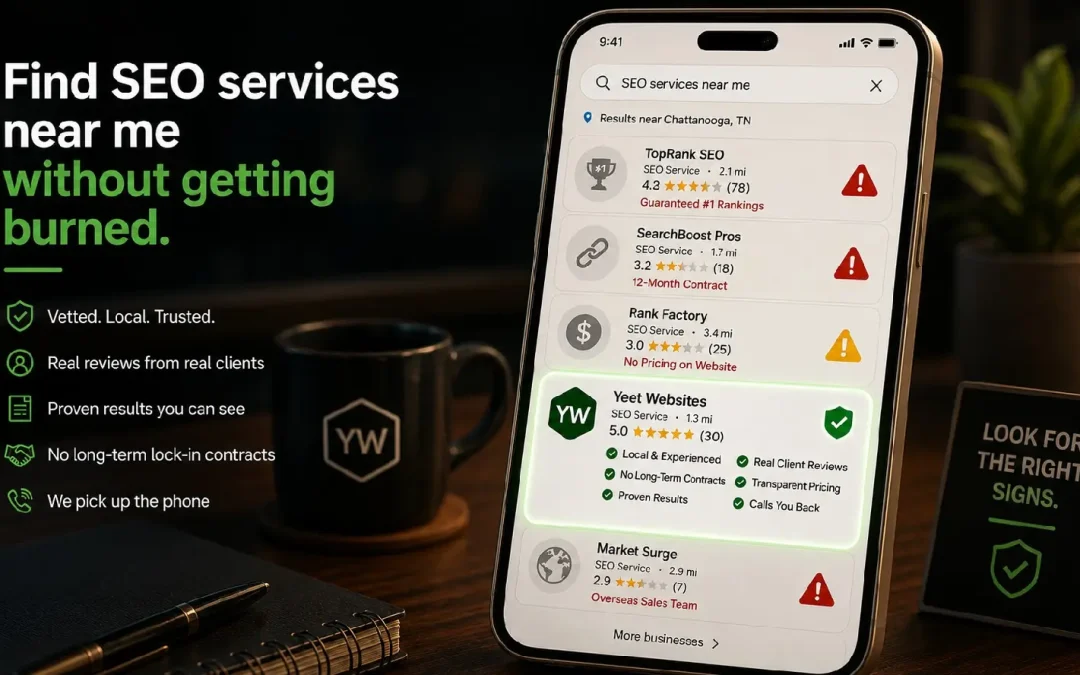
You open a new tab, type seo services near me, and hit enter. The results load. There are twelve of them above the fold, a couple of map pins, a few ads, some organic listings with star ratings that may or may not be real. One says $99/month. Another says “call for a custom quote,” which is code for more than you can afford. A third has a stock photo of a handshake and a headline that could apply to literally any company in any industry in any city on Earth.
You’re not comparing options yet. You’re standing at the entrance to a minefield and trying to figure out which direction to walk.
That’s what searching for SEO services for your small business feels like. The page is dense, the language is unfamiliar, and nothing about the experience tells you who’s real and who’s pretending. And the stakes, months of money, months of time, your entire search visibility, are sitting behind whichever link you click first.
This post is about what to look for before you click. Not the pitch. Not the portfolio. The stuff that separates a provider who moves the needle from one who charges and prays you don’t notice.
The Search Results Page Is Not Your Friend
When someone searches seo services near me, the results are going to be anything from local SEO services at $299 a month all the way up to “we are this and that and the other, call for pricing.” The spectrum is enormous, and there’s no filter built into the page to help you sort it.
Here’s what makes it worse: a lot of the providers on that page are fantastic. They’re good at what they do, they’re going to move the needle, and they’re going to deliver exactly what they say they can deliver. And then there are just as many who don’t really know what they’re doing, they’re just charging and praying that you don’t notice, and it’s going to be a disaster.
Both types show up on the same page. Both types have websites. Both types have testimonials. And if you’re not conscious of what you’re looking at, you can’t tell the difference between them from a search result alone.
The terminology doesn’t help either. There are so many terms people use, on-page, off-page, technical SEO, local SEO, link building, domain authority, content strategy, and there are so many questions a business owner wants to ask that are hard to answer if the person answering them isn’t making the effort to speak plainly.
That’s the first filter. If someone can’t explain what they do in words you understand, they either don’t understand it themselves or they don’t respect your time enough to try.
What to Look for in an SEO Provider
The obvious answer is results. Great rankings, more traffic, more leads. But you won’t know any of that for six to nine months, so that’s not the answer when you’re looking to hire a SEO services provider. Not when you’re standing in the decision and trying to figure out who to trust with your money before you’ve seen a single deliverable.
The real answer is behavior.
Do they communicate simply? Do you understand them? Do you believe them? Are they nervous? Are they talking fast like they’re trying to get through the pitch before you ask a hard question? Or are they talking slow and confident, like someone who’s done this enough times to not need the script?
If you’re a business owner, you’re already a studier of people, you just maybe don’t credit yourself with it. You’ve sat across from vendors, employees, partners, customers. You know when someone’s telling the truth. You can just tell. You know when someone’s confident versus performing confidence. You can tell that too.
Use your gut.
If you don’t have an advocate, someone in your circle who understands this space and can help you evaluate, use your gut. If you don’t trust your gut, who else is going to?
The advocate concept matters here. If you have someone, a friend, a business contact, someone whose judgment you respect, who can sit in on a call or review a proposal with you, get that advocate. Figure out what you need from that person before you start shopping. An informed second opinion is worth more than ten hours of Googling.
But if you don’t have one, your instincts about people are better than you think they are. Business taught you that. Trust it.
Gerd Gigerenzer, a psychologist and the director of the Center for Adaptive Behavior and Cognition at the Max Planck Institute for Human Development, spent decades studying how people make good decisions when the future is uncertain and the information is incomplete. In Gut Feelings: The Intelligence of the Unconscious, he described the tension between what the experts preach and what they practice:
“Can following your gut feelings lead to some of the best decisions? It seems naive, even ludicrous, to think so. For decades, books on rational decision making, as well as consulting firms, have preached ‘look before you leap’ and ‘analyze before you act.’ Pay attention. Be reflective, deliberate, and analytic. Survey all alternatives, list all pros and cons, and carefully weigh their utilities by their probabilities, preferably with the aid of a fancy statistical software package. Yet this scheme does not describe how actual people,including the authors of these books,reason.”
— Gerd Gigerenzer, Gut Feelings: The Intelligence of the Unconscious. Source: hadinur.net
The Prospecting Call That Ended in Thirty Seconds
Several years ago, we called a guy on a prospecting call. We were talking websites, and then we asked if he wanted SEO. He said, “Oh, I’ve already got a guy. He’s done my friends, my other friends, and they all have great results from it.”
Our response: awesome, go with him.
He said, “What?”
Then: “Well, you’re not even gonna try to sell me?”
Why would we? He had someone with a proven track record, vetted by four of his friends, in his own town. You’d be a fool to go with us. An absolute fool. Why would you take a gamble on someone you don’t know when there’s a sure thing in your backyard that’s already been vetted by people you trust?
We both laughed. Haven’t talked to that guy since. Based on what he told us, he’s doing well, and we’re happy for him.
That’s what a good SEO provider looks like from the outside. Not someone with the flashiest website or the most aggressive pitch. Someone whose clients’ friends already know the name. Someone with proof that doesn’t require a case study PDF, just a phone call to a buddy.
What the Wrong Provider Costs You
The wrong SEO provider will crush you.
That’s not an exaggeration. A bad provider can ruin your backlink profile, tank your domain authority, get your site penalized by Google, and leave you in a position that takes years to recover from. Sometimes the damage is permanent, not because it can’t be undone, but because the business can’t afford to wait another eighteen months to get back to where they were before the bad provider touched anything.
The money is the easy loss. A few thousand dollars gone, painful, but recoverable. The time is what kills you. Six months of bad work doesn’t just mean six wasted months. It means six months of falling behind while your competitors were building. When you finally start over with someone competent, you’re not starting from zero. You’re starting from behind zero.
That’s why the evaluation matters more than the price. A $750/month provider who does real work is cheaper than a $300/month provider who does nothing, because the $300 provider costs you the $300, plus the six months, plus the recovery work the next provider has to do to fix what was broken.
Does “SEO Services Near Me” Even Matter?
It’s mattering less and less.
“Near me” used to be a big signal. If you searched for something with “near me” in the query, Google leaned heavily on your physical location to decide what to show you. It still does to some extent, but the search landscape has shifted. Google is so sophisticated now, and all the LLMs, Claude, ChatGPT, Grok, Perplexity, are recommending services too. The entire internet is connected in a way that it’s never been connected before.
People still buy domains like plumbernearme.com and that still works, having the keyword as your business domain is still a thing. But it’ll work until it doesn’t. Everything about this space is changing almost weekly with large language models entering the recommendation game, and anyone building a strategy on a single signal is building on sand.
When it comes to geography, worry less about the “near me” part and worry more about unique content. The more you can reference landmarks in your city, specific things that only people in your area would understand, neighborhoods, local phrases, little turns of expression that only the locals know, the more Google recognizes that your content is rooted in that place.
Google knows about all those things. It knows your neighborhoods. It knows your landmarks. It knows whether your content sounds like someone who lives there or someone who Googled the zip code.
Tacking “near me” at the end of every single line? That’s lazy. Landmarks, neighborhoods, the little cool turns of phrase that only the locals know, that’s where the magic juice is and the great SEO companies will tell you in a honest, Yeetish way so you feel good about the answer and understand the strategy.
How to Think About Geography When Hiring for SEO
Here’s the practical application. If you’re a plumber in Chattanooga, the question isn’t whether your SEO provider is also in Chattanooga. The question is whether they understand how to create content that sounds like it came from someone in Chattanooga, or whether they’re going to produce the same generic “we serve the greater metro area” copy that every template provider churns out.
A good SEO provider in another state who writes content grounded in your actual market is worth more than a local provider who uses the same boilerplate for every client. Geography matters for the content. It doesn’t necessarily matter for the provider.
That said, there’s something to be said for being able to pick up the phone and talk to someone who gets your market without a briefing document. If a provider already knows your city, the neighborhoods that convert, the competitors who dominate the map pack, the seasonal patterns that affect search volume, that’s a head start. But it’s a head start, not a requirement.
The requirement is competence. The requirement is communication. The requirement is someone who does real work and tells you the truth about what it’s producing. Where they sit while they do it matters less than whether they do it at all.
Frequently Asked Questions
How long before I know if my SEO provider is working?
Six to nine months is the honest window. Anyone who promises results in thirty days is either lying or redefining what “results” means. Real SEO, the kind that builds sustainable traffic, takes time because Google takes time. You’ll see early signals before six months (indexing improvements, ranking movement on lower-competition terms), but meaningful business impact takes two to three quarters.
Should I hire a local SEO company or does it not matter?
It matters less than you think. What matters is whether the provider understands your market, your neighborhoods, your competitors, your customer base. A provider across the country who writes content grounded in your actual city will outperform a local provider who uses the same template for every client. Local is a convenience, not a qualification.
What’s the biggest red flag when talking to an SEO provider?
They can’t explain what they do in plain English. If the first call is a wall of jargon, domain authority, link velocity, crawl budget, semantic indexing, and you walk away confused, that’s not a knowledge gap on your end. That’s a communication failure on theirs. The best providers make it simple because they’ve done it long enough to not need the complicated version.
What should I ask an SEO provider before hiring them?
Ask them to show you a link report from a current client. Not a case study they built for their website, an actual report. Ask what a backlink from their work looks like. Ask where the content comes from. Ask how they’ll communicate with you monthly and what you’ll receive. If they get vague on any of those, that’s your answer.
Is $99/month SEO worth it?
At that price point, you’re paying for a dashboard, not a service. Real SEO, link building, original content, technical audits, ongoing optimization, requires hours of skilled work every month. That doesn’t happen at $99. If the budget is tight, it’s better to save until you can afford a provider who does real work than to spend $99/month for a year and end up exactly where you started.
The search results page for seo services near me is not your friend. But your instincts are. Trust them, find the advocate if you can, and don’t hand your money to anyone who can’t explain what they’re going to do with it.