
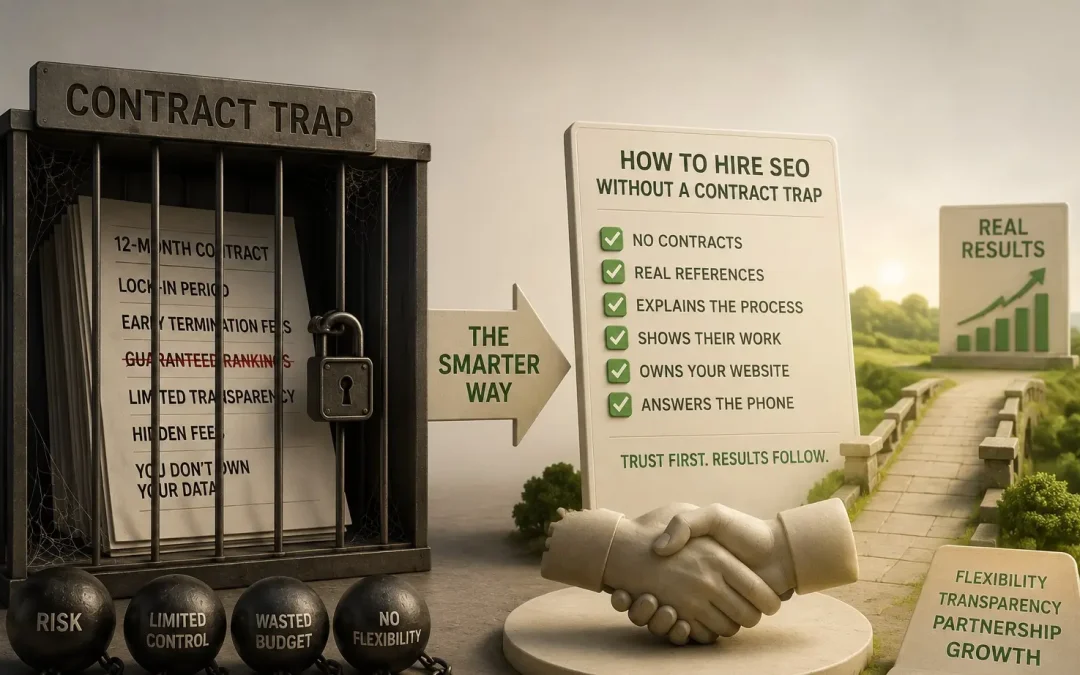
Post Summary: You’re Deciding on Trust Before They’ve Earned Any
The gap between a company that knows what it’s doing and a company that knows how to sound like it is almost invisible from the outside. The proposals look similar. The promises sound the same. And if you’re not technical, you’re making the decision on trust before they’ve done anything to earn it.
Start with the website. Is the pricing published, and is it clear, or is it buried behind schedule-a-call buttons designed to get you on the phone before you know what anything costs? Then get on a call, because this is a long-term working relationship and you need to feel comfortable talking to them. Nobody can hand you real answers on that first call, there’s too much to check: your backlink profile, your competitors, your content, your technical health, your local market. Our turnaround for coming back with something real is 24 to 48 hours.
We don’t have contracts. If we’re doing a bad job, or if you don’t like us, or if we’re doing a great job and you just want to cut ties, bye. Where results take months, the one thing a term agreement guarantees is the payment schedule, and if the work is good enough to keep you, no document is needed to hold you there. An appliance service company in Delaware County was getting calls and clicks, but the leads were coming in from 300 and 400 miles away, and they were tens of thousands of dollars in the red before they got out. Walking away in month two would have saved all of it.
You don’t have to learn SEO to protect yourself. In every family there’s somebody who knows something about the internet, and that person probably knows someone more technical. Get them on the meeting, or at minimum get the proposal in front of them before you sign. If a company gets defensive when that person shows up, that tells you everything.
One question does most of the sorting: say “sell me SEO.” Someone who starts pitching deliverables and packages and timelines before asking about your business, your market, and your goals is reading from a script.
The Wrong Hire Costs Time You Can’t Get Back
Hiring an SEO company is one of the easiest ways to waste money in marketing. Not because SEO doesn’t work, but because the gap between a company that knows what it’s doing and a company that knows how to sound like it knows what it’s doing is almost invisible from the outside. The proposals look similar. The promises sound the same. And if you’re not technical, you’re making a decision based on trust before they’ve had a chance to earn any.
That’s the part nobody warns you about. You’re not just buying a service. You’re entering a working relationship, one that’s going to last months, maybe years. The wrong hire doesn’t just cost you money. It costs you time you can’t get back, rankings you never built, and leads that went to your competitors while you were waiting for results that were never coming.
How to Hire SEO Services, Step by Step
If a friend called and said they were about to hire an SEO company, here’s exactly how we’d walk them through it.
First, visit the website. Is there pricing on their website? Number one. If it’s listed, great, is it clear? Does it make sense? Or is it buried behind “schedule a call” buttons designed to get you on the phone before you know what anything costs? A company that publishes pricing is telling you something about how they operate. A company that hides it is telling you something too. If you’re starting your search for SEO services, the pricing page is the first filter.
Second, talk to them. This is a close, long-term working relationship. You need to be able to talk to them and feel comfortable talking to them. Set an appointment. Call them up. Get on a call and see how it feels.
But here’s the filter most people miss: if they try to sell you immediately, walk away.
SEO is not something you can pitch on the fly. It’s not like a website where someone can pull up your site on a screen share and walk you through what they’d change. For SEO, there’s too much to check, your backlink profile, your competitors, your content, your technical health, your local market. None of that happens in a cold call. And if they’re trying to close you before they’ve looked at any of it, why are they so desperate? That’s what I would be asking.
A legitimate company will do an intro call, figure out who you are, what you need, what your goals look like. But they’re not going to be able to give you any real information right then, and you shouldn’t expect it. They’ve got to do the research, and that’s totally reasonable. Our timeline is 24 to 48 hours. If they’re slower, they’re slower, it depends on their workload.
Third, evaluate the follow-up. When they come back with information, pay attention to how they communicate. Is it real language or is it jargon? Are they explaining what they found and what they’d do, or are they rattling off acronyms and hoping you nod along? The way a company talks to you before they have your money is the clearest preview of how they’ll talk to you after.
And then ask yourself the simplest question: do you like them? Do you think you can work with them for the long term? SEO isn’t a one-month engagement. If the chemistry isn’t there on the first call, it’s not going to magically appear in month four.
The Contract Red Flag
We don’t have contracts. If we’re doing a bad job, or if you don’t like us, even if we’re doing a great job and you just want to cut ties, bye. No problem.
And I don’t mean “bye” like we never want to see you again. Just bye. It’s fine. You’re not going to hurt us. You’re not going to break our hearts. We’ll obviously miss working with you, but if you don’t want to work with us, we are not going to hold you.
Six and twelve month terms are common in this industry. Here’s the risk for you: if you’re in a really bad situation and you’re in a contract, you’re in a really bad situation longer than you need to be. You can’t leave when it’s not working. You can’t redirect that money somewhere useful. You’re stuck paying for results that aren’t coming while the calendar runs out.
That’s a red flag. And that’s why we don’t have contracts.
Not every contract is a scam. But in this industry, where results take months, the one thing a term agreement guarantees is the payment schedule. Your results aren’t in the document. The payments are. If a provider’s work is good enough to keep you, they don’t need a document to hold you there.
What It Looks Like When the Hire Goes Wrong
We took over an appliance service company that had been locked into a local seo services contract in Delaware County. By the time they got out, they were tens of thousands of dollars in the red with very little to show for it.
Here’s what went wrong.
They were getting calls. They were getting clicks. On paper, the numbers looked like something was happening. But the leads weren’t in the right county. They were coming in from areas 300, 400 miles away. An appliance service company that serves Delaware County was fielding calls from people who couldn’t hire them even if they wanted to. The traffic was there. The relevance wasn’t.
And because they were locked into a contract, they couldn’t walk away when it became clear the work wasn’t producing anything useful. They had to ride it out. Every month, another invoice. Every month, more irrelevant leads.
When they finally got out, we took over and made the situation better. More local leads in month two. But the damage, the money, the time, the missed opportunities in their real market, that doesn’t come back.
What would have prevented it? No contract. If they could have walked away in month two when the leads were coming in wrong, they’d have saved tens of thousands of dollars and months of lost ground. The contract didn’t protect them. It trapped them.
How to Evaluate SEO Proposals When You Don’t Understand SEO
This is the question most business owners are afraid to ask out loud, how do I compare SEO proposals when I don’t know what any of this means?
Here’s the answer: get an advocate.
In every single family, there’s somebody who knows something about the internet. Maybe they’re not an expert, but they’re technical enough to sniff out jargon and ask follow-up questions. And that person, the techie in your family, probably knows someone in their circle who’s even more technical. Think of it as a chain. You’re connected to someone who’s connected to someone who knows this stuff. Use that chain.
Get your advocate on the meeting. Or at the very minimum, get the proposal sent to them so they can review it before you sign. I’m a huge advocate of having an advocate, I know it sounds funny to say it that way, but it’s true. If you are not a technical person, you need someone technical that you can trust to be in the room with you.
We encourage it. A lot of times when we’re doing a meeting with prospective clients, it feels like we’re on their side of the table with them, trying to figure out if it’s right for them. Not pitching. Not closing. Just looking at the same information together and being honest about what it means.
That’s how you protect yourself without having to become an expert. You don’t need to learn SEO. You need someone in your corner who can ask the questions you don’t know to ask. And if the company you’re considering won’t let that person in the room, or gets defensive when they show up, that tells you everything.
The One Question That Tells You Everything
If we had to hire our own replacement tomorrow, someone to handle SEO for a business we cared about, there’s one thing we’d do.
We’d say: sell me SEO.
If they start selling without asking questions, they’re gone.
That’s the whole test. A person who starts pitching deliverables and packages and timelines before they’ve asked a single question about your business, your market, your goals, your current situation, that person is reading from a script. They’re selling a product. They’re not solving a problem.
After decades of sales, here’s what it comes down to: it’s about making the connection, building the trust, finding the problems, and fixing the problems so that your client can go about their day without having to worry about it. That’s it. It doesn’t get simpler than that.
We’re not selling SEO. We’re selling more leads, more money, whatever the “more” is that you’re looking for. A company that understands that will ask you questions before they pitch you answers.
The way someone responds to “sell me SEO” tells you whether they’re a partner or a vendor. That distinction is the one that matters.
Frequently Asked Questions
What should I bring to a first meeting with an SEO company?
Bring someone technical if you can, a friend, a family member, someone in your circle who understands the internet well enough to ask follow-up questions. You don’t need to be an expert. You need an advocate in the room. Beyond that, know your goals: are you looking for local visibility in your service area, broader online presence, or both? The clearer you are about what you want, the easier it is to evaluate what they’re offering.