
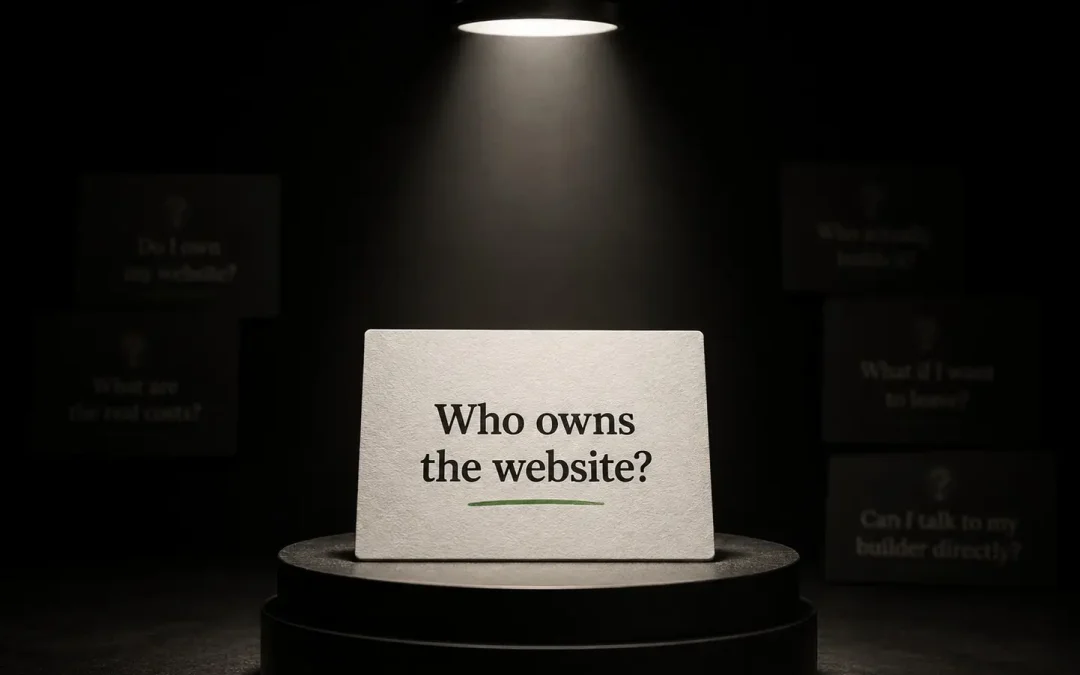
Post Summary: Ask What Working Together Looks Like, Then Listen
Nobody expects a business owner to know how to evaluate a web company. You are an expert at your own work, and that expertise does not transfer. So the gap is not a failure, it is just how being good at one thing works.
One question closes most of it. Ask them to describe the whole thing start to finish: how the sale goes, how the build goes, how launch goes, and what happens after. A company that can walk through all four has done the work. One that steers you back to the portfolio or the price has not.
Then get specific. What is each line item and what does it buy. Is there a contract and what happens if you leave. Can you take the site with you. And bring someone technical if you know one, because an advocate on the call hears what you would miss.
With three proposals in front of you, the deciding question is smaller than it looks: who do you want to work with. A hundred dollars is not worth a relationship that grinds.
Nobody Hands You the Questions
You’re not supposed to know what questions to ask. That’s the whole problem.
You’re sitting in front of a web company’s sales page, or on a Zoom, or standing in your own shop while someone explains what they can do for your business, and you’re trying to figure out whether any of it is real. Whether the thing they’re describing is worth the money. Whether the version of themselves they’re showing you right now is the version you’ll get six months from now.
And you don’t have the vocabulary to check.
That’s not a failure on your part. We can only be so good at so many things, and we can only understand at a deep level what questions to ask about the things we’re good at. These things are inherent in the human condition, and that’s fine. The information gap doesn’t come from laziness or carelessness, it comes from the fact that buying a website triggers real fears in people who are experts at running their own businesses and not at evaluating someone else’s.
This post is the framework. Not a list of clever questions to memorize, a way of thinking about the buying process that makes the right questions obvious once you’re in the room.
Ask Them to Walk You Through All Four Stages
If you’re coaching a business owner through the buying process, the first thing you tell them to ask is this: what does it look like, us working together? That question alone can stop you from overthinking how you should hire a web designer.
Not “what do you charge.” Not “can I see your portfolio.” Not “how long does it take.”
What does it look like?
Briefly outline the sales process, the build process, the launch process, and the customer service process. That alone will tell you so much. You’ll be able to clearly see if that’s how you want to work. You’ll find things you don’t like, and even with us, we’re not a fit for everybody, but you’ll know before you commit instead of finding out after.
Most people skip this question because it feels too broad. It’s not. It’s the most diagnostic question you can ask, because it forces the company to describe reality instead of selling a feeling. A company that can walk you through each phase clearly has done the work. A company that redirects you to the portfolio or the pricing page has thought about the close and not about the experience.
The Follow-Ups Worth Asking Next
Once you’ve asked the big-picture question, get specific. There are a handful of follow-ups that are worth asking every time.
Detail exactly what I’m paying for. What is this line item and what do I get for it? Do I have a contract? Can I take my website with me if I leave?
Ask us any of these and it’ll be very clear that we’re indifferent to the answer. The answers are on the website, in the pricing, on the first phone call. There’s nothing to protect because there’s nothing hidden.
That isn’t universal, and the reason to ask is that vague answers are easy to give. A line item nobody explains stays unexplained. A contract nobody mentions stays unmentioned. Portability never comes up in a conversation where you don’t know to raise it.
These aren’t trick questions. They’re the baseline. How a company handles them before you pay is a fair preview of how it handles questions after.
What to Ask About Contracts
Contracts are a big one. Especially now, when everyone’s so used to that terms of service popup where you just check the box. Download an app, agree to the update, click through to the next screen. Nobody reads that stuff, and over time the checkbox has become something close to a blank signature.
Some of these arrangements get made door to door, and plenty of people buying a website aren’t tech-savvy. “Okay, we’re all set, sign here.” The one-year term doesn’t come up. That’s common enough in sales that it’s worth assuming it’s possible every time you sit down with someone new.
So ask, at the start of any arrangement: is there a contract at all? If I give appropriate notice and leave, is there a penalty?
Worth asking in anything you do these days, because the answer is rarely volunteered. That’s not cynicism, it’s pattern recognition from decades of watching how business relationships go wrong, and the contract is where they go wrong most quietly. Once you’re locked in, the pressure to keep earning your business comes off.
When a business website fails, it’s rarely because the design was bad on day one. It’s because nothing required it to keep getting better.
Why You Don’t Know What to Ask, and Why That’s Normal
The information gap comes from life.
Nobody is good at everything. You’re an expert in your business. You understand your customers, your margins, your competitive landscape, the things that matter to your daily operation. Web design is not one of those things, and it shouldn’t have to be. The fact that you don’t know what heading hierarchy means or what a CDN does or why your hosting matters for page speed doesn’t say anything about your intelligence. It says you’ve been busy running a business.
But almost everybody knows somebody who’s good at this stuff. A friend who works in tech, a cousin who built their own site, a business contact who’s been through the process and came out the other side with opinions. Find that person.
Bring an advocate. Do these meetings with that advocate, someone who understands the questions to ask, who can validate what the web company is telling you, who can sit on the Zoom and listen for the things you wouldn’t catch on your own. We encourage it. A client who brings someone to push back is a client who ends up more confident in the relationship, because the pushback happened before the money did.
Not everyone has that person, and not everyone feels comfortable asking. That’s fine too. But if you do know someone willing to hop on a call with you, use them. You’ll be in conversations where nobody prompts you to ask the right questions, and the advocate is your insurance policy for those.
Three Proposals on the Table and You Can’t Think Straight
Here’s what happens more often than people admit: you got one proposal and it was overwhelming. So you thought, if I get more, the answers will come to me. Now you have three, and you’re more confused than when you started.
That’s not a you problem. That’s a confusing proposals problem.
A proposal written to impress is not the same as one written to inform, and stacking three of them on top of each other tends to leave the price as the only thing that’s clearly different. Which is the worst possible way to make this decision, because the cheapest option and the best option are almost never the same thing.
You need to find a trusted advisor and have them sift through it. You can reach out to us and we’ll analyze all three and give you a fourth. And if someone is legitimately better than us, better pricing, better deliverables, clearly knows what they’re doing, then obviously we’re not going to say go with us. That’s not how we operate.
The real question, once you’ve got comparable options in front of you, is simpler than you think: who do you like better?
If they’re $10 different but you love one company’s personality, what they stand for, how they communicate, that’s worth more than the $10. If they’re $100 cheaper but you think the more expensive option will work better with you long-term, that relationship is a more valuable thing than just cheaper. Because cheaper gets you exactly what that is. It doesn’t necessarily get you better.
The affordable option isn’t always the cheapest one. It’s the one where the price makes sense relative to what you’re getting and who you’re getting it from.
What the Questions Can’t Guarantee
They won’t guarantee anything.
Some people will answer every question on this list cleanly, look you in the eye, and still break those answers six months later. Salespeople under pressure do things that calm circumstances don’t produce. Someone who believes the promise they’re making in the moment may not think too hard about whether the company behind them can keep it.
But the questions make that harder. They create a record, in your memory and in their words. Answers this specific are difficult to give and then quietly contradict, and the more questions you ask, the sooner that shows.
This isn’t about becoming a web design expert before you hire one. It’s about walking into the room with a framework that brings honesty to the surface, so you can see it when it’s there and feel the absence when it isn’t.
If you want to go through this list with someone, we’re right here.
Frequently Asked Questions
What is the single most important question to ask before buying web design?
Have them lay out the whole arrangement end to end, from the first conversation through to how support works once the site is live. It forces a real answer instead of a pitch, and it tells you more than any portfolio.
Why do business owners struggle to know what questions to ask a web company?
Because web design is not their expertise and it does not need to be. Nobody is deeply knowledgeable about many things at once, and that is all this gap is. Business owners are experts at running their businesses. The fix is bringing an advocate to the conversation who understands the technical side and can push back on vague answers.
How do I compare three web design proposals without getting overwhelmed?
Get someone you trust to read them alongside you. Three documents written to impress rather than inform will leave you more muddled, not less. Once you have comparable options, the deciding question is simple: who do you like better? Relationship fit matters more than a small price difference.
What should I ask about what I’m paying for?
Ask them to detail it line by line. Ask whether a contract exists and what leaving costs. Ask whether you own the website or are renting it. Those are ordinary questions with ordinary answers, and how easily they come is worth paying attention to.
Should I bring someone with me to a web design sales meeting?
If you know someone who understands tech or has been through the buying process, bring them. An advocate who can validate what the company is telling you and ask the questions you wouldn’t think to ask is the best insurance you can carry into these conversations.
What does Yeet Websites charge and is there a contract?
Two options: $4,000 to own your site outright, or $130 per month with a $600 setup fee. No contracts on either model. Cancel the subscription with a few days notice, no penalty. The person you talk to is the person who builds and manages your site. Use the website cost calculator to get a number before any conversation.