
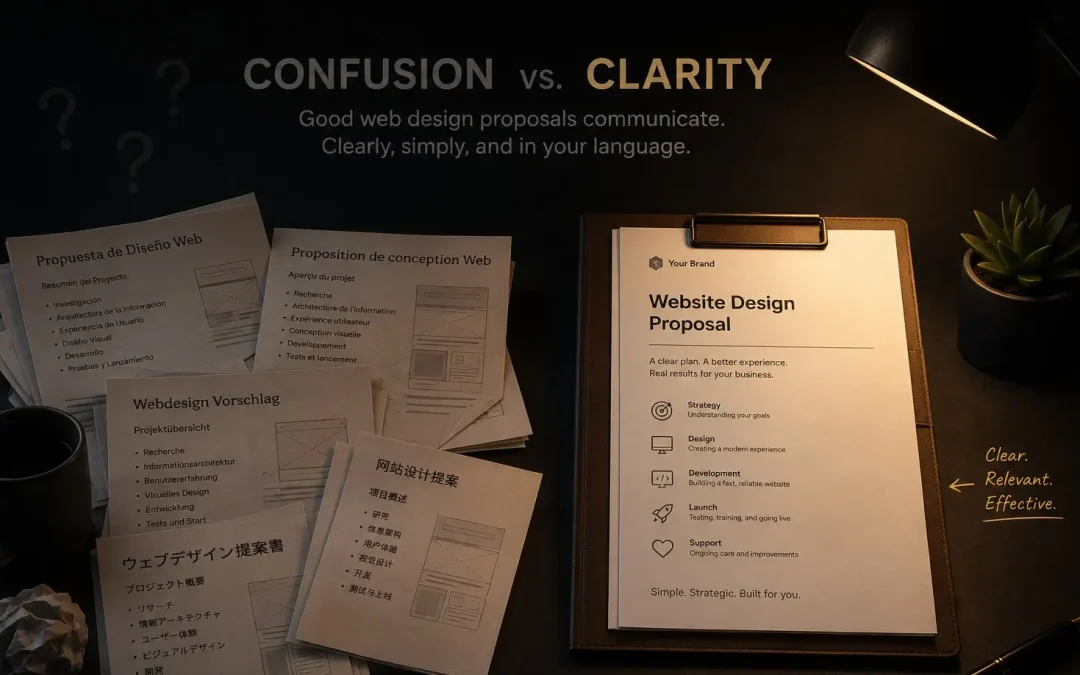
Post Summary: The Words to Ask About Before Signing
“Up to 10 pages” is a ceiling. Six pages sits inside that and satisfies the agreement. Same shape applies to “up to 5 revisions” and anything else that sets a maximum where a number was expected.
Four more worth asking about: an SEO line with no description of the work behind it, a content management system nobody has explained in terms of what you’d be doing day to day, domain registration that doesn’t say whose account it lands in, and any price that moves depending on something you can’t see.
None of it is necessarily written to mislead. Spend long enough in a field and the shorthand stops registering as shorthand. The effect on the reader is the same either way.
Below: what a proposal typically contains, and what to do with one already sitting in front of you.
Reading It Twice and Still Not Knowing
You’re sitting at your kitchen table at 9:30 at night, reading a six-page proposal. You’ve read it twice. You still don’t know what you’re buying.
Not because you’re not smart. Not because this is complicated technology. Because the proposal was written in a language designed for people who already know the answer, and you were handed it like it would explain itself.
“We will index your domain across 100+ search engines and implement structured data markup to improve crawlability and SERP visibility.” Okay. What does that mean for your business? What does it do for a customer trying to find you? The proposal doesn’t say. It keeps moving.
Confusing web design proposals are one of the most common reasons good businesses end up with bad websites. Not because the technology failed. Because nobody explained what they were buying before they bought it, and most people feel too uncomfortable to admit they’re lost.
What a Typical Proposal Contains
Most proposals from larger web companies follow a pattern. There’s a cover page with a logo and a handshake-style mission statement. Then a scope section. Then a line-item breakdown. Then pricing, sometimes at the end, sometimes buried in the middle, sometimes expressed as a range that doesn’t resolve until you ask.
The scope section is where it gets murky. You’ll see things like:
“Up to X pages with CMS integration and responsive design across all breakpoints.”
What’s a breakpoint? What’s included in “up to X pages” and what isn’t? What happens if you need X+1? The proposal doesn’t say.
Line items are where the real traps sit. “SEO setup”, what does that cover? Is it a one-time technical pass or ongoing work? “Hosting”, whose servers, what uptime guarantee, what happens to your files if you leave? “Monthly maintenance”, who’s doing it, what specifically gets done, and is that the same person who built the site or a support queue in another time zone?
Each of those line items can mean ten different things depending on who wrote the proposal. That vagueness has consequences whether or not anyone intended it. A proposal that leaves room for interpretation leaves room for the cheaper version of what it implied.
Is the Confusion Intentional? The Honest Answer Is Complicated
Here’s the thing: most of the people writing these proposals aren’t trying to deceive you. Spend long enough around the same vocabulary and it stops registering as vocabulary. When you spend years talking to other web professionals, you start thinking in the same shorthand. Acronyms feel like plain English. Scope language that would confuse anyone outside the field reads like standard operating procedure to the person writing it.
It’s the same thing that happens when a doctor writes discharge instructions in clinical terminology, or when a lawyer writes a contract that requires another lawyer to translate. They’re not hiding something. They forgot what it felt like not to know.
The best thing a web professional can do is periodically strip everything out, forget every abbreviation, every technical shortcut, and imagine reading their own materials as someone who’s never thought about websites before. Not as a permanent limitation on the work, just as a filter on how you communicate about it. It’s an easy step to skip.
That said: some confusion is intentional. Not at every company, but the pattern exists. A proposal that can’t be pinned down to a specific deliverable is a proposal that can’t be held to one. Vague scope is easier to underfill. “Up to” and “exactly” are different commitments, and only one of them is a floor. If you’re trying to figure out which kind of confusing you’re looking at, ask for specifics. Watch what happens.
The Five Terms Worth Flagging
You don’t need to understand every technical term to protect yourself. You need to understand what you’re agreeing to. Those are different things.
Flag anything with “up to” in it. Up to 10 pages. Up to 5 revisions. Up to 3 rounds of feedback. “Up to” is a ceiling, not a commitment. If the scope says “up to 10 pages,” they can deliver 6 and be technically compliant.
Flag anything labeled “SEO” without a description of the work. SEO means roughly a hundred different things depending on who you ask. Is this on-page optimization during the build? Blog content over time? A one-time technical audit? Link building? All of the above? None? Ask what specifically will happen, by whom, and on what schedule.
Flag “content management system” if nobody’s explained what that means for your day-to-day life. A CMS is just the dashboard you’d use to update your own site. Some are easy to use. Some require a developer to touch anything meaningful. Which one you’re getting, and how much you’ll be able to do yourself on your own, matters enormously.
Flag anything that mentions “domain registration” without specifying whose account it goes into. If the web company is registering your domain in their account, you don’t own it. They do. That’s not a hypothetical risk, it’s one of the first questions on any good pre-hire checklist.
And flag any pricing that seems to depend on a variable you don’t control. “Starting at” is not a price. “Dependent on scope” is not a price. If you can’t calculate what you’ll owe at the end of the engagement, you haven’t been given a real proposal.
Why Ours Takes Ten Minutes
We don’t usually send proposals in the traditional sense. Most of the time, we do this over a screen share. If you’re local to Chattanooga, we’ll do it face to face. Either way, the pricing takes about ten minutes to cover, because there isn’t that much to cover.
Which product do you want? Here are the two options. Let’s go through each one. Do you have questions about hosting? About the number of edits? About what happens to the site if you want to leave? Here’s the pricing. Here’s the timeline. Which one makes more sense for where you are right now?
That’s it. No contracts. No lock-ins. No line items that need a translator. If we send something in writing, every line means what it says.
Some things are hard to explain simply, SSL certificates, for instance. The short version is: it keeps your site secure and tells browsers you’re trustworthy. The longer version involves encryption standards and certificate authorities that aren’t useful to anyone who just needs to know their site is protected. So we just tell you: yes, it’s included, yes, it’s handled, here’s what you’d see if something went wrong. That’s the whole conversation.
The goal is that you leave knowing what you bought. Not because we simplified the work, because we translated it. That same approach carries through every conversation we have about your website, not just the sale.
What to Do If You’re Holding a Proposal Right Now
Don’t sign it confused. That’s the whole rule.
Give the company a chance to explain it. Not just “do you have questions”, ask them to walk you through every line item in plain language. What does this mean? What exactly will you deliver? When? Who’s doing the work? What happens if the deliverable isn’t what you expected?
Watch how they respond. A company that’s confident in their work will welcome those questions. They’ll have clear answers because they’ve thought through what they’re offering. A company that gets defensive, vague, or impatient when asked to explain themselves is telling you something important, and they’re telling you before you’ve signed anything, which is the best possible time to hear it.
If they explain it well and everything makes sense, great. If you still have a nagging feeling that something doesn’t add up, trust that feeling. You’re not being paranoid. You’re being a business owner.
And if you want a second set of eyes on it, from someone with no stake in whether you sign it or not, bring it to us. We’ll tell you what the language means, what looks standard, and what’s worth pushing back on. No charge, no pitch. Just a straight read. We’ve seen enough proposals to know which ones define what they’re selling and which ones leave the important parts open.
You shouldn’t need a translator to understand what you’re buying. The fact that you do tells you something about who wrote the proposal.
Frequently Asked Questions
Is it normal to not understand a web design proposal?
More common than it should be, yes. Most proposals are written by people who’ve been in the industry long enough that technical language stopped feeling technical. That doesn’t make it okay, it makes it a sign that the company hasn’t invested in communicating clearly with clients. You should be able to read a proposal and know exactly what you’re getting.
What’s the single most important question to ask before signing?
“Who specifically will be doing the work?” Not the company. Not the department. The person. If they can’t name them, or if they hedge with “whoever is assigned”, you’ve learned something important about how much continuity you can expect after the sale.
What does “up to X pages” really mean in a proposal?
It means the company has committed to building no more than X pages. They can deliver fewer and stay within the agreement. If you need exactly 10 pages, “up to 10” is not the same as “10.” Ask them to commit to a specific number, or ask what happens if you need more than the ceiling.
Should I get multiple proposals before choosing a web company?
Comparing proposals can be useful, but be careful about comparing line items from different companies like they’re equivalent. “SEO setup” from one company and “SEO setup” from another can mean completely different things. Focus on understanding what each company is committing to deliver, not just which proposal has more bullet points or the lower number.
What happens if I sign something I didn’t fully understand?
Depends on the contract. If you’re locked into a term agreement, your options may be limited. If you’re on a month-to-month arrangement, the cost of a mistake is one billing cycle. This is one of the reasons we don’t use contracts, if something isn’t working the way you expected, you can leave. The pressure of being locked in tends to keep people in bad situations longer than they should stay.
How do we price at Yeet Websites?
We have two products: a subscription and an ownership option. The subscription is $130/month after a one-time $600 setup fee, both numbers are stated upfront before you sign anything. There are no escalating tiers and no “starting at” pricing that turns into something else. The number we quote is the number you pay.