
Post Summary: The Form Has No Field for What Makes You Different
Open three roofing companies in your city in three tabs and try to remember which was which. The homeowner searching at 9pm with a leak in the ceiling can’t either, so they call whichever showed up first.
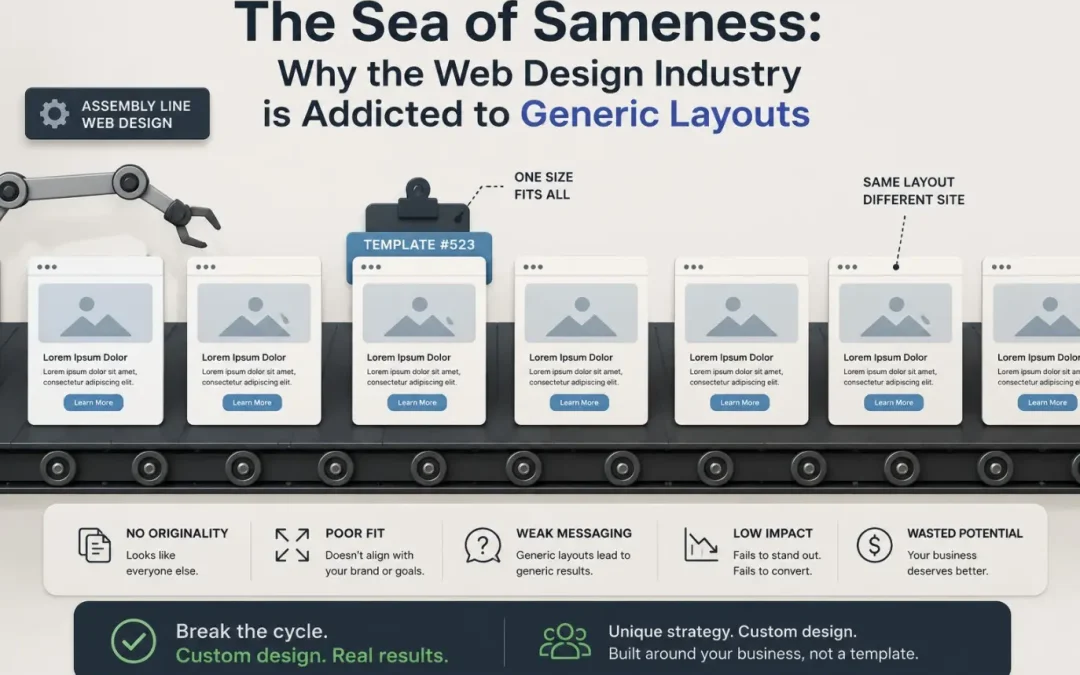
The template isn’t the problem. Hero image, service boxes, testimonials, call to action is a proven structure. The problem is the assembly line: sales reps called web designers, told to turn and burn. Nobody tests the email link. Nobody customizes past the logo and the stock photos. Nobody asks what makes the company different, because the form has fields for name, phone, services, and upload your logo.
The cost is invisible. It’s the call that never comes, from the person who opened three tabs, felt nothing, and went with a referral instead.
A roofing contractor described his process: after the crew finishes, the owner walks the property with the homeowner, asks what could have been done better, then asks for the review. No template has a field for that, which is why putting it on the site makes the site impossible to mistake for anyone else’s.
Those details surface around the fifteen-minute mark, when the client stops giving the rehearsed pitch and starts telling you what they never told a web designer because nobody asked.
Not every company builds this way. The pattern exists because the model rewards speed over depth and hires for sales skills over building skills. Generic is what happens when nobody has the time or training to do anything else.
Three Tabs and a Leaking Ceiling
Pull up three roofing companies in your city right now. Open them in three tabs. Click between them.
Big hero image, probably a drone shot of a roof or a guy in a hard hat smiling at the camera. Three boxes underneath with icons for “Residential,” “Commercial,” and “Emergency Repairs.” A testimonial slider. A “Why Choose Us” section with bullet points about being licensed, insured, and family-owned. A stock photo of a service worker who has never touched that company’s actual roof.
Now try to remember which one was which. Can you? Because the homeowner searching Google at 9pm with a leak in their ceiling can’t either. They opened the same three tabs you just did, saw the same three layouts, felt the same nothing, and called whichever one showed up first, or whichever one a neighbor recommended. The websites didn’t help. They didn’t hurt. They just existed, identically, accomplishing nothing.
That’s why so many websites look the same. And it’s costing you more than you think.
The Template Rotation You’re Not Supposed to Notice
Business owners who switch to us describe the same thing: a set of templates they were asked to pick from, before anyone asked a question about how they run their business. The rotation is what you notice from the outside. The same base layouts recycled across industries, across cities, across businesses that have nothing in common except paying the same company.
When you’ve seen as many sites as we have, you start spotting them in seconds. The same shift from section to section. The same little disclaimer boxes with different text pasted in. The same hover icons on the sidebar that pop out when you mouse over them, and half the time the links don’t even work. You click “email” and it goes nowhere, because the sales rep who set it up didn’t test it before shipping.
These templates weren’t always bad. The original designer who created the framework was probably talented. The layout itself, hero image, service boxes, testimonials, CTA, isn’t inherently wrong. It’s the basis of a website. What separates one from the next is what gets built on it.
The problem isn’t the skeleton. It’s the assembly line. When a company hires sales reps, calls them web designers, and tells them to turn and burn these sites as fast as possible so they can move to the next one, quality dies. The pressure is relentless. Get it shipped, get the next sale, hit the quota. Nobody has time to test the email link. Nobody has time to customize beyond swapping the logo and the stock photos. Nobody has time to ask the business owner what makes their company different, because the template doesn’t have a field for “different.” It has fields for name, phone, services, and upload your logo here. It’s the same model we break down in detail when looking at what happens when you hire a marketing agency for web design, volume over depth, every time.
And then you add the smiley service worker stock image, the guy in the hard hat who has never set foot on your job site, grinning like he just won the lottery, and it’s over. Whatever thin illusion of custom remained just evaporated. Your website now looks like a costume, not a business.
Why Sameness Costs You Money You’ll Never See
The cost of blending in isn’t dramatic. Nobody calls you and says “I chose your competitor because your websites looked identical and theirs loaded first.” It’s invisible. It’s the call that never comes. The homeowner who opened three tabs, felt nothing, and went with a referral instead. The potential client who couldn’t remember which company was yours because nothing about your site gave them a reason to.
Now, if your business has been around for decades and you’re built on referrals and reputation, a generic website might not sink you. Your name carries weight. People find you through word of mouth, not through Google.
But here’s the question you should be asking: is that the legacy you want to lead? A business that’s been the best in its market for thirty years, and the digital footprint says “we stopped trying”? Because the thing about being the best is that someone is always coming. Maybe not today. Maybe not tomorrow. But at some point, a hungrier company with a sharper website and a better digital presence walks into your territory. And when your site looks like every other template in the industry, the thing that used to protect you, your reputation, starts competing against someone who looks more modern, more professional, and more intentional.
When you’re the best, it’s the best time to look your best. In every avenue. Including the one most people see first.
What Makes a Website Feel Like It Was Built for THAT Business
Here’s a story from a client conversation that shows the difference.
A roofing contractor told us about his process. After the crew finishes a job, the owner personally goes back to the site for a final walkthrough with the homeowner. Not the crew lead. The owner. He walks the property, checks the work, asks the homeowner if everything looks right. Then he asks a specific set of questions: Were we good on cleanup every day? Did anything bother you during the process? Is there anything we could have done better? And then he asks for a Google review, because by that point, he’s earned it.
That’s a remarkable business model. That’s the kind of detail that makes a homeowner tell their neighbor “use these guys.” And when that process is on the website, not buried in a generic “Our Process” section, but told as a story, in the owner’s voice, with the kind of specificity that only comes from actually doing the work, the site doesn’t look like a template anymore. It can’t. Because no template has a field for “the owner does a personal walkthrough and asks what we could do better.”
That’s what separates a website that was built for THAT business from one that was built for any business in that industry. It’s not the layout. It’s not the color scheme. It’s the content, the specific, niche, no-one-else-does-it-this-way details that only surface when someone takes the time to listen.
The problem is that most of these sales-reps-turned-designers don’t know to ask. They don’t understand the value of going that deep. They’ve got a form with twenty fields, business name, phone number, services offered, upload your logo, and that’s the extent of the discovery. They’ve never run a business. They’ve never done a roofing walkthrough. They don’t know what questions to ask because they don’t know what makes one roofer different from the next. And if you don’t know what makes the business different, the website will look like everything else.
The Fifteen Minutes That Change Everything
When we start working with a new client, there’s a moment in the first conversation that changes the entire trajectory of the project. We call it internally the aha moment, and you can feel it happen in real time.
It starts with us asking questions that go deeper than “what services do you offer.” We want to know how you run your business. What happens when a customer calls. What you do differently than the company down the road. What you’re proud of that nobody knows about. And somewhere around the fifteen-minute mark, something shifts. The client stops giving us the rehearsed version, the elevator pitch, the “about us” paragraph they’ve been repeating for years, and starts telling us the real stuff.
The thing they’ve never told a web designer before because nobody asked. The process they developed over twenty years that they thought was too detailed to put on a website. The story about the client who almost left but stayed because of something small the team did that nobody else would have noticed. The phrase they use in every sales call that always lands.
We’re writing as fast as we can. And the client is excited, maybe for the first time in the entire process of getting a website, because someone finally wants to know what makes them different instead of just what their phone number is.
That fifteen minutes gives us what we need to build a site that sounds like that business. It filters through every page like a thread that pulls you out of the labyrinth and into something specific, something real, something that no template and no assembly line could ever produce. Because you can’t template a conversation. You can’t template a story that only this business owner knows. And you can’t fake the kind of specificity that only comes from someone taking the time to listen, which is exactly why the story ends badly when the person who had that conversation walks out the door.
Good Companies Exist, This Isn’t About All of Them
We want to be clear about something. Not every web design company builds template sites. Not every company with a large roster delivers generic work. There are good companies out there, some of them large, that take the time, do the work, and build sites that look and feel custom.
This post isn’t about them. It’s about the pattern. The reason SO MANY websites look the same, across SO MANY industries, built by SO MANY companies that all claim to deliver custom work. The pattern exists because the model incentivizes speed over depth, volume over quality, and hiring for sales skills over building skills. When those incentives are in place, sameness is the natural outcome. Not because anyone set out to build a generic website, but because generic is what happens when nobody has the time or the training to do anything else.
If your company is one of the good ones, you already know who you are. And if you’re a business owner wondering whether yours is, look at your website with fresh eyes. Open your competitor’s site next to yours. If you can swap the logos and nothing feels wrong, the answer is obvious.
What It Looks Like When Someone Builds It Right
The difference between a generic website and one built for your business isn’t a design trick. It’s not a fancy animation or a more expensive stock photo. It’s information. The right information, presented in a way that sounds like you, because it came from you.
When your roofing website describes the owner’s walkthrough process in detail. When your plumbing site explains what happens in the first fifteen minutes of a service call and why that matters. When your landscaping company’s homepage doesn’t just say “quality work at fair prices” but tells the story of the time your team came back three days after a job to check whether the drainage held up after a storm, for free, because that’s just what you do.
Those details can’t be templated. They can’t be generated by a sales rep who spent thirty minutes on your project before moving to the next one. They come from a conversation where someone asked the right questions, listened to the answers, and understood why those answers matter to the person searching Google at 9pm with a problem and three identical tabs open.
We build every site from that conversation. Not from a template. Not from a rotation. From the specific, irreplaceable details of how you run your business, because that’s the only thing that makes your website yours.
Frequently Asked Questions
Why do so many business websites look the same?
Because the companies building them work from a limited rotation of templates and don’t invest the time to customize beyond surface-level changes. The model rewards speed and volume, get the logo swapped, the colors changed, and the stock photos dropped in. When no one asks what makes the business unique, the website defaults to the same generic layout as everyone else in the industry.
Does it matter if my website looks like my competitors’ sites?
It depends on how much your business relies on digital visibility. If you’re built entirely on referrals and reputation, a generic site may not hurt you today. But it leaves you vulnerable. A competitor with a sharper, more specific online presence can enter your market and capture the customers who are searching online, the ones who open three tabs and can’t tell the difference between you and everyone else.
How can I tell if my website is a template?
Skip the code, since what a site was built with says nothing about whether the content was written for your business. Put your logo on a competitor’s site and theirs on yours. If nothing feels wrong, you have your answer. Then take the most specific sentence on your homepage and search it in quotes. If other companies come up using the same words, that copy came off a shelf. And look at the photos: if nobody in them has ever touched your job site, that’s the tell. For a more thorough check, send it to us and we’ll tell you straight.
Can a template website still look unique?
To a degree. A skilled designer can customize a template enough that it doesn’t feel generic. The issue is that most template builds aren’t done by skilled designers, they’re done by sales reps under pressure to ship quickly. The template itself isn’t the problem. The assembly-line process that deploys it is.
What does Yeet Websites do differently to avoid the sameness problem?
We start with a conversation that goes deeper than “what services do you offer.” We learn how you run your business, the processes, the stories, the specific details that no competitor shares. That information becomes the foundation of every page. You can’t template a conversation, and you can’t fake the kind of specificity that comes from someone who took the time to listen.