
Post Summary: Your Website Is Never the Service Generating Monthly Revenue
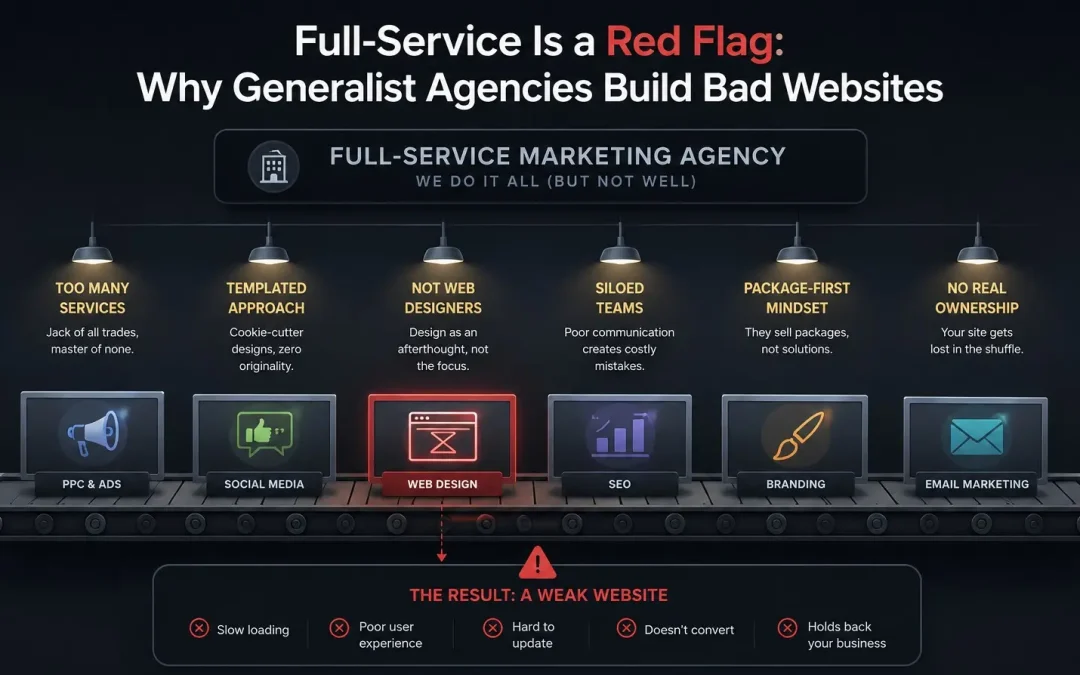
A company selling seven services will have difficulty reaching depth in any of them. Every hour spent managing an Instagram feed is an hour not spent learning how Google weighs heading structures, and every dollar spent on a social media coordinator is a dollar not spent on a developer who understands site speed at the code level.
The results show up in the same places: heading tags missing or duplicated, URL structures that look machine-generated, sitemaps never submitted, calls to action buried where nobody clicks.
Partner badges don’t close that gap. The Google Partner badge takes ad spend over 90 days, a 70% optimization score, and half the account strategists certified. None of the three measures whether a client’s ads convert. Ask what the badge means in terms of results for clients like you and listen for whether the answer contains a number.
Inside a company running six or seven verticals, your website is one priority among several, and the top one is whichever service generates the most revenue this quarter. That’s rarely web design, because a website gets built once while ad management bills every month. So the site goes live and then sits.
One question separates the answers: what kind of communication can I expect a year from now? The first ninety days are easy. Month thirteen is the test, when the build revenue has been collected and you’re a line item. Systems, check-ins, and specific metrics are an answer. A commitment to client success with no detail attached is not.
The Fourteen-Page Menu With Laminated Photos
There’s a type of restaurant that serves everything. Burgers. Sushi. Tacos. Pad Thai. A fourteen-page menu with laminated photos and a dessert section that includes both tiramisu and churros. You’ve been to a place like this. You’ve looked at that menu and thought “there’s no way the sushi is good here.” And you were right. Because a kitchen that tries to master fourteen cuisines masters none of them. The ingredients aren’t fresh because they can’t move enough volume in any single category. The cooks aren’t specialists because they’re rotating between stations all night. The whole operation exists to give you the feeling of choice while delivering mediocrity across the board.
That’s a full-service marketing company doing your web design. And if you’re thinking about hiring a marketing agency for web design, this is what you need to understand before you sign anything.
Why “We Do Everything” Should Make You Nervous
Full-service companies pitch a compelling vision. One partner for all your marketing needs. SEO, PPC, social media, email campaigns, branding, content creation, web design, web development, all under one roof. One invoice. One relationship. One team handling every piece of your marketing puzzle.
On paper, it sounds efficient. In practice, it means the company splits its attention across six or seven verticals and achieves depth in none of them. Every hour a company spends managing someone’s Instagram feed is an hour not spent learning how Google’s algorithm weighs heading structures. Every dollar invested in hiring a social media coordinator is a dollar not invested in hiring a developer who understands site speed at the code level. Every new service on the menu dilutes the focus that made any single service good in the first place.
This isn’t a theory. We see the results every time a client comes to us from one of these companies. The website has problems that a focused web design company would have caught before launch, heading tags missing or duplicated, URL structures that look like they were generated by a machine, sitemaps that were never submitted, calls to action buried where nobody clicks them. The kind of details that only get caught by someone whose entire professional life revolves around building websites.
We built our business around web design and SEO, plus the paid search that supports them. That’s what 95% of our small business clients need. Not social media management. Not email drip campaigns. Not a fourteen-page menu of services with laminated photos. One discipline with a few levers, done at a level that a company juggling seven verticals can’t touch, because we wake up every morning thinking about nothing else.
The Badges That Mean Nothing
Here’s one of the more effective tricks in the full-service playbook. Badges.
Google Partner. Facebook Marketing Partner. Certified this. Authorized that. You see these logos on a company’s website and your brain does exactly what it’s supposed to do, it assumes competence. If Google trusts them, they must be good. Right?
Wrong. The badge has three requirements: $10,000 in ad spend over 90 days across managed accounts, a 70% optimization score, and half the account strategists certified. That sounds rigorous until you look at what each one measures. The spend threshold is a volume test, not a results test. The optimization score rises when a company applies Google’s recommendations, which lean toward broader match types and automated bidding, and it rises when they dismiss those recommendations too, because responding at all earns the points. The certification exams are free and repeatable. None of the three measures whether a single client’s ads are converting.
And these companies know exactly what those badges do to a prospect’s brain. They put them above the fold on the homepage, right next to their “trusted by 500+ businesses” line, and let you fill in the gap between what the badge means and what you assume it means. It’s not a lie. It’s a carefully arranged implication. And it works on business owners who’ve never had a reason to question what “Google Partner” actually certifies.
Ask them. Next time you see one of those badges, ask what it means in terms of results for clients like you. Watch the answer. If it’s specific, “our average client sees X return on ad spend”, that’s a real answer. If it’s vague, “it means Google recognizes our expertise”, that’s the laminated menu talking.
What Happens When Your Website Is One of Seven Priorities
The structural problem with hiring a marketing company for web design isn’t that the people are bad at their jobs. It’s that the business model makes mastery impossible.
Think about what it takes to build a website that performs. Not just looks good, performs. Drives calls, generates leads, ranks on Google, loads fast, works on every device, communicates clearly who you are and why someone should hire you instead of the other three businesses on the same search results page.
That takes someone who understands design, development, content strategy, SEO, conversion psychology, and your specific industry well enough to make a hundred small decisions that compound into a site that works. Those decisions, which heading level to use, where to place the phone number, how to structure the services page so Google understands what each page is about, are the kind of decisions that only come from experience. Deep, focused, this-is-all-I-do experience.
Now put that person inside a company that also runs Facebook ads, manages TikTok accounts, builds email funnels, designs logos, and writes blog posts. How much of their day is spent on your website? How much of the company’s investment goes into keeping that person’s skills sharp versus hiring the next social media coordinator?
Full-service companies don’t build bad websites because they’re lazy. They build mediocre websites because the model doesn’t allow for the depth of focus that good websites require. Your site is one of seven priorities. And priority number one is always whichever service generates the most revenue this quarter, which is almost never web design. It’s usually ad management billed as its own line, disconnected from the site the ads point at, because that spend recurs every month. Your website gets built once and then it sits, and when the person who built it leaves, nobody tells you and nobody who replaces them knows your project.
What Honest Looks Like
We could offer social media management. We could offer email marketing. We could add five more services to our roster and pitch ourselves as the full solution for everything your business needs. The revenue would look great on paper.
But your website would get worse. Our SEO work would get shallower. The listening that we do on the front end, the intake conversation before anything gets built, would get rushed because we’d have more plates spinning. The thing that makes us good at what we do is the same thing that limits what we offer. Focus isn’t a marketing word for us. It’s a resource allocation decision.
So here’s what we tell clients. If you need social media, we’ll help you find someone great. Videography? We know people. Full branding, logo, identity, the whole system? We have contractors we trust who specialize in exactly that. We’re not going to pretend we’re experts in something we’re not just to keep the invoice under one roof.
That’s not a limitation. We’d rather tell you what we don’t do than pretend otherwise to keep the invoice under one roof. That’s what ongoing support is supposed to look like.
The One Question That Reveals Everything
If you’re sitting in a meeting with a full-service company right now, ask this:
What kind of communication can I expect from you a year from now?
Not next month. Not during the honeymoon period when you’re a new account and everyone’s attentive and responsive. A year from now, when the website is built, the launch buzz has faded, and you’re just another name in the CRM. What does the relationship look like then?
Because the first ninety days are easy. Every company is great at the first ninety days. They call you back. They send updates. They make you feel important. The real test is month thirteen. When the revenue from your build has been collected and the ongoing retainer is just a line item. When the social media coordinator who was so responsive during onboarding has moved to a bigger account, and you can’t get a straight answer from anyone. When the only time you hear from them is when the invoice hits your inbox.
Ask the question and listen to the answer. If they talk about systems, regular check-ins, and specific metrics they’ll track for your business, that’s something. If they talk about “our commitment to client success” without a single concrete detail, you’re looking at the laminated menu again.
When we answer that question, we talk about what matters most to you. Not what we’ve decided matters. We ask “where do you want to elevate your business?” and that’s what we track. On top of that, we track other things too, because your priorities might shift, and when they do, we need the data from the past to pivot with you. That’s what ongoing support is supposed to look like. Not a retainer with a badge on top. A relationship where someone’s paying attention, and one where you’re not trapped if the relationship stops working.
Frequently Asked Questions
Is it always a bad idea to hire a full-service company for web design?
Not always. If you’re a large operation with massive growth, spending heavily across every channel, and you need centralized campaign management, a full-service partner can make sense. But even then, many businesses get better results by hiring a specialist for the website and farming out the other pieces to focused providers. The question isn’t whether full-service can work, it’s whether the web design output will match what a focused company would deliver. Usually, it won’t.
What’s wrong with having one company handle everything?
Convenience comes at the cost of depth. Every service a company adds dilutes the attention and expertise applied to each one. Your website ends up being built by a team whose primary revenue driver is probably paid ads, not web design. The site gets built, it goes live, and it sits while the company focuses on the services that generate recurring monthly spend.
What do Google Partner and Facebook Partner badges actually mean?
The Google Partner badge has three requirements: $10,000 in ad spend over 90 days across managed accounts, a 70% optimization score, and half the account strategists certified in Google Ads. None of the three measures whether a client’s ads are converting. The optimization score in particular rises whether a company applies Google’s recommendations or dismisses them, since responding at all earns the points. Always ask what the badge means in terms of measurable results for clients like you.
Does Yeet Websites offer services beyond web design and SEO?
PPC, in the 99 out of 100 cases where it supports the SEO work: same keyword research, same landing pages, same site. For branding, logo work, and videography, we have trusted contractors we refer out to rather than pretending those are our specialties. Our core focus is web design and SEO because that’s what 95% of small business owners need, and doing one thing exceptionally is worth more than doing seven adequately.
How do I know if my current company is spread too thin?
Ask a specific technical question about your website, heading tags, sitemap status, page speed score and what’s dragging it down. If the person you’re talking to can’t answer without checking with someone else, or if different people handle different parts of your project with no one holding the full picture, the company is likely spread too thin to deliver depth in any single area.