
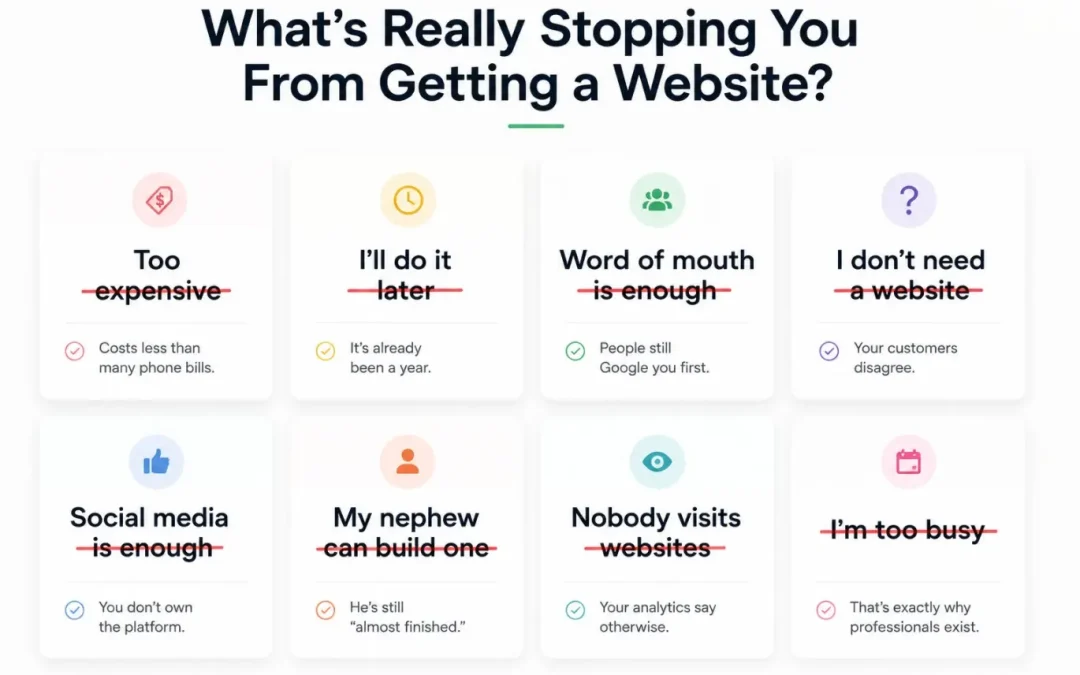
Post Summary: The Money Isn’t What’s Stopping You
Most businesses saying they can’t afford a site are already spending more than $130 a month on things returning less. So the sentence is usually standing in for something else.
What it stands in for is a bad experience with the last person who built one. Someone who took the money and went quiet, or delivered something the owner was embarrassed to send anyone. That attaches itself to web design generally rather than to the company responsible, so the next honest offer arrives already filtered through the last dishonest one.
Nothing about a better sales pitch fixes that. What does is evidence someone can check, and enough patience to let them check it at their own speed.
The Real Reason “I Can’t Afford It” Isn’t True
Price is almost never why businesses don’t have websites. If you’re running a business, paying employees, keeping the lights on, buying inventory and covering insurance, you have $130 a month. Plenty of owners are paying more than that for the light bill and have never sat down and put the two numbers side by side. It isn’t a resource problem, it’s a framing one, and once you see what affordable website design costs without the smoke and mirrors the framing shifts quickly.
The real reason is harder to say out loud:
- The guy who built you a site two years ago and disappeared
- The company that charged for a year and delivered something you were embarrassed to show people
- The sales pitch that made sense until the invoice didn’t
- The form that never worked and the call that was never returned
None of that leaves a budget gap. It leaves a trust gap, and trust gaps don’t show up on a balance sheet, so they get described as money problems instead.
The Contractor Who Thinks He Doesn’t Need One
The usual defence is the contractor who’s been in the same town for 30 years, booked solid on word of mouth. That person exists, and even they are handing something up. Someone who hears the name and looks for it finds nothing, and decides what that means on their own.
Most businesses saying it aren’t that contractor anyway. They aren’t fully booked. They’re not so well-known that customers find them regardless. They’re losing leads to competitors with a basic web presence, and “I can’t afford it” is easier to say than “I don’t trust the process” or “I don’t know where to start” or “the last time I tried this, it didn’t work.”
Trust and Overwhelm
The number one blocker is trust. Not cost. Trust.
Here’s the dynamic that makes this so hard to overcome. When someone is referred to a vendor by a person they know, that referral comes pre-loaded with credibility. The person who referred them has lived experience, they can say “here’s what happened, here’s what I paid, here’s what I got.” That testimony carries weight because it’s anchored to a real relationship.
When someone finds us cold, through a search, through an ad, through this post, they’re hearing the same things from us that their referral would have told them. Same words. Same promises. But we’re strangers. Our credibility starts at zero, and their skepticism starts high, because someone with a different face and a similar pitch already let them down.
We can’t shortcut that gap with a better sales deck. We close it with reviews, case studies, transparency about how we work and what we charge, and patience. We wait for people to get there. Pushing doesn’t help. The trust either builds or it doesn’t, and if it doesn’t yet, that’s not a lost sale, it’s a conversation that isn’t finished.
The second blocker is overwhelm. They don’t know where to start, what to ask, what to expect, or how to evaluate whether they’re getting what they’re paying for. Web design has ended up feeling technical and opaque to anyone outside it. Confusion is easier to sell into than clarity is. Most businesses without websites have been confused long enough that they’ve stopped trying to get clarity.
What One Bad Experience Costs
When you get burned by a web company, that experience gets scorched into your psyche. That’s not a figure of speech, it’s how memory works around negative experiences with high stakes. The money lost, the time wasted, the embarrassment of showing people a site that didn’t work, the silence when you tried to get it fixed. That cluster of feelings becomes attached to the category of “web design” as a whole, not just to the company that caused it.
So the next time someone legitimate comes along, the past experience filters the present conversation. Reasonable claims sound like the same claims that didn’t pan out. Transparent pricing looks like the pricing that turned out to have add-ons. A friendly salesperson feels like the last friendly salesperson who stopped picking up the phone in month three.
Getting burned doesn’t just cost the money you lost. It costs the trust you’d need to try again. And that’s the more expensive thing.
For some people this creates hesitation. For others it creates real anger, a conviction that every company in the space operates the same way, that transparency is a pitch and not a practice, that the whole category is rigged. We meet both types. The hesitant ones need time and evidence. The angry ones need to feel heard before they can hear anything else. If you’ve been through it and you’re weighing whether to try again, switching web design companies is less painful than most people expect, and we walk through what that looks like.
Neither reaction is irrational. Both make complete sense given what they’ve been through. The work of earning trust from someone who’s been burned isn’t marketing, it’s just being the company that doesn’t do the thing that burned them. Eventually that becomes visible. Eventually the track record speaks louder than the pitch.
The Two-Year Version
“I’ll get a website when I can afford a good one” has usually outlived its reason by year two. What’s missing by then isn’t the money. It’s trust, clarity, and stakes low enough to make the move feel safe.
Here’s what we’d say to that person: you may not have lost obvious business yet. But your customers and prospects are going to your website before they call you, and if there’s no website, some percentage of them are doing a quick check of a competitor who does have one, just to compare. Not necessarily switching. But validating. And the absence of a site is a small, quiet signal that something might be off. Not always a dealbreaker. But an opening for doubt where there shouldn’t be any.
Some businesses hold on by being everywhere else instead: strong social media, chamber membership, a Better Business Bureau listing, a steady local profile. That buys time. It doesn’t buy nothing lost, it buys not noticing what’s lost.
Worry about repeating a bad decision has kept more businesses offline than the price of a good site ever has. What settles that isn’t a better pitch. It’s a track record someone can look at.
What Finally Tips It
We don’t run long sales cycles. We’re not going to follow up for two years hoping you come around. What we’ve seen, over and over, is that the insight that finally moves someone to act often comes from us, and the action sometimes goes somewhere else. That’s fine. If someone takes our explanation of how this works and uses it to make a better decision, even with a different company, then the conversation did what it should have done.
What moves people isn’t usually a new argument. It’s a new experience, or the exhaustion of waiting for a better moment that doesn’t come. A competitor launches a site that starts showing up in searches. A prospect says they Googled the business and couldn’t find it. A referral falls through because the person they were referred to couldn’t verify the business existed online. At some point the cost of not having a site becomes concrete enough to feel real.
When that moment comes, the question becomes who to trust with it. That’s where the reviews matter. The case studies. The transparent pricing. The fact that the person you talk to is the person who builds your site and the person who picks up the phone six months later. That’s what a legitimate company looks like from the outside, and the inside tends to match.
If you’ve been sitting on this a while, you already know your own reason. You’ve been living it. The real question is whether the reason still applies, or whether you’ve been using it past its expiration date.
It was about what the money represented, and whether the person on the other end of the transaction was worth the risk.
Frequently Asked Questions
Can a business really survive without a website in 2026?
Plenty do, and they’re all losing something they can’t see. The site is the validation step that happens before a prospect calls. Without one, you’re relying entirely on other people to vouch for you, with nothing of your own for anyone to check.
What’s the actual difference between not being able to afford a website and not trusting the process?
If you’re running a business with regular expenses and $130 a month would genuinely break the budget, that’s a real constraint. But most business owners who say “I can’t afford it” are already spending more than that on things with less return. The actual question is usually whether the investment feels safe, and that’s a trust question, not a budget question.
How do you build enough trust to make the leap with a web company you don’t know?
Read reviews from real clients, not the ones on the company’s homepage, the ones on third-party platforms. Ask specific questions about what happens after launch. Ask who you’ll be talking to six months from now. Ask what the cancellation process looks like. A company that answers those questions clearly and without hedging is showing you something. A company that deflects is showing you something too.
What if I’ve been burned before and I’m skeptical of every web company now?
That skepticism is earned and it’s appropriate. The answer isn’t to ignore it, it’s to use it. Ask harder questions. Request more evidence. Look at more case studies. Take more time before signing anything. A legitimate company will be fine with all of that. A company that pushes back on reasonable due diligence is telling you something about how they handle things after the sale too.
Is waiting for a better moment ever the right call?
Temporarily, yes. If you genuinely just launched, revenue isn’t stable yet, and you need to conserve every dollar, waiting makes sense. A DIY site or even no site can work in the very early stage. But “temporarily” has a clock on it. Two years in, with a functioning business, the reason has usually expired. The website you’re waiting to afford is almost certainly within reach right now.
Does Yeet work with businesses that have never had a website before?
Yes, and we’d argue those are some of our cleanest projects. No bad structure to inherit, no redirect mess, no previous branding decisions to work around. We start from your business, not from someone else’s half-finished version of it. The intake process takes care of what we need to know.
What’s the first step if I’ve been putting this off for a while?
Call us or fill out the form. Don’t over-prepare. You don’t need a brief or a design vision or a list of pages. You need a conversation with someone who’ll ask the right questions and tell you honestly what makes sense for your business. That’s the whole first step.