
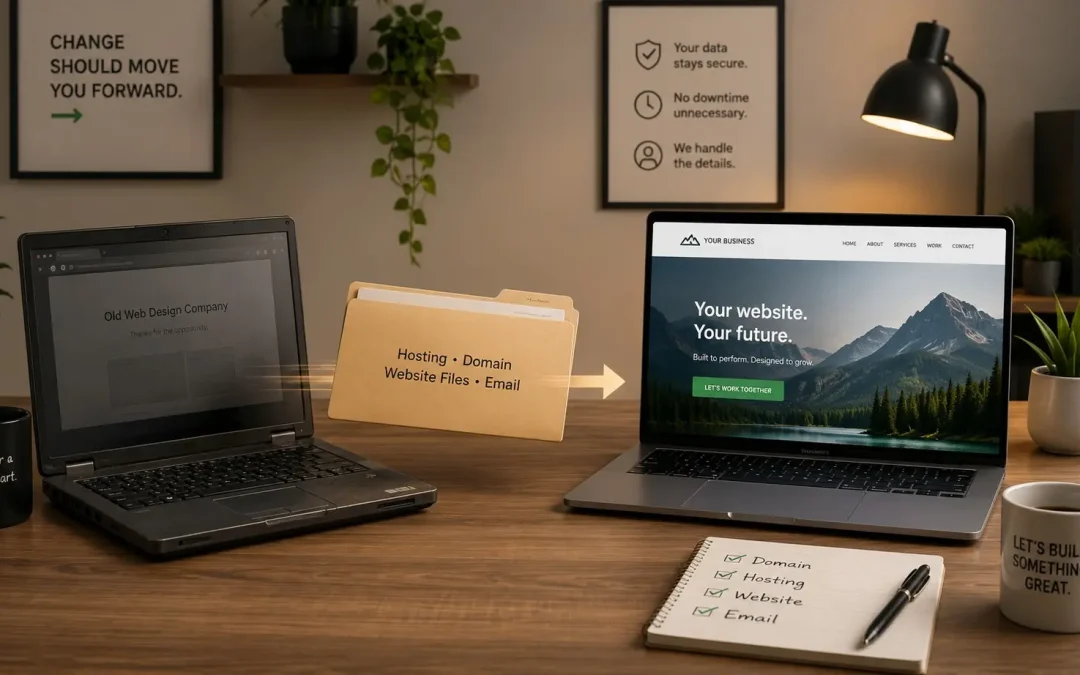
Post Summary: What the Move Involves, Start to Finish
If the domain is in your name, the whole thing comes down to one screen share. The new site gets built alongside the old one, you approve it, you change a couple of numbers in your domain account while we read them out, and an hour or two later the new site is live. Nothing goes dark in between.
If your current company holds the domain, a transfer adds a few days. It’s a standard request and they’re required to facilitate it.
The money already spent doesn’t come back by staying, which is the part that keeps people in place longer than they meant to. And for anyone who needs to see something real before trusting the arrangement, a fifteen page custom site has gone from start to live in seven days.
Why Switching Feels Bigger Than It Is
If you’ve been telling yourself “maybe it’ll get better” for six months, you already have your answer. The question is what’s kept you from acting on it.
Usually it’s not the process. Moving to a new web company is straightforward, and we’ll walk through exactly what it involves further down. What makes it feel heavy is that you’ve done this once already and it didn’t go the way you hoped. You absorbed the cost, adjusted your expectations, and told yourself you’d be more careful. Staying put started to look like being careful.
That’s a reasonable instinct, and it’s a common one. The situation you know is easier to picture than the one you don’t, even when the one you know is costing you every month.
It usually takes something concrete to break the pattern. A launch date that came and went. Pages still broken half a year on. An invoice arriving on schedule while nothing else does.
We’ve seen this play out plenty of times. Owners who’ve been unhappy for a year, sometimes longer, who arrive almost apologetic about not moving sooner. What we hear once they’re settled is usually some version of: “Finally. I feel like I got a win.”
That’s not relief about a website. That’s relief about something that had been quietly draining them for longer than they’d have admitted.
The Plumber Who Explained Sunk Cost
A plumber told us something years ago that we’ve never forgotten: don’t chase good money after bad.
It’s the clearest version of the sunk cost argument we’ve ever heard. Clearer than any economics textbook. And it applies exactly here.
You’ve been paying a web company $200 a month for 18 months. That’s $3,600. The site isn’t generating leads. The service has gone cold. But $3,600 is sitting in your head as a reason to stay, because if you leave now, you’ve “lost” it. If you stay a little longer, maybe you recoup it somehow.
That money is gone. It was gone the moment it was spent. Staying another six months doesn’t recover it, it adds to it. Every month you hold on hoping to break even is a month of additional cost on top of what’s already gone.
Think about it like a stock that’s down 20%. Everything points to further decline, but you hold because you want to get back to even. Then it’s down 30%. Then 40%. The original loss hasn’t changed, you just kept making it worse while waiting for something that wasn’t coming.
The money you’ve already spent is not a reason to keep spending. It’s a sunk cost. The only decision that matters now is what the next dollar buys.
If the next dollar buys you a web company that picks up the phone, builds what they said they’d build, and produces a site that earns back its cost, that’s the math that counts. Not the math behind you. And if the question underneath the money is whether you can afford to start over, affordable website design has a clearer answer than most people expect.
When Someone Has Been Through This Before
The most cautious people we talk to are the ones who’ve been through it more than once. Not just burned once, burned repeatedly, across different industries, by different companies. The sales pitch that overpromised. The service that evaporated. The billing that kept running while the relationship went cold. By the time they find us, the hesitation isn’t really about websites anymore. It’s a pattern recognition response. Every company they talk to gets filtered through every company that’s let them down.
For those conversations, we slow down. More meetings, not fewer. More reviews, more process walkthrough, more time before anything is signed. Nothing about that is a rush toward a signature.
We also have a practical tool for the most hesitant clients: we compress the timeline. We’ve delivered a finished custom site, over 15 pages, in seven days. That’s not standard, and it’s not something we offer to everyone on request. But for someone who needs a deliverable fast to believe the relationship is real, we can move that way. Getting a finished product in front of a nervous client early changes everything. The hesitation doesn’t vanish, but there’s a lot less for it to stand on once the site is live.
What the Switch Involves, Step by Step
Here’s the reality: switching web design companies is not hard. Its reputation is worse than the reality. The process itself is simple.
If you own your domain, here’s what the switch looks like: we build your new site. You approve it. We get on a screen share, you log into your domain account, and we tell you exactly which numbers to change. You make the change. An hour or two of propagation time later, your new site is live. That’s the whole process.
If your current company holds your domain, which is a red flag on its own, and worth knowing before you sign with anyone, then a domain transfer is required. That takes a few extra days and some coordination, but it’s a standard process, not a crisis. We handle it regularly.
The content migration, the redirects if needed, the DNS, none of it requires you to become a technical expert. That’s our job. Your job is to approve the finished site and say go.
For the record: if a client of ours ever wanted to leave, we’d do the same process in reverse without hesitation. We’d transfer the domain out, hand over everything they own, and make it clean. That’s not an abstract promise, it’s how we’re structured.
The Six-Month Question
Six months is long enough to know. Not to be certain, but to have a clear enough picture to stop pretending.
Here’s a useful distinction: unhappy about the service is different from unhappy about the performance. If you launched a site two months ago and you’re not on page one of Google yet, that’s not a service failure, that’s an expectation mismatch. SEO takes time. That’s real, and no reputable company will tell you otherwise.
But if you’re unhappy because the site has unresolved issues six months after launch, broken forms, pages that look wrong on mobile, changes you’ve requested that haven’t been made, that’s a different conversation. Website-related issues after launch should be cleaned up within two weeks. If something is still visibly broken six months later, that’s not a performance problem. That’s a service problem. And service problems don’t age well.
The “maybe it’ll get better” loop usually means one of two things: either the problems are real and fixable but nobody’s fixing them, or the relationship has already run its course and you’re waiting for permission to leave. Either way, staying another six months doesn’t resolve it. It just means six more months of the same.
Come talk to us. Bring the specific issues. We’ll tell you if they’re things that should have been fixed, and we’ll tell you what fixing them would look like on our end. No obligation. Just a straight answer, which is something you should have been getting from your current company all along.
If the hesitation isn’t really about the current company but about a deeper reluctance to commit to a website at all, the post on why businesses don’t have websites names the real blockers more clearly than most people expect.
Every month you stay is a month of lost leads. That was true six months ago. It’s still true today.
Frequently Asked Questions
Will I lose my existing website content when I switch?
Not if we’re doing the switch. We build the new site alongside your existing one, your current site stays live until the new one is approved and ready. Nothing goes dark during the transition. Content migration is part of the process, not an afterthought.
What if my current company owns my domain?
That’s the first thing to resolve, and it’s resolvable. A domain transfer is a standard process, your current company is required to facilitate it if you request one. If they resist or make it difficult, that resistance tells you something important about the relationship you’re in. We handle domain transfers regularly and will walk you through every step.
How long does the switching process take?
For most small business sites, two to four weeks from kickoff to launch, sometimes faster depending on how much content you have ready. If you’re in a situation where speed matters, tell us that upfront. We’ve launched complete custom sites in seven days when the circumstances called for it.
What if I’m locked into a contract with my current company?
Read it carefully, specifically the cancellation terms and what you own when you leave. Many web contracts are month-to-month even when they feel like long-term commitments. If you’re genuinely locked in, we can start building your new site now so it’s ready the day your contract ends. The wait is finite. The cost of staying indefinitely isn’t.
Is switching worth it if my current site has existing SEO value?
Yes, if done right. The key is preserving your URL structure and setting up proper redirects for any pages that change. SEO equity built on a site doesn’t have to disappear when you switch, it transfers if the migration is handled carefully. A site that’s properly migrated loses very little. A site that’s poorly migrated can take a hit, which is why the technical side of the switch matters.
What does Yeet Websites charge to switch me over?
The same as any new client: $600 setup fee for the subscription model, then $130 a month. There’s no “switching fee” or migration surcharge. You’re a new client. You get the same pricing and the same process as everyone else. The cost calculator on the site will show you the full picture before any conversation happens.