
Post Summary: What Breaks First, and Why You Won’t See It
The failures start underneath. Plugins fall behind, a certificate lapses, a backup stops running, and none of it shows on the homepage. Six to twelve months of nothing being done is usually where the first visible crack appears, and by then it’s been building a while.
The harder situation isn’t a company that vanishes. It’s one still invoicing after the work has stopped, where there’s never quite enough wrong to justify leaving.
One thing is worth checking today regardless of any of this: whose name the domain is registered in. If it’s not yours, and the relationship ends badly or the renewal lapses, the site, the address and the email tied to it all go with it.
The Plant Nobody Remembered to Water
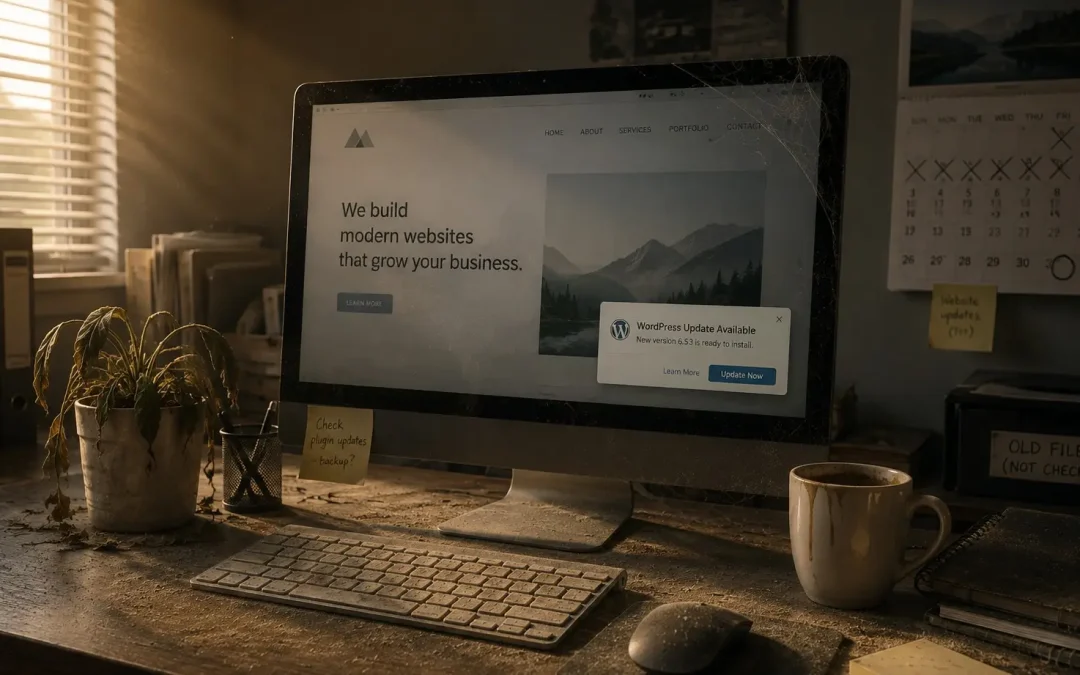
Picture a plant on a windowsill. Nobody killed it. Nobody decided to let it die. The owner just got busy, forgot a week, then two, then a month. The leaves started yellowing. Then wilting. Then one day it’s a brown, dried husk sitting in the same pot, in the same spot, like nothing happened. Still there. Just dead.
That’s what happens to an unmaintained website. Not a dramatic crash. Not a hacker wiping everything out overnight. Just a slow, quiet decline that’s easy to miss from the inside, because the site still loads, the phone number still shows, the logo still looks okay. To the business owner, it feels like the website is fine.
To the person looking at it from the outside? Something’s off. They can’t always name it. But they feel it.
If you’ve ever wondered what happens if I stop maintaining my website, or if you’ve suspected your web company has quietly stopped caring, this is what that looks like in practice. Not the theory. The pattern.
The First Things to Go Are Invisible
When a website starts dying, the visible stuff is the last to go. What breaks first is under the hood, and that’s exactly why nobody catches it.
Plugins go stale. WordPress runs on a stack of third-party tools, contact forms, image galleries, security scanners, caching layers, backup systems. Each one needs periodic updates. When nobody’s minding the store, that stack starts falling behind. And plugins that fall too far behind stop working properly, start conflicting with each other, or worse, become exploitable.
SSL certificates lapse. That little padlock next to your URL in the browser? It’s not decorative. It tells the visitor their connection is encrypted, their data is safe. When it expires, browsers throw a warning page. Not a subtle one, a full red-screen “Your connection is not private” message that most people treat like a stop sign. Visitors bounce. Some permanently. And if your web company isn’t watching, nobody tells you it happened. You find out when a customer calls asking if you got hacked.
Backups stop running. This one has no visible symptom at all, until your site gets corrupted, a plugin update goes sideways, or a host migration goes wrong. Then you find out you have no clean copy to restore from. The absence of maintenance only reveals itself at the worst possible moment.
None of this appears on your homepage. None of it shows in your analytics if nobody’s logging in to check. It’s all accumulating silently while you’re running your business, assuming someone else is handling it.
The Point It Becomes Visible
Eventually, it surfaces. And it surfaces in ways that make your business look bad, not your web company, not the technology. You.
Old pop-ups that nobody turned off are a classic. Something about a previous event, a deal that ended eighteen months ago, a holiday promotion from two winters back. Visitors see it and wonder if you’re still in business. Or if you’re competent enough to keep your own house in order. It’s a two-second impression that costs trust you’ll never know you lost.
Outdated menus or service pages. This is a collaboration issue, and a real one. If a restaurant client updates their menu but never sends us the new version, that old menu lives on the website until someone catches it. We watch for these things. We’ll reach out if something’s clearly seasonal or time-sensitive. But we’re not psychic, we can’t update what we don’t know has changed. When the web company isn’t talking to the client, both sides assume the other is handling it. Nobody is.
Videos that stop loading. Embedded videos from third-party platforms sometimes go dead when those platforms change their embed behavior. Nobody catches it because nobody’s testing the site. A visitor clicks play and gets nothing, just a broken gray box where there should be social proof or a product demo.
The cumulative effect is subtle but devastating: the business starts looking like it’s not doing well. That’s the consumer takeaway from a stale website. Not “this company’s web company stopped paying attention.” Just: “this business is struggling.”
The Version That’s Harder to Spot
There’s a version of neglect most people know, the company that ghosts. They take your money, stop answering emails, and eventually disappear entirely. That’s bad. But there’s a version that’s harder to spot because it looks like service.
The company still billing while the work has stopped. Tickets get answered eventually. Someone is technically reachable. The account has drifted down the priority list without anyone saying so. Nothing obvious enough to justify canceling. Nothing good enough to feel like you’re getting what you paid for. You can’t put your finger on it, so you stay. Month after month.
A business owner isn’t going to catch this on their own. If you’re a plumber, plumbing is your expertise. That’s what you’re good at, and it should be. Websites aren’t supposed to be your second job. You’re not meant to audit your own plugin stack or test your SSL certificate or verify that your backup ran last Tuesday. That’s the web company’s job. And when they stop doing it quietly, when nothing breaks dramatically, things just slowly get worse, you have no way of knowing unless someone tells you.
This is where the relationship matters as much as the technology. A web company doing their job doesn’t just fix problems. They catch problems before you’d ever notice them. They’re the ones who see the SSL expiring three weeks out and renew it before the red screen ever appears. They’re the ones who notice that old banner from last holiday season and reach out. The quiet signs that a web designer has stopped caring are often the exact things they stopped doing proactively, not anything you’d ever think to ask about.
Who Holds the Domain
Here’s the scenario that turns a bad situation into a catastrophic one.
A web company builds your site, registers your domain on your behalf, and holds it in their account. You’re paying monthly. The site is up. Everything seems fine. Then the relationship ends, either they ghost, or you leave, or something falls apart, and you can’t get to your domain because it’s not in your name. It’s in theirs.
We went through a full server migration recently, changed every client’s A record, which is the DNS setting that tells the internet where your website files live. That’s a significant process. We were able to execute it for almost every account without issue. But there was one client whose domain was still held by an old web developer who hadn’t built them anything in years. That person was still alive, still reachable, thankfully, and we were able to get it sorted. But the client had no control over that outcome. If that developer had been unreachable, the site would have gone down and stayed down.
If your domain expires while it’s in someone else’s account, you lose it. A competitor can scoop it up. You lose all the search equity you’ve built on that URL. You lose the email addresses tied to it. You start over, completely, from zero, not because your business failed, but because a web company held something that should have been yours.
Get your domain in your name. If it’s not there right now, ask. If your web company makes that difficult or inconvenient, that hesitation tells you something important about how they view the relationship. That resistance is one of the clearest red flags a web company can show you.
Ghosted vs. Still Billing: Both Require Your Attention
Being ghosted is at least legible. When a company disappears entirely, you know. You stop paying. You start looking for someone new. You might lose time and money, but the situation is clear. You can act on it.
The billing-while-neglecting situation traps you. You keep paying because you’re not sure anything’s wrong. The company stays just responsive enough to keep you from canceling. Months accumulate. Meanwhile, plugins are aging, the site’s falling behind on performance, small problems are compounding into bigger ones, and you have no idea because the invoice keeps going out and the invoice keeps getting paid and everyone’s behaving as if service is being rendered.
The gap between what gets promised at the sale and what gets delivered afterward isn’t usually malicious. It’s structural. Sales teams get rewarded for signing new clients. The incentive to keep existing ones performing at a high level is often much lower. So the relationship degrades, not because of bad character, just because the economics of the arrangement don’t require anything better.
The economics don’t require anyone to watch your site closely. Someone still has to.
When the Site Still Loads: Should You Be Worried?
Here’s the question we get: “I haven’t heard from my web company in three months. Should I be worried?”
Probably not, if the agreement is being fulfilled and the site is doing what it’s supposed to.
Think about your Netflix subscription. Netflix doesn’t call you to check in. They don’t send a monthly update saying “we added more content, your shows still work, the app is performing normally.” They just deliver the service. Silence isn’t neglect when the thing works. If you agreed to a website and a web company is maintaining it, hosting it, and keeping it secure, and the site is up and functional, three months of no contact isn’t a red flag. It’s just how subscriptions work.
The question to ask isn’t “when did I last hear from them?” It’s “is the site performing?” Is it loading fast? Are the plugins current? Is the SSL active? Is the contact form delivering leads? If you don’t know the answers to those questions, that’s worth a conversation with your web company. A good one will walk you through it without making you feel stupid for asking.
If you’re not sure what you’re getting for your monthly spend, or you’re starting to suspect things have quietly gone sideways, call us. We’ll look at your current situation and give you a straight answer. If everything’s fine, we’ll tell you. If things can be improved and you’re open to it, we can talk about what that looks like.
The Conversation Most Business Owners Never Have
Here’s a scenario that plays out more than it should.
A business owner has been with the same web company for two years. The site looks fine. They haven’t heard much from the company, but they haven’t needed to. Then something breaks, a form stops delivering, a page goes blank, a customer calls to say the site threw a security warning. They contact their web company. Response takes three days. The fix takes another two. And somewhere in that process, they discover the last plugin update was fourteen months ago.
Not malicious. Nobody made a decision to let it slide.
It just slid.
The question to ask your web company isn’t “is everything okay?” That question always gets a yes. The question is: “when did you last update our plugins, check our SSL, and run a backup?” If they can answer that with a specific date, great. If they get vague, or redirect to something else, that vagueness is the answer.
We’re not perfect at this either. If you don’t tell us something’s changed, we can’t act on it. The content side is a collaboration, we’re watching the technical side; you’re the one who knows your business changed, your menu updated, your event passed. When both sides show up, the site stays healthy.
When only one side does? You get the plant on the windowsill. Still there. Nobody watered it. And the window it’s sitting in faces your customers.
Frequently Asked Questions
How long does it take for a neglected website to show real problems?
It depends on the site’s setup, but most websites start showing visible cracks within six to twelve months of zero maintenance. SSL certificates typically expire annually. Plugin conflicts tend to surface faster than that, especially after WordPress updates. Security vulnerabilities can be exploited much sooner if plugins aren’t patched. The invisible damage accumulates faster than the visible stuff.
Can a neglected website hurt my search rankings?
Yes, meaningfully. Google’s crawlers evaluate page speed, security status, and crawlability on every pass. A site with an expired SSL gets flagged. A site weighed down by bloated, outdated plugins slows down. Slow, insecure sites get deprioritized. The ranking effects are gradual but real, and they compound the longer the neglect continues.
If my site is still loading, does that mean it’s healthy?
Not necessarily. A site can load fine while running outdated plugins, an expired or expiring SSL certificate, no active backups, and a plugin stack that’s quietly conflicting under the surface. Loading is the most basic measure of site health, it just means the server is responding. There’s a lot that can be wrong underneath that.
What’s the difference between Yeet’s subscription service and just paying for hosting?
Hosting keeps the files on a server. That’s it. Our subscription covers the website itself, builds, edits, security, plugin management, backups, and support when something comes up. Hosting is infrastructure. Our service is what makes the infrastructure useful to a real business.
What happens to my website if I stop paying my web company?
That depends on the terms you agreed to. In some cases the site goes offline immediately. In others, the files get archived and you have a window to retrieve them. If you own your domain and your hosting is separate, you have more options. If the web company controls both, you have fewer. This is why we give clients full domain access and ownership control from day one.
How often should a web company be in touch even if nothing’s wrong?
There’s no magic number, but once a quarter is a reasonable baseline. A good web company should be reaching out proactively when something warrants attention, a plugin update that needs your sign-off, a seasonal piece of content that should come down, a feature that’s underperforming. If you haven’t heard anything in six months and nobody’s watching, that silence isn’t professionalism. It’s absence.
Is it possible to get my website out of a bad web company’s control?
Usually yes, but the process depends on who owns what. If you own the domain, you can point it wherever you want. If the company owns the domain, you’d need them to transfer it, or wait for it to expire and buy it when it drops, which carries some risk. The website files themselves belong to whoever built them, legally, unless your contract says otherwise. This is exactly why we build on platforms clients can take with them, and why we push hard for domain ownership from the start.