
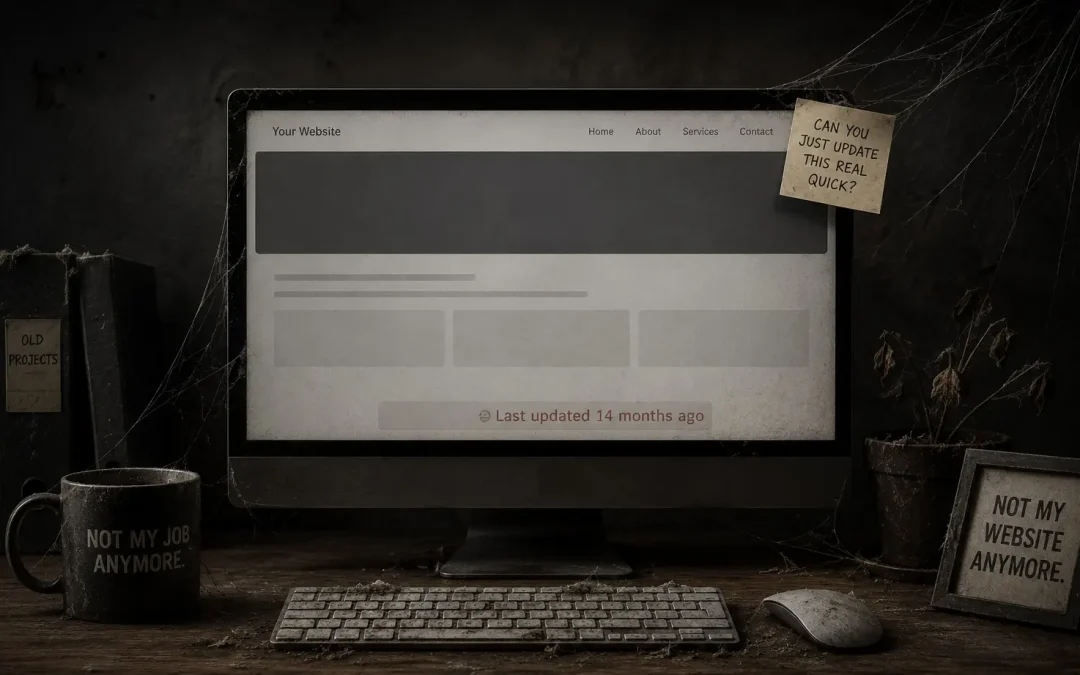
Post Summary: The Response Times Slip First
Nobody announces it. What used to come back inside an hour takes a day, then two, and the wording starts sounding like it was written for anyone. Updates get done to the letter of the request and nothing more. Problems come back as explanations instead of fixes.
Underneath, the site is drifting: plugins behind, a certificate close to lapsing, images broken on pages nobody has opened in a while.
The cause is usually structural rather than personal. Selling brings in money and maintenance doesn’t, so attention flows one way. And when a builder moves on, whoever inherits the account starts from nothing on a relationship that was two years in.
Below: what to check this week, and how to raise it without setting fire to the relationship.
It’s Not Ghosting, It’s Worse
Ghosting is obvious. The emails stop. The calls go to voicemail. You know something is wrong because the silence is deafening. It’s painful, but at least it’s clear. You can name it. You can act on it.
What’s harder to name, and far more common, is the company that’s technically still there. They respond to your emails. Eventually. They pick up when you call. Sometimes. They do the work you ask for. Sort of. But something has changed and you can feel it in your gut even if you can’t point to a single dramatic failure.
The quality is fading. The energy is gone. None of it is loud. It’s quiet. A slightly longer response time. A slightly less polished update. A slightly more generic tone in the emails that used to feel personal. It’s death by a thousand paper cuts, and by the time you’re bleeding enough to notice, you’ve been settling for months.
This post is about naming what you’re feeling, because once you can name it, you can decide what to do about it.
The Slow Decline That 99% of Clients Describe
When business owners come to us from another provider, we ask what happened. And the answer is almost always some version of the same story: “The first few weeks were great. Then everything changed.”
Ninety-nine percent. That’s not an exaggeration. It’s the most common thing we hear. And it never makes sense to us, because why would you treat the person who’s paying you every month worse than the person you’re trying to convince to pay you? The attention span companies have for prospects versus existing clients is backwards. The prospect gets the red carpet. The client gets the hallway.
We think of client relationships like a marriage. The onboarding phase is exciting, it’s new, it’s full of possibility, you’re learning about each other. But a long-term marriage is more enjoyable, more meaningful, and more rewarding than the honeymoon phase ever was. That’s what client relationships should be. And like any good marriage, it requires respect for the other person at every stage, not just the beginning.
When that respect fades, the signs show up before the client can articulate what’s wrong. They just know something feels different. And they’re right.
The Four Quiet Ones
The loud version is easy to spot: missed deadlines, broken promises, radio silence. But the quiet version is what catches most business owners off guard. Here’s what it looks like from the inside:
Response time creep. Week one, they replied same-day. Month three, it’s 48 hours. Month six, you send a follow-up to your follow-up. Nobody announces the decline, it just happens, so gradually that you adjust your expectations downward without realizing it.
Generic communication. Early on, the emails felt personal. They referenced your business, your goals, your last conversation. Now the emails could be sent to anyone. Template language. No specifics. The person writing to you doesn’t remember what you talked about last month, or doesn’t care enough to check.
Minimal effort on updates. You ask for a change and it gets done. Technically. But there’s no craftsmanship in it anymore. No “while I was in there, I noticed this other thing and fixed it too.” No proactive suggestions. Just the bare minimum of what was requested, executed with the enthusiasm of someone watching a clock.
Excuses replacing ownership. When something goes wrong early in a relationship, a good company owns it immediately. “That’s on us, we’ll fix it today.” Six months into a declining relationship, the same problem gets a different response. “That’s a hosting issue.” “That’s been there since the build.” “We’ll look into it.” Deflection replaces accountability, one small excuse at a time.
Disappeared vs. Stopped Caring: Two Different Problems
A company that disappears just stops communicating. You can’t get a hold of anybody. If you do reach someone, they say they’ll take care of it and then don’t. It’s frustrating, but the diagnosis is simple: they’re gone. Time to move on.
A company that stops caring is more insidious. They’ll still work with you, but the quality of work is so low that it’s clear they don’t want your business anymore. And sometimes that’s strategic. They might be changing their pricing model and you’re paying so little they figure you won’t pay double. So they give you the minimum resources until you leave on your own. They don’t fire you, they bore you into quitting.
Sad, but it happens more than you’d think. The incentive structure rewards it. Keeping an unhappy low-revenue client on life support costs less than having an honest conversation about whether the relationship should continue. So they coast, and you pay for the privilege of being neglected.
What a Neglected Website Looks Like Under the Hood
When we take over a site from a company that was phoning it in, the pattern is consistent. And here’s what’s interesting: it’s almost never a case where the site was dynamic and well-built and then fell apart. Usually, the initial build was mediocre from the start. The only thing keeping the client around was the customer service, and once that dropped off too, there was nothing left to hold the relationship together.
Under the hood, we typically find:
Outdated code and plugins. WordPress sites need regular updates, themes, plugins, PHP versions. A neglected site has plugins that haven’t been touched in months or years. Some are no longer supported by their developers. Each one is a potential security vulnerability and a performance drag.
SSL certificate issues. That little lock icon in the upper left corner of your browser? It means your site’s connection is secure. When an SSL certificate isn’t maintained, that lock breaks, and visitors see a warning that the site isn’t safe. Some browsers won’t even load the page. This is basic maintenance that takes minutes, and neglected sites fail at it because nobody’s watching.
Broken images and formatting. Links that go nowhere. Images that don’t load. Mobile layouts that are misaligned. Forms that stopped working months ago and nobody noticed because nobody tested them. The site looks fine at a glance, but spend sixty seconds clicking around and the decay is everywhere.
No performance monitoring. No analytics tracking. No uptime monitoring. No speed checks. The company has no idea whether the site is performing well or performing terribly, and they don’t care to find out, because caring requires effort.
We don’t fix sites like this. We rebuild them. Because patching a neglected site is like remodeling a house with a cracked foundation. You can paint the walls and replace the fixtures, but the structural problems remain. Start clean. Build right. Maintain it properly from day one.
The Incentive Problem
The short answer: the business model rewards acquisition over retention.
In most of these arrangements, sales generates revenue. Maintenance doesn’t, or at least, not the exciting kind. A new $5,000 build looks great on a quarterly report. A $130/month maintenance client doesn’t make anyone’s highlight reel. So the company’s energy, attention, and best people flow toward new business. Existing clients get whatever’s left over.
And when clients start leaving faster than they arrive, the pressure tends to land on sales rather than on retention. Offset the losses with new logos. Frontload revenue to paper over the fact that the backend is falling apart.
It’s a loop. The harder the push for new sales, the less capacity there is for existing clients. The worse the service gets, the faster those clients leave. The faster they leave, the harder the push. Nothing in that cycle asks whether the problem is the product rather than the pipeline, and the client sitting inside it is the one absorbing it.
The other factor is staffing. Good web developers are hard to find and expensive to keep. When the person who built your site leaves for a company that pays more, you get reassigned to whoever’s available, someone who doesn’t know your site, your business, or your preferences. They’re doing their best with incomplete information, and “their best” is noticeably worse than what you had before. Not because they’re bad at their job, because they’re starting from zero on a relationship that was at year two.
Three Things to Check This Week
Most business owners don’t know what to look for. They check whether the site loads and assume everything is fine. The real indicators are in the details, and here’s a more honest checklist:
Does the site look like it’s being maintained? Check the footer, does it still say last year’s copyright date? Check the blog, is the most recent post from eight months ago? Check the contact form, does it still work? These are the canaries in the coal mine. If the visible stuff is stale, the invisible stuff is worse.
Are you getting what was promised? Pull out the original agreement or the email from when you signed up. Were you promised monthly reports? Are you getting them? Were you promised updates within 24 hours? Is that happening? The gap between promise and delivery is the gap between caring and coasting.
Test the communication. Send an email. See when they respond. Call and see if they pick up. Text and see if you hear back. Not as a gotcha, as a genuine test of whether the systems they promised on day one still function on day 180.
But here’s the part most people miss: check your own expectations. If you signed up for a website and you’re frustrated because you’re not ranking number one on Google, and you never signed up for SEO, the company isn’t the problem. A website without SEO is like setting up a booth in a convention center with a million other business owners. Your banner’s there. Your business cards are on the table. But nobody’s walking people over to your booth. That takes a different investment entirely, and a website by itself is just the booth. You need someone actively directing traffic to it, and that’s not what a website alone does. It’s not fair to blame the web company for a service you didn’t purchase.
The honest test is: are they doing what they said they’d do? If yes, they care. If no, they don’t. It really is that simple, which is why the companies that do care aren’t afraid of the question.
When to Give Benefit of the Doubt
Here’s something we tell every business owner who comes to us frustrated with their current provider: if the company was great for two or three years and then suddenly went dark, something might be wrong on their end. Illness. A personal crisis. A key employee leaving. That kind of sudden drop-off after years of good service doesn’t happen because someone stopped caring, it happens because something disrupted the machine.
Before you switch, do your due diligence. Call every number. Try every channel. Send a genuine “is everything okay?” message. Because walking away from a three-year relationship without checking is the same lack of respect you’re upset about receiving.
But if the decline has been gradual, if the service has been slipping for months, if you’ve raised concerns and nothing changed, if the quality of work is consistently below what was promised, that’s not a disruption. That’s a pattern. And patterns don’t reverse themselves because you complained once.
One more thing: make sure you have control over your domain. If your web company registered your domain on your behalf and they’re the ones with the login credentials, you’re in a vulnerable position. Before you switch, secure that access. Otherwise you’re not just changing providers, you’re potentially losing your web address.
Frequently Asked Questions
What’s the earliest sign that a web company is starting to coast?
Response time. It’s always response time. Before the work quality drops, before the communication tone changes, before anything visible happens on the site, the time between your message and their reply stretches. If you’re tracking it (and you should be), you’ll see the pattern weeks before anything else changes.
Is it normal for the level of service to change after the initial build phase?
The type of service changes, you move from active building to ongoing maintenance and growth. But the quality and responsiveness shouldn’t change at all. If your provider was responsive during the build and becomes unresponsive after launch, that’s not a phase change. That’s a priorities change. You moved from “revenue-generating project” to “recurring maintenance client” in their system, and their attention shifted accordingly.
How do I bring this up without burning the relationship?
Direct and specific. Not “I feel like things have changed”, that’s easy to deflect. Instead: “On January 3rd I sent a request and didn’t hear back for four days. On January 15th the update you made broke the mobile layout. On January 22nd I asked for a status update and got a one-sentence reply.” Facts are harder to argue with than feelings. If the company takes the feedback seriously, the relationship gets better. If they get defensive, you have your answer.
Should I check my website regularly even if I’m paying someone to maintain it?
Yes. Not because you should have to, but because trusting without verifying is how neglect goes unnoticed for months. Spend five minutes once a month: load the site on your phone, click through the main pages, fill out the contact form, check the footer date. If something is broken, you’ll catch it before your customers do.
What if the work is fine but I just don’t hear from them unless I reach out first?
That depends on what was promised. Some companies operate on a “we’re here when you need us” model, reactive by design. If that’s what you signed up for and the work quality is solid, silence between requests might be normal. But if you were promised proactive communication, monthly check-ins, performance updates, strategic recommendations, and you’re getting crickets unless you initiate, that’s a broken promise regardless of work quality.