
Post Summary: What Lands in Your Inbox, and When
Within a couple of hours of paying, a short email arrives. What was charged, what happens next, that nothing binds you and you can stop whenever you like, and an invitation to ask anything. That’s the whole of it.
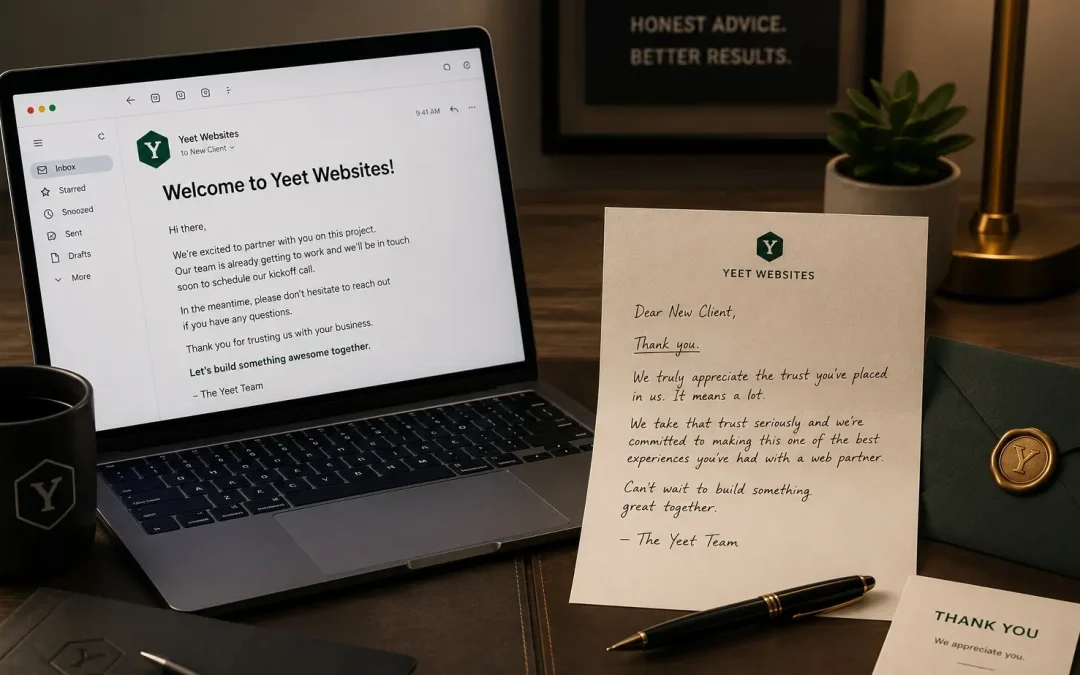
There’s also something in the post that same day, handwritten, with stickers and a card or two. People bring that one up years later.
Below: both versions of the email side by side, why each got shorter over time, and what the register of it tells you about the months ahead.
The Letter That Got a Phone Call Back
The best first impression we’ve ever made didn’t come from a great sales pitch. It didn’t come from a slick website or a perfectly timed follow-up call. It came from an email. A short, plain-text email that said exactly what it needed to say, and nothing more.
That’s not an accident.
A welcome email from a web designer is not really about the email. It’s about what the email signals. Before your new site is built, before a single pixel is placed, that first message tells you everything about how the next several months are going to feel. Is this company going to communicate clearly? Are they going to respect my time? Do they know what they’re doing, or am I about to spend the next six weeks chasing someone down?
The welcome email answers those questions before the client even thinks to ask them. So we’ve thought carefully about what ours says, and what it doesn’t.
The Two Versions, Side by Side
We have two versions: one for subscription clients and one for ownership builds. Here’s what they look like.
The subscription version:
Hi [Client Name],
We’re pumped to work on your site. I’ll reach out next week so we can meet up and you can see your new design. Once that’s approved, I’ll finish up your site.
Payment info: we’ve collected the $600 setup fee. In 30 days, your $130 subscription begins. None of our products have contracts, and you can cancel any time, all payments are final.
Questions, let me know.
Best,
[Signature]
The ownership version:
Hi [Client Name],
We’re pumped to work on your site. I’ll reach out next week so you can see your new design.
Payment info: we’ve collected the $4,000 one-time website investment. When the site launches, hosting will be $350 a year, hosting keeps your site online and includes 30 minutes of monthly website edits. None of our products have contracts, and you can cancel any time, all payments are final.
Questions, let me know.
Best,
[Signature]
That’s the whole email. Both of them. No paragraphs about our process. No excitement about what we’re going to build together. No lengthy next-steps and timelines and stakeholder touchpoints and project kickoff surveys.
Just what you need to know.
Two things worth pointing out. First: the meeting line isn’t generic. It reflects the actual conversation we had during onboarding. If we agreed on a specific day and time, the email says that day and time. If we left it open, it says I’ll reach out to schedule. Second: neither email is a template sent to a list. The client name is typed. The details match that client’s product. The whole thing is supposed to feel like it was written for them, because it was.
The billing transparency carries through to everything that follows, including how our invoices work throughout the relationship. Same principle: no ambiguity, no surprises.
What It Should Feel Like to Open
There’s a specific feeling we’re trying to produce with the welcome email, and it’s worth being precise about what that is. When someone finishes reading it, we want them thinking: this little legit company is giving me the information I need and isn’t overwhelming me with all this BS that I don’t need.
That’s the target. Not impressed. Not wowed. Not reassured by three paragraphs about our commitment to their success. Just: settled. Clear. Confident they made a good call.
Everything in the email is engineered to land that feeling. The plain text format, no graphics, no branded header, no color-coded sections. The short paragraphs. The payment information stated clearly and without hedging. The line about no contracts and the ability to cancel any time. The direct invitation to ask questions.
We’ve noticed that clients who sign and immediately feel clear and settled tend to stay that way. The ones who sign with a vague sense of “I think this is right but I’m not sure what happens now”, they generate a lot of check-in emails in week two. That’s not the client’s fault. That’s a communication failure in the first 24 hours, and the welcome email is where it starts.
An email that’s trying too hard to impress is covering for something. This one isn’t covering for anything. It’s not building to a sales ask. It’s not warming you up for a cross-sell. It’s a communication from one person to another that says: here’s what’s happening, here’s what you paid, here’s what comes next.
No performance. Just the information.
Every One Is Written Fresh
We have these preloaded so we’re not writing from scratch every time, that would be a waste of time. But every email that goes out is customized. The meeting line changes. The payment details match the actual product. The client name isn’t a merge field.
Why does this matter? Because a template reads like a template. Clients can tell when they’ve received the same email that went to the person before them. And the thing a template communicates, even a well-designed one, is that you are a unit of throughput. A processed account. An activation event in a workflow.
We know what we discussed on the call. The email should reflect that. If it doesn’t, the client immediately wonders whether the person on the call is the same person handling their site, or whether they’ve already been handed to a system.
They haven’t. There is no system. There is one person who talked to you, and that’s the person writing this email and building your website.
The Letter That Follows
Every new client gets something in the mail.
An actual handwritten, personally signed letter, customized to them. Some stickers. A couple of business cards. Sent the same day they sign.
We’re old school and Gen X, and we think getting letters is awesome. But it’s more than nostalgia. In 2026, when everything is digital and instant and automated, a piece of physical mail from a company you just hired creates a different experience than anything that lands in your inbox. Your inbox is full. It’s been full for years. There’s a psychological ceiling on how much any email, even a good one, can do, because it arrives in the same place as everything else competing for your attention.
Something in the mail is different in a way that’s hard to articulate until you receive one. You hold it. You open it. It’s slow on purpose.
And the specific details matter. Handwritten means someone sat down and wrote your name and thought about what to say. It wasn’t generated and printed. It wasn’t produced by a system that also handles 40 other clients that week. Stickers are personality, they say the company has one, that there’s a human being running it who thought about what to put in the envelope. Business cards are practical: now you have something to hand to someone when you’re telling them about the company that built your site. Same day means it went out before we moved on to the next thing. It wasn’t sitting in a “to-do” pile. It was the first thing we did after you signed.
None of that is strategy. It’s just the right thing to do, and it’s consistent with how we think about communication everywhere else. Plain. Personal. Specific. No performance.
The clients who mention the letter usually mention it weeks later, usually when something else is going well. “Also, I got your letter, thank you.” That’s the landing it gets. Not a big reaction. Just a quiet acknowledgment that someone did a thing they didn’t have to do.
That’s the whole point.
Why It Kept Getting Shorter
The current welcome email is not the welcome email we sent five years ago. It has been revised down, deliberately, repeatedly, until what remains is only what needs to be there.
The early versions were longer. They had qualifiers. Sentences that existed to protect us rather than inform the client: language about timelines being subject to change, notes about what counts as a revision, reminders about what’s included and what isn’t. All of it technically accurate. All of it building a hedge around the relationship before the relationship had even started.
What we figured out, and it took longer than it should have, is that every qualifier is a signal. Not the signal you intend, but the signal it sends: we’re already thinking about what happens when something goes wrong. We’re covering ourselves before we’ve done anything. We want you to have agreed to this in writing before you have any reason to disagree.
That’s not the relationship we want to establish in the first email. That’s an adversarial posture dressed up as thoroughness.
So they came out. One by one. Anything that was in the email for us, not for the client, got cut. What’s left is what the client needs to know in the first 24 hours: when we’ll talk next, what they paid, what comes after that, and the standing invitation to ask questions.
The discipline of trimming is harder than it looks. Adding feels productive. Removing requires you to ask an uncomfortable question: who is this sentence for? If the answer is “for us”, to protect us, to document something, to establish a standard we can point back to, it doesn’t belong in the welcome email. The welcome email is for the client.
That’s the standard. It still is. Everything that gets drafted for any communication goes through the same filter. Does this serve the reader, or does it serve us? If the answer is the latter, it gets cut.
What the Tone Is Telling You
Consistency is the real point, and it’s worth developing what consistency means in practice, because it’s easy to say and hard to execute.
If our calls are no-jargon and direct and we answer questions without hedging, and then the first email we send after you sign is a six-paragraph onboarding document with bullet points about project phases, that doesn’t add up. The person on the call has apparently been replaced by a marketing department. The client doesn’t know who they hired anymore.
We try to stay consistent with all forms of communication from launch and out into year one, two, three and beyond, to year five and ten. Same process. Same tone. Same person.
Think about why McDonald’s works the way it does. Whatever you make of the food, you know for a fact you’re getting the same thing whether you walk into the one in Chattanooga, Tennessee or San Ramon, California or New York, New York. Same awful burger. Guaranteed. That knowing, that reliability, is the whole product.
Now apply that to a web company. What does it mean for a client to receive consistent communication not just in the first email, but in year four?
It means when you email at 10 AM on a Tuesday in month 42 of the relationship with a question about your site, you get the same voice you got in the welcome email. Same directness. Same speed. Same person who doesn’t require you to re-explain the context because they already know your business. The welcome email wasn’t a first impression, it was a sample of what every impression is going to feel like. It was setting a standard that we then have to hold for as long as the relationship lasts.
Most clients don’t think about it that way when they read the welcome email. They’re just relieved that it makes sense. But the ones who stay for years, and we have clients from 2021 still with the same person, eventually name it. They’ll say something like: “I’ve worked with a lot of vendors and you’re the only one where every interaction feels the same.” They mean it as a compliment. We take it as proof the system is working.
Your brand is exactly represented the way you want it with every touch point. The welcome email is one touch point. The invoice is one touch point. The call four months in is one touch point. The way we explain things throughout the relationship is one touch point, and that commitment to plain language over jargon runs through all of it. They should all feel like they came from the same company, because they did, and because we built it that way on purpose.
The tone of the first email sets the standard. Everything after it gets measured against it. We know that, which is why we take it seriously.
What It Deliberately Leaves Out
We don’t know what other companies send as their first communication after you sign. We’re not particularly interested in finding out. We don’t track competitor behavior and reverse-engineer our process off of it.
We speak to our process because we know clients and we know people. We’ve been doing this a super long time, and this is what works. Has it refined over the years? Absolutely, see above. And it’ll keep refining. If we find something in the email that exists for us instead of for the client, it’ll come out.
But the core has been stable for a long time, and the core is simple: tell them what they need to know, make it easy to read, sound like a person, get out of the way.
That’s it. That’s the welcome email philosophy. If you’ve never signed with a web company that communicated that way from the very first message, and kept communicating that way three years later, that’s something we’d like to change.
Talk to us.
Frequently Asked Questions
Why is the welcome email in plain text instead of a designed HTML email?
Because designed email templates are for marketing campaigns, newsletters, promotions, announcements. The welcome email isn’t a campaign. It’s a direct communication between the person who built your site and the person who hired them. Plain text is more personal. It reads like an email from a human, because it is one. A branded HTML email in that moment would say: you’ve entered a pipeline. We don’t want that to be the first thing you feel.
Does every client get the same welcome email?
Every client gets an email built from the same structure, but customized to them, the product they chose, the payment details relevant to their situation, the timing of the next meeting based on the actual conversation we had. Nothing in it should feel like it could have been sent to anyone else. A handwritten note goes in the post that same day, because some things still work better on paper.
What payment information is in the welcome email, and why include it?
We include exactly what was collected and exactly what comes next. Subscription: the setup fee and when the monthly rate begins. Ownership: the one-time investment and the annual hosting cost, which covers monthly website edits. The reason it’s in there: if you’re paying for something, you should understand what it is. No ambiguity about what you were charged. No surprise when the next billing cycle hits. People can do the math, that’s the point.
Why did the welcome email get shorter over time?
Early drafts carried hedges written to cover us rather than tell you anything. Those came out, one by one. Trimming like that requires asking who each sentence is serving. If the answer is “us,” it doesn’t belong there.
How does the welcome email tone carry through the rest of the relationship?
The register holds across everything, through year one and year ten alike. Same process, same person. Whatever level that first note sets is the one everything after gets measured against. Clients who’ve been with us for years eventually name it: every interaction feels the same. That’s not accidental. That’s the whole system working the way it’s supposed to.