
Post Summary: Every Line on the Bill, in Plain Words
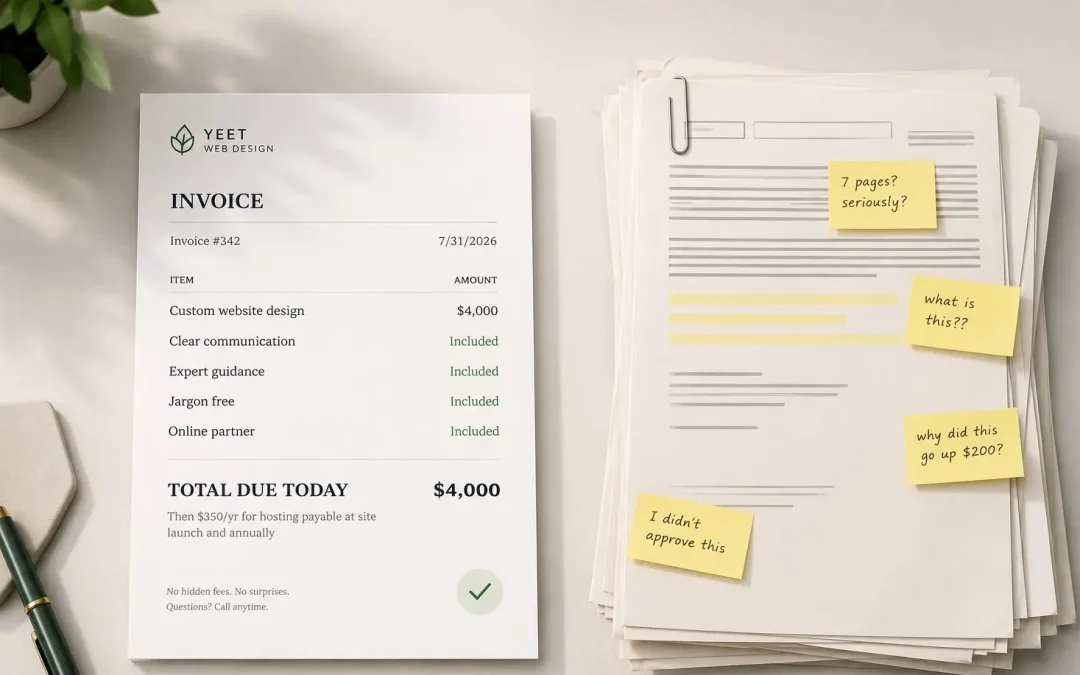
The bill lists what was done, in words anyone can read. The site itself, the design, the development, mobile, post-launch setup, and what happens each month afterward. Point at any line and there’s a straight answer about what it covers.
The test it has to pass: could you hand it to a spouse or a business partner and have them follow it without you sitting there explaining.
Below: the full list of what’s on it, why a sparse bill is a worse problem than a confusing one, and what to do if your current invoice doesn’t explain itself.
What a Real Invoice Explains That a Vague One Doesn’t
You’ve probably looked at an invoice from a company before and had to read it twice. Not because the numbers were confusing, but because the line items meant nothing. “Digital infrastructure maintenance.” “Strategic platform hosting.” “Tier 2 content optimization.” You paid the invoice. You’re not even sure what half of it was for.
That’s not billing. That’s camouflage.
When you pay someone $130 a month for a website, you should be able to explain exactly what that $130 pays for. Not because you need to audit us, because understanding what you’re getting is basic respect. And the fastest way to show you there’s nothing to hide is to put everything on one page and hand it to you.
That’s the philosophy behind our simple web design invoice. It’s not just a design preference. It’s a statement about how we do business.
What Sparse Billing Looks Like in Practice
We’ve seen invoices from other web companies, not often, but enough. And the problem isn’t usually that the bill is confusing. The problem is that it says almost nothing.
Four keywords. $800. That’s the entire SEO explanation.
If you’re paying $800 for SEO work, you deserve more than two words and a number. You’d want to know: what keywords? Researched how? Placed where? What work was done? Imagine going to the mechanic because something’s knocking, and the quote comes back: “Engine. $2,000.” You don’t know if it’s the whole engine. You don’t know if it’s a part. You don’t know what parts are going in, what tools are being used, whether they’re pulling and replacing or doing something surgical. You’d ask. You’d push back. You’d want a real explanation.
Sparse invoices have persisted for a long time, because most business owners don’t know exactly what goes into building and maintaining a website. That information gap is where sparse billing survives. A line item nobody can explain can carry any number and any name.
That’s not the way we operate. Transparency isn’t just something we say, it’s what makes the billing relationship work without friction or suspicion.
What a Simple Web Design Invoice Shows
Ours isn’t a two-line invoice. It’s detailed, because the work is detailed. Every category of what we do is listed, and the scope within each category is spelled out. Not in jargon. In plain language that a business owner can read without a translator.
Here’s what’s on it.
To start the subscription it’s $600 one time setup fee. 30 Days from setup payment your $130/month subscription will start and every month thereafter. No contracts. All payments are final.
That’s not a mystery. That’s a list. You can point to any item and ask about it, and you’ll get a straight answer.
Why It All Fits on One Page
Everything above lives on a single page. That’s the standard we hold ourselves to, not a stretch goal.
It’s built to function almost like a reference sheet, something you could hand to a spouse or business partner and have them understand what you’re getting without needing you to explain it. Easily consumable, even when it covers technical ground.
The idea is simple: no one should need a decoder ring to read what they’re being billed for.
For clients who primarily pay through our online system, invoices don’t come automatically, everything is just included. But they’re available whenever you want one. Ask and it’s there.
Sparse Is a Different Problem Than Confusing
It’s rarely that a web company’s billing is confusing, it’s that it’s sparse. There’s a difference.
Confusing billing has too many line items that don’t track. Sparse billing has almost none. And sparse billing serves one purpose: it keeps you from being able to do the math.
When a bill is clear, the client can look at it and decide whether the value matches what they’re paying. They can say, “I’m getting X, Y, and Z for this amount, okay, this makes sense.” That’s arithmetic. And arithmetic is empowering. When the bill is vague, that calculation isn’t possible. You can’t weigh value you can’t identify. You can’t push back on line items you can’t read.
We don’t have anything to hide in the billing. So we don’t hide it. If you’re looking at an invoice from your current web company right now and can’t explain what half the line items mean, you should ask. They might be doing right by you. If you have a real relationship with a company, give them a chance to explain it. Most of the time that conversation reveals whether the ambiguity was intentional or just lazy formatting.
But if you give them that chance and they can’t account for what you’re paying for? That tells you something.
What This Has to Do With the Whole Communication Philosophy
The invoice is one artifact in a larger system. The welcome email we send on day one, the plain-English way we explain every decision during the build, the way we answer questions without hedging, all of it connects. An invoice that doesn’t need decoding is just that philosophy applied to billing.
It’s the same reason we don’t use jargon in conversations. If you’re paying for something, we think you should understand what it is you’re paying for. Not because you have an accounting background or a technical degree. Because you’re an adult who runs a business and you’re writing a check to someone every month. Understanding what that check buys isn’t an unreasonable ask.
We’ve seen what the alternative looks like when people come to us after years of sparse invoices. The feeling isn’t just confusion, it’s a low-grade suspicion that they’ve been paying for something without fully knowing what. That suspicion is corrosive to a client relationship. A clear invoice is one of the simplest ways to make sure it never starts.
That ties directly into the communication standard we hold ourselves to across every touchpoint, not just invoices, but conversations, updates, and every question you ask during the build or after.
Is This Unusual? More Than It Should Be
It shouldn’t be unusual to receive a clear bill from your web company. But it is. Vague has been the default long enough that a detailed invoice can read as excessive.
We’d rather be accused of over-explaining what you’re paying for than under-explaining it.
The list of what’s included exists because the work exists. We didn’t pad it to make a point. Custom design takes time. Mobile optimization takes attention. Post-launch setup, search console, sitemap, SMTP, is real work that other companies either skip or charge separately for. Writing it all down isn’t a sales tactic. It’s an accurate accounting of what happens between the first conversation and the day your site goes live.
For anyone exploring their options and comparing what different companies deliver, the full scope of what we build is worth reviewing alongside the price. The price isn’t unusual. The scope is. And if you want to understand how we explain every piece of it, that’s worth a look too.
What Happens After You Ask
If you’ve reached the point where you’re reading your current invoice line by line and drawing blanks, ask. Give your current company a real chance to explain it. Call them. Not email. Ask what the specific line item means, what work was done, what the result was.
That conversation will tell you a lot. Companies that are doing legitimate, documented work for you can answer that question in under two minutes. A vague answer to that question is itself the answer, especially when it sounds like an explanation without being one. “That covers your overall digital presence maintenance” is not an answer. It’s a sentence that sounds like one.
You don’t need to be adversarial. You don’t need to accuse anyone of anything. You just need to understand what you’re paying for.
If you’re shopping around and want to understand what our billing covers before you sign anything, ask us too. The invoice is one of the clearest things we can hand you. Nothing on it requires a footnote.
The Same Pattern Shows Up in Answers
There’s a related pattern worth naming. It’s not just billing that gets vague, it’s answers. Ask most web companies a direct question and you’ll get hedging. “It depends.” “Every situation is different.” “We’d have to assess your specific needs.”
Some of that hedging is honest, some things do depend. But a lot of it isn’t hedging. It’s deflection. And it usually signals that the person answering doesn’t want to be held to anything specific.
The pattern of vague answers and vague invoices comes from the same place. If you never commit to specifics, you can never technically be wrong. It’s protection. Just not for you.
Frequently Asked Questions
Can I see the invoice before I sign anything?
Yes. We’re happy to walk through exactly what’s included before you commit to a thing. The invoice isn’t something we reveal post-signature, it’s something we’ll hand you during the conversation so there are no surprises on either side.
What if I only need a few of those items, can the scope be adjusted?
Our pricing is flat because the scope is flat. We don’t unbundle pieces and charge à la carte. What’s on the invoice is what every client gets. It keeps the math simple and makes sure no corners get cut because someone picked the stripped-down version.
Does a simple web design invoice mean you do less work?
The opposite. The reason the invoice is clear is that every item on it represents real, documented work. Vague invoices often cover for thin deliverables. Our billing is simple because the scope is defined, not because there’s less to account for.
What if I can’t explain what my current web company’s invoice covers?
Ask them directly. If they do solid work, they should be able to tell you in plain terms what any line item represents. If they can’t, or if the answer sounds like an explanation but doesn’t explain anything, that’s information worth having before you renew.