
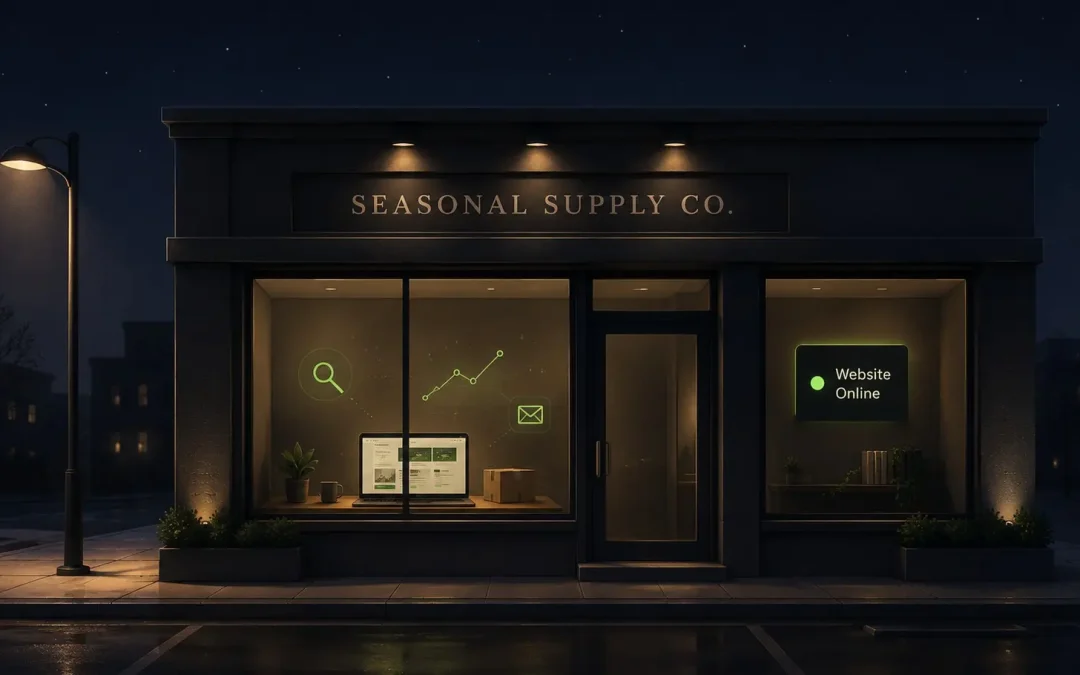
Post Summary: The Slow Months Are When the Website Does the Work
When revenue dips, the reflex is to trim whatever isn’t visibly earning. A quiet season is the one window where there’s time to market at all, and it’s when a business gets noticed by people who hadn’t noticed it before.
One landscaping client left everything running through a quiet winter. The equipment stopped, the searching and clicking did not. When the weather turned, that client was already positioned for the season instead of starting it cold.
A second landscaping client shut the site off instead. A few months of that and the pages fall out of the results, which search engines read as a closed business. Existing customers started asking whether the company had folded.
That’s the real math. In 2026, a search that comes back empty doesn’t say on hiatus, it says finished. The savings from switching it off never cover what it takes to climb back to where you were.
When the Website Bill Feels Like Dead Weight
You’re looking at the invoice. It’s the same number it’s been every month, but this month it hits different because the phone isn’t ringing. Revenue is down. The schedule is light. And there’s that line item, website, just sitting there, billing you for something that doesn’t feel like it’s doing anything.
A landscaper said it to us almost exactly like that. Business was slow, winter had set in, and the question came up the way it always does: should I still be paying for this?
It’s a fair question. And the answer isn’t what most people expect.
Why Winter Is the Time to Market, Not Retreat
Here’s what we tell every client who calls during a slow stretch. When you’re slow in the winter, that’s the best time to start marketing your website and your socials. That’s when people start to realize that you’re out there and you can go ahead and capture that business.
The instinct is to cut. Pull back. Wait it out.
But the people that slow down and batten down the hatches in the winter are the ones that don’t have business in the spring. Every time. The businesses that stay visible during a dead stretch aren’t just surviving, they’re the ones prospects find first when the season turns.
And when you’re busy, you don’t have time to market or as much time. You don’t make time because you’re tired or whatever. So the slow months are the window. That’s when it’s critical to pump up marketing, because you have the bandwidth now that you won’t have later.
One Landscaper Stayed Visible All Winter
We had a landscaping client whose business went quiet over the winter. Same pattern, revenue dipped, the temptation to cut was there. They kept the website. Kept their presence. Kept reaching out to their market through their site and socials all winter.
What happened was incredible. Customer interaction didn’t stop just because the mowers did. People were still searching, still clicking, still finding them online. By the time the weather broke, that client was ramped up for the spring before spring even showed up.
That doesn’t happen by accident. It happens because the website was still there, still working, still putting them in front of people through the months when nobody expected to hear from them.
That kind of consistency is the whole point, and it holds even when a payment slips through the cracks.
Another Landscaper Cut the Website, and Customers Thought They Were Out of Business
Different client. Coincidentally, also a landscaper. They did cut their website during the slow period.
What happens is, especially if you do it for more than two or three months, suddenly your pages aren’t ranked and then you’re gone and search engines start treating you like you’re out of business. That’s not a slow fade. That’s a hole you have to dig yourself out of when you’re ready to come back.
But the part that really stung was the customer reaction. It can confuse current customers too. They’re like, “Hey, are you out of business? What’s going on?”
Because it’s just not normal to not have your website. In 2026, if someone searches your name and nothing comes up, the assumption isn’t that you’re on a break. The assumption is that you’re done.
The money saved by cutting the site for a few months doesn’t come close to the cost of rebuilding the trust and the rankings you lost while it was dark. If you want the full picture of what happens when you stop paying for your website, that’s a longer conversation, but the short version is right here in this story.
That slow month invoice looks a lot different when you realize what the alternative looks like on the other side.
If you’re in a slow stretch and wondering whether the website is worth it, it is. And we’d rather have that conversation with you now than help you recover from cutting it later.
Yeetish Question
If my business is seasonal, am I paying for a website that’s doing nothing half the year?
No, and that’s the part most seasonal business owners get backwards. Whether you’re slow or not, it has nothing to do with the website. The website in the winter helps promote business in the spring and the summer. The months you think it’s sitting idle are the months it’s building the pipeline you’ll need when things pick up. A seasonal business with a year-round website has a head start every single season.