
Post Summary: What a Handoff Costs
Trust, judgment and context accumulate over months of the same relationship, and none of it survives a handoff. Early on, a client’s answers to questions are short and polite. By month four or five, they start elaborating, the customer segment they’ve been trying to crack, the competitor eating their lunch, the thing they’ve wanted on the site but never brought up. That kind of information surfaces because a person trusts another person enough to think out loud, not because a questionnaire asked the right question.
One client’s business existed as a tribute to a personal tragedy, something that only came up after months of conversations that went deeper than button colors. The memorial page that resulted became one of the most meaningful pages on the site, and it only came to exist because the relationship had run long enough for the story to surface.
When the same person handles design, development, and client service, a request goes directly from the client to the person who understands the business, instead of degrading through an account manager, a project manager, and a developer each interpreting it separately. That same person also learns which kind of client they’re working with, the one who wants every decision explained, or the one who just wants it handled, something a new account manager has no way to know yet.
By month twelve, the relationship isn’t reading the room anymore, it’s already in it, the busy season, the top-performing page, the question customers keep asking. Rotating teams reset that clock every time someone leaves, which in web design tends to be every six to twelve months.
What Changes When You Explain It Twice
There’s a moment that happens in almost every client relationship we take over from another company. It’s not dramatic. It’s not a blowup. It’s quieter than that, and worse.
The client gets an email from their web company. New point of contact. Someone named Josh or Amanda or whoever. “Hi! I’m your new account manager. I’m excited to work with you!” And the client thinks: Here we go again.
Because they know what comes next. They’ll spend the first three conversations re-explaining things they already explained six months ago. Their industry. Their customers. The decision they made during the build about the homepage layout and why it matters. The thing they tried last year that didn’t work. All of it, gone. Erased. Because the person who knew all of it is gone too.
This is the rotating team model, and it’s the common arrangement. It gets presented as a feature: a whole team working on your account. What that usually means in practice is you’ll never work with the same person long enough for them to understand what you need without being told.
We don’t do that. When the choice is one web designer vs team, we pick one every time, because the math isn’t even close.
What Accumulates, and What Doesn’t Transfer
When you work with the same person for months, then years, something accumulates that no onboarding document can replicate.
It starts with trust. In the beginning, when we ask a new client “What are your goals?” the answer is usually short. Polite. Surface-level. They’ll say something like “I want more customers” or “I need a better website.” Fine. That’s a starting point.
But by month four or five, something shifts. They start elaborating. They tell you about the part of the market they’ve been circling for two years. They mention the competitor taking work they should be getting in a specific zip code. They share the thing they’ve always wanted on their site but never brought up because they weren’t sure it was possible.
That’s not information you extract with a questionnaire. That’s information that surfaces because a human being trusts another human being enough to think out loud in front of them.
And it’s not just what they say. It’s how they make decisions. After a few months, you know whether this client wants three options or one recommendation. You know whether they want the explanation or just the result. You know that when they say “I’m fine with whatever” they genuinely mean it, or they’re being polite and you need to dig in.
All of that disappears in a handoff. Every bit of it. The new person shows up with a CRM note that says “Client prefers email communication” and thinks they’re caught up.
The Memorial Page Story
We have a client whose business is deeply personal to them. There was a tragedy, a loss that shook the foundation of why the business exists. Over months of working together, through regular conversations about updates and changes and goals, they kept coming back to it. How important it was that the business honored this person’s life. How the business itself was, in many ways, a living tribute.
Nothing in a kickoff call would have reached this. No questionnaire has a field for it. It only came up because we’d been in the relationship long enough for the conversation to go deeper than “what color should the button be.”
So we said: “Why don’t we build a memorial page? We can put it on a separate page or integrate it into your About section, whatever feels right.”
They chose a separate, dedicated page. We built it together. Their story, their words, their photos, structured in a way that honored the person and connected that legacy to why the business matters. The client loved it. Their customers responded to it. It ended up mattering more than anything else on the site.
None of that reaches someone arriving cold. Anyone still working out where the logins live isn’t in a position to notice it.
Where the Skill Gap Really Is
A team has real advantages and they’re worth stating plainly. More hands means more capacity, so a large build moves faster. Specialists go deeper than a generalist can. And a team survives someone leaving, where a single builder is a single point of failure.
What a team costs is what happens between the people in it. Project manager, designer, developer, account manager, QA. Every handoff is a place where the message degrades.
You tell the account manager you want to change the homepage hero. The account manager writes a ticket. The project manager assigns it. The designer interprets the ticket, which has already lost most of what you said. The developer builds what the designer interpreted. You get back something that’s technically what you asked for and completely not what you meant.
Three days and four people for something that should have taken one person twenty minutes.
But here’s the part that really costs you: the skill gap between the person you’re talking to and the person doing the work.
When the person who maintains your website is the same person who built it, the decision-making is different. They look at a request and immediately know whether it’s a five-minute fix or a structural change. They know whether it’s something that should be done now or something that needs to wait because it’ll affect three other things. They know when to pick up the phone and call you because the situation is complex, and they know when to just take care of it because it’s simple and you don’t need to be in the weeds.
That judgment comes from having all the skills in one place, sales, design, development, client service. Most companies split them across four departments because one person rarely has all four. We don’t split them because one person here does.
The result is that nothing gets lost in translation. Your request doesn’t pass through three interpretive layers before someone touches your site. It goes from your mouth to the person who understands your business to your live website. That’s it.
Who Owns the Account
There’s a version of the team model that’s even worse than the rotating account manager. It’s the one where technically nobody rotates, but nobody owns your account either.
You email “the team.” Someone responds. It might be the same person as last time. It might not. Your request enters a shared queue and gets picked up by whoever’s available. They look at your site for the first time, spend ten minutes trying to figure out the context, make their best guess, and move on to the next ticket.
This is how most web companies operate after the sale. The senior people who impressed you during the pitch are long gone. Your day-to-day experience is whatever junior person happens to pull your ticket off the stack.
And because nobody owns the relationship, nobody remembers the conversation you had last month about wanting to update your services page. Nobody follows up on the thing they said they’d check on. Nobody creates a task to remind themselves that this client has a seasonal promotion coming up and the site needs to be ready.
Ownership is the difference between proactive service and reactive ticket-closing. When one person owns your account, really owns it, not just has their name on a spreadsheet, they think about your business when you’re not on the phone. They notice things before you do. They bring ideas you didn’t ask for because they’ve been watching your site perform and they see opportunities.
That’s not something you can replicate with a shared inbox.
The Two Types of Clients, and How Each One Is Handled
After working with hundreds of small business owners, we’ve noticed most people fall into one of two general camps, with plenty of variation in between.
There’s the client who wants to understand everything. They ask questions. They want to know why you chose that font, why the CTA is positioned there, what the SEO implications are of changing their headline. They’re not micromanaging, they’re genuinely curious and they want to learn. When you explain something, they listen, ask follow-ups, and make informed decisions.
Then there’s the client who wants it done right and doesn’t want to be in the weeds. They say “I trust you, just handle it” and they mean it. They don’t need a thirty-minute walkthrough of every change. They need to know it’s handled and their site is performing.
Both types deserve great service. And knowing which one you’re talking to takes months of the same conversation.
When the curious client asks a question, we dig in. We explain. We show our work. When the “just handle it” client sends a request, we take care of it, confirm it’s done, and don’t clutter their inbox with details they didn’t ask for.
A new account manager doesn’t know the difference yet. They either over-explain to the client who’s already exhausted, or under-communicate with the one who wants transparency. Both feel like bad service, even though the underlying work might be identical.
Knowing your client isn’t a soft skill. It’s the difference between a relationship that works and one that slowly erodes until they leave.
What Month 12 Looks Like
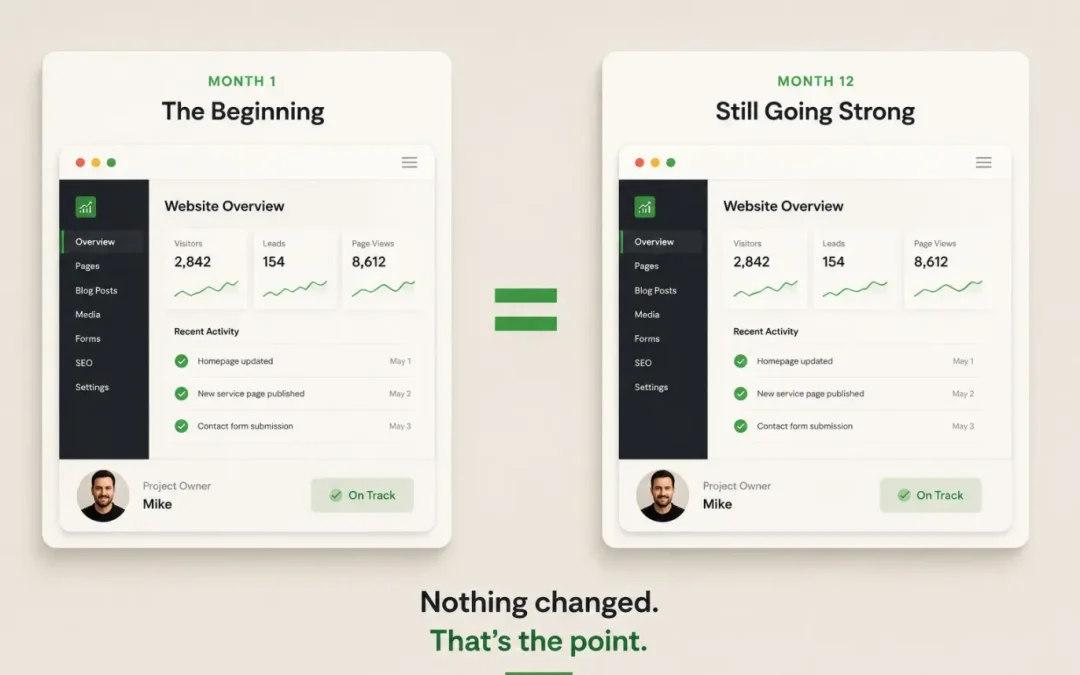
At month one, we’re learning your business. Your preferences. Your communication style. Your goals. We’re good, but we’re still reading the room.
At month twelve, we’re not reading the room anymore. We’re in the room. We know your busy season is coming because we managed your site through it last year. We know your top-performing page because we’ve been watching the data. We know the question your customers always ask because we’ve seen it in your contact form submissions and built an FAQ section around it.
This is what happens when nobody leaves. The quality compounds. Every conversation, every update, every phone call adds to a base of knowledge that makes the next decision faster, the next change more accurate, the next recommendation more relevant.
Companies that rotate people reset this clock to zero every time someone leaves the team. And in web design, where turnover is notoriously high, that might mean resetting every six to twelve months. Your site never gets the benefit of compounding knowledge. It gets a series of first impressions from people who are trying their best with incomplete information.
We’ve been talking to clients from 2021. Same person. Same relationship. Four years of accumulated context that makes every interaction better than the last. That’s not because we’re sentimental. It’s because we’ve built a business model where the person who earns your trust is the same person who keeps it, forever.
Not for the first 90 days. Not until they get promoted. Forever.
Frequently Asked Questions
What happens if the one person handling my account gets sick or goes on vacation?
We have systems and documentation that ensure nothing falls through the cracks during short absences. But here’s the key difference, when the same person comes back, they pick up exactly where they left off. There’s no “getting the new person up to speed” because there is no new person. The continuity is the point.
Doesn’t a team bring more expertise than one person?
Yes, genuinely. A specialist knows more about their specialty than a generalist does, and on a large or unusual build that depth matters. The trade is distance. Expertise that reaches you through a relay arrives having lost something on the way. For most small business sites, the depth on offer is more than the site needs and the distance costs more than it’s worth.
How do you handle things that are outside your individual expertise?
Nobody knows everything. The difference is that when we hit something that requires outside input, we bring in the right resource, manage the process, and keep you talking to one person. You never get handed off. You never have to re-explain anything. We handle the coordination behind the scenes so you don’t have to manage a team you didn’t hire.
What about scalability? Can one person really handle all their clients?
We’re deliberate about how many clients we take on. We don’t scale by adding account managers and diluting the relationship. We scale by building efficient systems that let one skilled person do the work of an entire team, without the communication overhead that makes teams slow. If we can’t serve you at the level we promise, we won’t take you on.
Why isn’t this the standard?
Because it requires someone who can sell, design, develop, and service clients, and those people are rare. It’s easier to hire specialists and connect them with a project manager. A team is easier to staff and easier to scale. We went the other way because the relationship is the thing that compounds.