
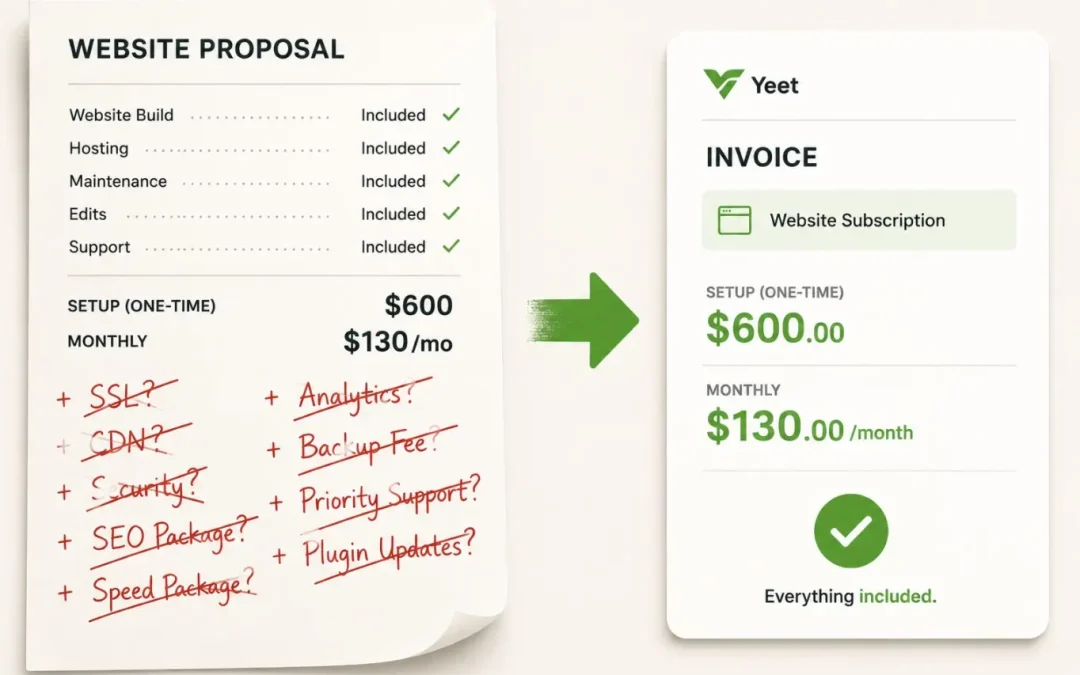
Post Summary: What Separates Web Design Advice From a Sales Pitch
A roofer was already buying every service on the menu when a five hundred dollar addition arrived. The figure wasn’t the issue. He was purchasing everything available and the requests kept coming. His instinct was that something was off, and the item in question turned out to be one he had no use for.
A limo operator had a business listing missing its photo and most of its detail. Money was tight, he had said so, so rather than price the job we handed him the steps and told him he was capable of it. He was.
What tells them apart is the opening move. One begins with an item for sale and a figure attached, nothing else behind it. The other begins with something someone noticed in your business, and a question about how you see it, well before any number surfaces.
So ask for the evidence. Specifics about what was found and why it matters to you. Without those, nobody has made a case.
The Two Minute Call That Turns Into a Pitch
You call to change a phone number or swap out a photo, something that takes two minutes, and a new product comes up before you hang up. It would be really good for your business. You didn’t ask. You weren’t shopping. You called about a phone number.
It sounds important, and you’re not in the web industry, so it is easy to cave. Yeah, do it. It’s just 50 bucks a month. Or 80. Or whatever. Saying yes is the quickest way out of the call.
That isn’t a sales conversation. That’s a surrender.
The Roofer Who Finally Said Screw This
A roofer came to us recently. He’d been paying thousands a month to his old web company, the website, the SEO, the paid ads, the whole stack. Every service they offered, he was on it.
Then came one more add-on. Five hundred dollars.
That was the straw. Not because five hundred dollars is a lot of money on top of what he was already paying, though it is, but because of what it meant. He’s already giving them everything, and they’re still asking for more. His words when he came to us: You know what? Screw this. This is too much. Like you’re not happy with all I’m doing.
He didn’t say that to the old company. He said it to us. And then he said something quieter: It just didn’t feel right.
When we looked at what he was being charged for, he was right. It wasn’t right. It was unnecessary. The thing they were trying to add was something he didn’t need, stacked on top of services he was already overpaying for. He literally said, Hey, look at this. This is what they’re trying to sell me. And once we saw it, the conversation was simple. You don’t need this. You never did.
That roofer isn’t unusual. We hear a version of it from painters, electricians, every trade we work with. And the part that lands hardest isn’t the money. It’s the moment the trust goes.
The Limo Driver Who Didn’t Get Pitched
One of our clients runs a limo service. We built his website. During a review, we noticed his local business listing didn’t even have a photo on it. We dug in deeper, asked for manager access, and the whole thing needed work.
He’d told us money was tight. So we wrote him a bullet-point list of everything that needed to be done. Took about two minutes. And we told him: You can do this. I believe in you. You’re a smart guy and it’ll be in your words. It’ll be great.
Could we have quoted it and done it ourselves? Sure. But a listing he fixes himself beats one that stays broken for want of a budget.
He did it. Turned out just fine. Problem solved. Win win.
That’s what it looks like when someone isn’t trying to sell you something every time you talk.
How to Tell the Difference
A real recommendation and a manufactured upsell can sound alike. There’s one clean signal that separates them.
One leads with evidence. The other leads with a product.
The upsell shape sounds like this: This new product came down my pipeline and I think it’s perfect for you. No specifics. No analysis. Just a product and a price.
The recommendation shape sounds like this: I was analyzing your site. I found some areas that can be improved in your marketing. It just so happens there’s a tool that fits, but I didn’t want to just sell it to you, I wanted to make sure it was right for you. So this is what I did on your analysis. Found some gaps. What do you think?
Totally different.
One of those conversations starts with a product the company wants to sell. The other starts with your situation. If your web company leads with what they found in your data and asks what you think before quoting a price, that’s a recommendation. If it opens with a product name and a monthly fee, that’s a pitch.
Yeetish Questions
How do I know if my web company is upselling me things I don’t need?
Ask them to show you the data. A real recommendation comes with specifics, what they found, where the gap is, why this particular solution fits your situation. If all you’re getting is a name and a price, you haven’t been given a reason yet.
What does Yeet do when there’s something a client could benefit from but money is tight?
We tell them. And then we figure out whether they can do it themselves. If the answer is yes, we hand them the instructions and cheer them on. Something done imperfectly beats something not done at all because the budget wasn’t there.