
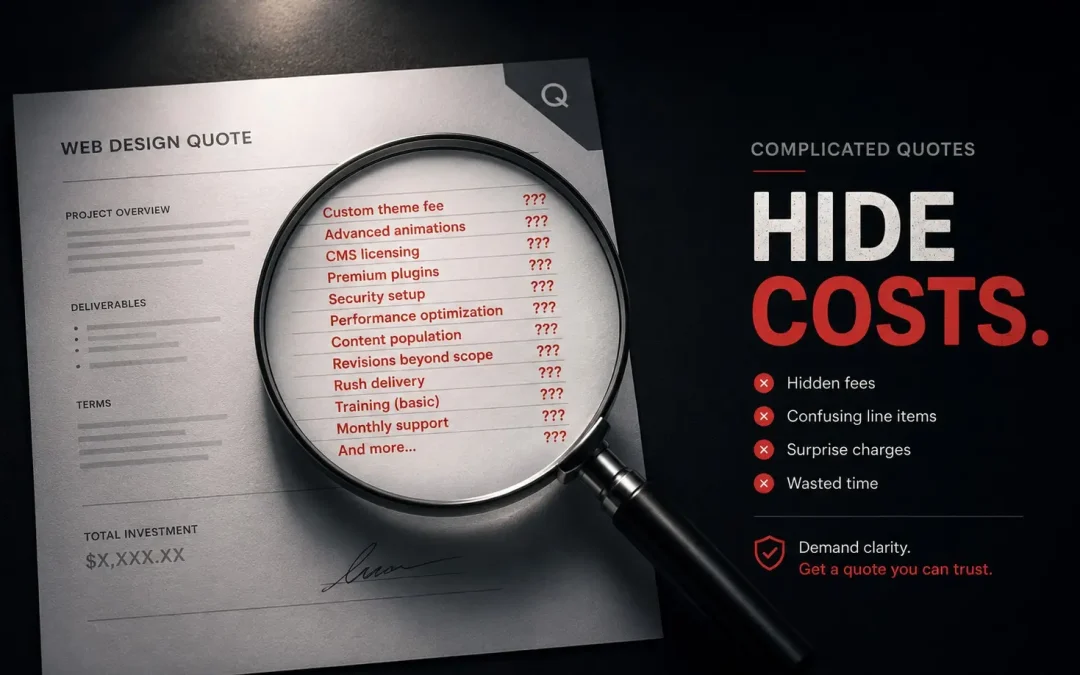
Post Summary: A Web Design Quote Should Fit on One Page
A confusing web design quote is a warning sign, not a sign of thoroughness. A proposal sent before any real conversation about the business is built on a template and a guess, not on what the business actually needs. Jargon that never gets translated into what it means for that specific business isn’t there to inform, it’s there to make pushback feel embarrassing. A real scope of work for a small business site, ten pages or so, should fit on one page. If the deliverable can’t be explained clearly in that space, either the project is unusually complex or the length is covering for a lack of clarity.
Pricing here is two options stated plainly: $130 a month for a subscription with hosting and an hour of monthly edits, or $4,000 to own the site outright with 30 minutes of edits and separate hosting.
The rest of the post covers why a high number of built-in revision rounds usually points to a weak intake process rather than generous service, and what tends to go wrong after someone signs a proposal they didn’t fully understand.
What a Web Design Quote Looks Like Before Anyone Talks to You
You’re sitting at your kitchen table at 9:30 on a Tuesday night. The kids are finally asleep. Your phone is charging. And you’ve got a web design proposal open on your laptop that might as well be written in Mandarin.
Six pages. Phrases like “keyword gap analysis” and “competitive positioning audit” and “responsive UX implementation.” There’s a section about page speed optimization that’s three paragraphs long. Another section about “content strategy alignment” that somehow doesn’t mention what anyone is going to write or who’s writing it. And at the bottom, a number. A big one. With a signature line next to it.
You don’t understand what you’re agreeing to. You don’t know which of these line items are real work and which ones are filler. And the worst part? You feel like you should understand it. Like this is basic stuff that everyone else gets and you’re the only one squinting at page four wondering what “schema implementation” means for your plumbing company.
You’re not the problem. That proposal is.
Nobody Should Be Quoting You Before They’ve Talked to You
Let’s start with something that should disqualify a company before you read a single line of their proposal. Did they send it before they had a real conversation with you?
Not a “tell us about your project” form submission. Not a fifteen-minute intro call where a sales rep ran through a script. A real conversation where someone asked about your business, looked at your current website, understood what’s working and what isn’t, and figured out what you actually need.
Because if none of that happened, what exactly is the proposal based on? A guess. A template with your name pasted into the header and a price calculated from a formula that has nothing to do with your situation. It’s the equivalent of a mechanic quoting you $3,200 for engine work based on the color of your car.
We’ve had prospects come to us holding proposals from other companies where it was obvious nobody had taken the time. The page count was wrong for the business. The services listed didn’t match what the owner needed. One had a line item for e-commerce functionality, for a lawn care company that doesn’t sell anything online. That’s not a proposal. That’s a mass mailing with a price tag.
When you sit down with us, there’s no document waiting for you. We get on a screen share. We pull up our pricing page, the same one anyone can see on our site, and we go through every line, out loud, together. Hosting. What it means. Why it exists. What’s included in the subscription versus ownership. If something doesn’t make sense, you ask, and we answer in words you’d use at a dinner table, not in a boardroom.
That’s the difference between a company that’s trying to help you decide and a company that’s trying to get you to sign.
The Jargon Isn’t There to Educate You, It’s There to Shrink You
Think about how you talk to your own customers. If you’re a plumber, someone calls you with a leak under their kitchen sink. Water’s pooling on the floor. They’re stressed. They want it fixed.
Do you show up and hand them a five-page assessment on hydraulic pressure differentials, elastomeric seal degradation, and fixture-specific flow variance? Do you explain that their issue stems from a “negative-pressure cavitation event in the secondary water line”?
Of course not. You’d lose the job before you finished the first sentence. You say “your washer’s worn out, I’ll swap it, here’s what it costs.” Because your job isn’t to make them feel stupid. Your job is to fix the problem and explain it in a way that makes them feel confident they’re spending their money wisely.
Web design proposals should work exactly like that. But they don’t. And it’s not because web design is more complicated than plumbing. It’s because confusion is profitable.
When a prospect doesn’t understand what they’re reading, they do one of two things. They either walk away, and the company loses the sale but doesn’t care because they’ve got fifty more proposals going out this week, or they sign anyway because they assume all of this must be important and they don’t want to look stupid asking what it means.
That second person? That’s the target customer. The one who’s too polite, too busy, or too embarrassed to push back. The one who signs on the strength of intimidation rather than understanding. And every piece of jargon in that document is aimed directly at them.
Page speed optimization. Keyword ranking strategy. Competitive gap analysis. Schema implementation. Content architecture mapping. Some of these are real things that matter. But if nobody has explained what they mean for YOUR business, not in the abstract, not in a glossary buried on page six, then they’re not in the proposal to help you. They’re in the proposal to make you feel like you need the company that wrote it.
We explain things in non-jargon terms. That’s not a slogan, it’s a business practice. If you can’t explain what you do in a way your client understands, you either don’t understand it yourself or you’re hoping they won’t ask.
How to Read a Web Design Quote by Measuring the Silence
Here’s what nobody tells you about reading a proposal. The most important thing isn’t what’s in it. It’s what’s missing.
Does it say how many pages you’re getting? Not “a multi-page website”, an actual number. Does it say who’s writing the content? Because if they’re building you a ten-page site and no one has discussed copy, either they’re expecting you to write it, which is a second job you didn’t sign up for, or they’re planning to fill it with generic filler that sounds like every other site in your industry.
Does it say what happens after launch? Not “ongoing support available”, specifics. How many edits per month? Who do you call when something breaks? Is there a number or a ticket system? Does a human answer, or do you get a chatbot and a 48-hour response window?
Does it explain the difference between what they’re building and what you could get somewhere else? Or does it just list services and assume you’ll trust that the price is fair because the document looks professional?
A real scope of work for a small business website should fit on one page. We mean that. These are ten-page sites for local businesses, a plumber, a dentist, a landscaping company. Not enterprise platforms with a hundred screens and a dev team of forty. If the proposal is longer than the website it’s describing, ask yourself who that length is serving. Because it’s not you.
We have two products. $130 a month for a subscription with hosting, an hour of monthly edits, and a fully custom site. Or $4,000 to own it outright with 30 minutes of edits and separate hosting. That’s the entire product line. Two options. No decoder ring required.
The Mirror Test: Would You Do This to Your Own Customers?
This is the question that cuts through everything. Forget the jargon. Forget the page count. Forget whether you understand what schema implementation means. Just ask yourself this:
Would you do this to your own customers?
If you run a painting company and someone asks for a quote, do you send them a nine-page document full of terms like “chromatic adhesion sequencing” and “substrate preparation methodology”? Do you make them sign a twelve-month contract before you’ll pick up a brush? Do you limit them to two rounds of color approval and charge extra after that?
You’d never do that. Because you’d lose every customer you talked to. Because people don’t do business with companies that make them feel confused and trapped. They do business with companies that make them feel heard and informed.
So why is the standard different for web design?
It’s different because most business owners have never bought a website before. They don’t know what’s normal. They don’t know that a six-page proposal for a ten-page site is absurd. They don’t know that being locked into a twelve-month contract isn’t industry standard, it’s one company’s decision to prioritize their revenue over your freedom. They assume this is just how it works because nobody has shown them an alternative.
We’re the alternative. And the reason you can tell is that our process looks like the way you treat your own customers. Clear pricing. Plain explanations. No contract. If we’re not doing a good enough job, you leave. That’s the deal. Same deal you give your customers every single day.
Why Their Edit Process Is a Confession
Some proposals build in two rounds of edits. Some build in three. Some five. Here’s what that number is really telling you.
It’s telling you how little they plan to listen on the front end.
When a company builds a website, the quality of the finished product is directly proportional to the quality of the intake. How detailed were the notes? How well did they understand the business? Did they ask the right questions, or did they send a questionnaire with twenty generic fields and call it discovery?
We take meticulous notes during intake. Absurdly detailed. The kind of notes that make the build feel like the website was supposed to look like that, because by the time we start designing, we already know your business well enough to get it close to right the first time. In every website we’ve built, the most rounds of edits we’ve ever needed is three. Most are fewer. Not because we limit edits, but because we front-load the work where it matters.
Compare that to a company that hands you a first draft that looks nothing like your business and says “don’t worry, that’s what the revision rounds are for.” That’s not managing expectations. That’s admitting their process is broken. They’re using your time, your rounds of edits, your feedback, your frustration, as a substitute for doing the homework they should have done before they touched a single pixel.
And here’s the part that really stings. By the time you’re in revision round three and the site still doesn’t feel right, you’ve already signed the contract. You’ve already paid the deposit. You’re not evaluating anymore, you’re stuck. And the edit limit that sounded reasonable in the proposal now feels like a wall. Two more rounds and you’re out, whether the site is right or not.
Ask any company how often they get the site close on the first try. If they hesitate, you have your answer.
What Happens After You Sign Something You Don’t Understand
Nobody talks about this part. Every article about how to read a web design quote focuses on what to look for before you sign. But the real damage happens after.
You sign the proposal on a Thursday night because you’ve been staring at it for a week and you’re tired of thinking about it. The first invoice hits and there’s a line item you don’t remember seeing. You email to ask about it and get a response two days later from someone you’ve never talked to, not the person who sold you, not the person who’s building the site. An account manager. Someone who wasn’t in the room when you discussed the project and is now your only point of contact.
The first draft arrives and it doesn’t look like what you described. You give feedback. Round two is closer but still off. Round three feels like you’re just approving it to be done with it. The site goes live and it’s… fine. It works. But it doesn’t sound like you. It doesn’t feel like your business. It feels like a version of every other website in your industry with your logo dropped into the corner.
And six months later, when you want to change something, a new service, an updated photo, a paragraph that doesn’t describe your business anymore, you find out that the contract doesn’t include edits. Or it includes two per month. Or the person who built the site left the company three months ago and nobody told you.
That’s what a confusing proposal costs you. Not just money. Time. Control. The slow-drip realization that you bought something you didn’t understand from a company that was counting on exactly that.
The One-Page Test
Here’s the simplest filter we can give you.
If a company can’t explain what they’re going to build, what it costs, and what happens after launch on a single page, something is off. Either the project is genuinely complex enough to warrant more detail (and for a small business site, it almost never is), or the company is padding the proposal to justify the price and create enough confusion to keep you from comparing them to anyone else.
The more pages the report, the more BS it is. That’s not a line. That’s something we’ve confirmed hundreds of times looking at proposals that clients have brought us from other companies. The length isn’t thoroughness. It’s theater. And you’re paying for the production.
If you’ve got a proposal in front of you right now and you’re not sure what’s real and what’s filler, we’ve written about what honest marketing looks like, and the principles are the same. Clear language. Defined scope. No mystery charges. If your current quote doesn’t pass that bar, it’s worth asking why.
Frequently Asked Questions
Should I worry if a company sends a proposal before we’ve really talked?
Yes. A proposal that arrives before anyone has asked about your business, your goals, or your current website isn’t based on anything real. It’s a template with your name in the header. Any company serious about building you something custom needs to understand what you need first, and that requires a conversation, not a form submission.
What’s the difference between a detailed proposal and a confusing one?
A detailed proposal answers your questions. A confusing one creates new ones. If you finish reading a proposal and feel more informed, you know what you’re getting, what it costs, and what happens next, that’s detail. If you finish reading it and feel like you need a glossary, that’s not detail. That’s a smokescreen.
How short should a web design quote be for a small business site?
One page. A ten-page website for a local business does not require a multi-page scope document. The deliverable should describe what’s being built, what’s included, and what happens after launch, clearly enough that you could explain it to a friend without referencing the document again.
Is it a bad sign if a company limits edit rounds?
It depends on how many. One to three rounds is normal if the intake process is thorough. But if a company is building in five or six rounds as a standard, or worse, charging extra per round, that’s not managing expectations. That’s compensating for a process that doesn’t listen well enough on the front end.
What should I do if I already signed a proposal I didn’t fully understand?
Start asking questions now. Ask for a plain-language summary of every line item. Ask what happens after launch. Ask who your point of contact is and whether that person is building the site. If you’re getting vague answers or being redirected, that tells you something about the company you’re working with, and it’s worth knowing sooner rather than later.
Can I bring another company’s quote to you for a second opinion?
Send it over. We’ll read the whole thing and tell you in plain English what’s real, what’s filler, and what questions you should be asking. No charge, no pitch. We’d rather you make an informed decision, even if that decision isn’t us, than sign something you don’t understand. Here’s where to reach us.