
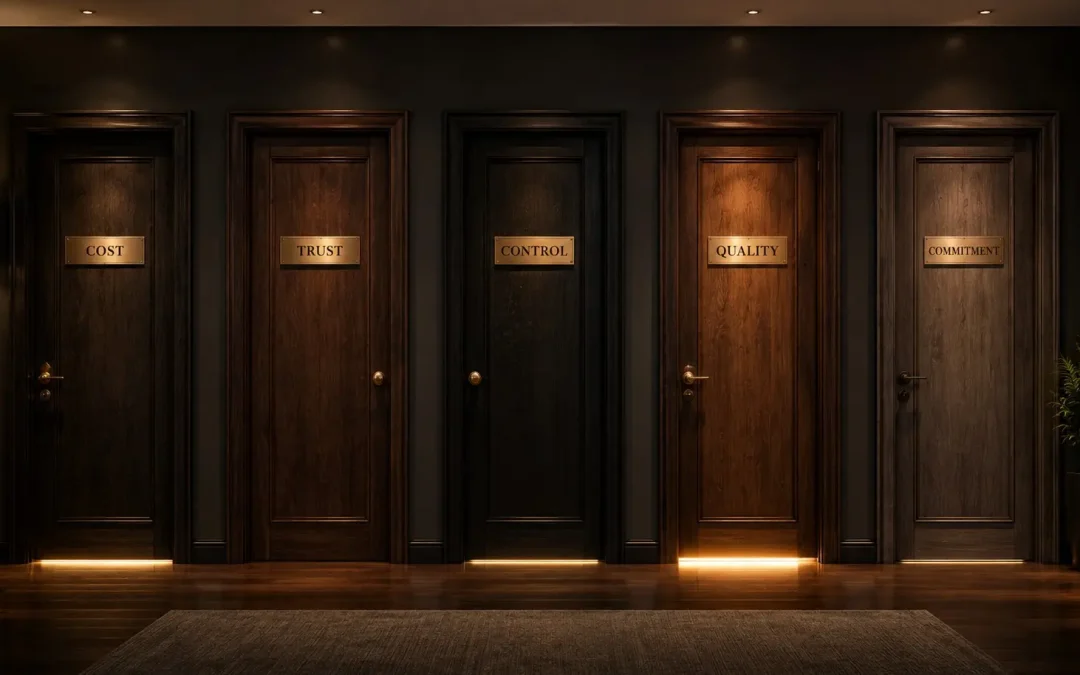
The Short Version: What Each Fear Sounds Like on a First Call
Cost, trust, intimidation, performance, control. Those are the five. After 300+ business owners, they show up in the same combinations no matter the industry or the size of the company. Cost gets voiced the most. Trust and control get felt the hardest and said out loud the least.
Here is what one of them sounds like. A cold call to a tile company got a voicemail, and the voicemail got returned, which is rare enough to notice. The owner took it on speaker with his longtime assistant listening in, and the wariness carried down the line. Every answer we gave was being measured against whatever had happened to him before. Somewhere in the middle of it the questions stopped being defensive and started being about what he wanted built. They are still a client.
That is fear #2, trust. Below are all five, what each one sounds like when a business owner says it, and what we do to resolve it.
Why You’ve Been Sitting on That Quote for Three Months
You already know your website matters. That’s not the problem.
The problem is that knowing something matters makes the decision to act on it harder, not easier. When the stakes are low, you move fast. When they’re high, when you know this thing could make a real difference for your business, your income, your family, you slow down. You research. You hesitate. You start a conversation and then don’t finish it. You get a quote and sit on it for three months.
That’s not procrastination. That’s fear. Reasonable, intelligent fear from someone who understands what’s at stake and doesn’t want to get it wrong.
We’ve talked to 300+ business owners about their websites. And across every industry, every size of business, every kind of person, the same fears show up. Not always said out loud. Sometimes dressed up as practical concerns about budget or timing. But underneath: the same five things, in different combinations, at different intensities.
If you’re carrying any of these right now, you’re not alone. And you’re not being irrational. You’re being human about something important.
Why Buying a Website Feels Different From Other Purchases
Most purchases don’t feel like this. You know what you’re getting. You can compare it to something you’ve bought before. You can return it if it’s wrong.
A website is different on every one of those dimensions.
You’re buying something you probably can’t fully evaluate, because you’re not a web designer, and you were never supposed to be. You’re trusting someone else to understand your business well enough to represent it online, to make decisions you’ll live with for years, in a medium you don’t fully control. And you’re doing all of that while also trying to run an actual business.
The fears about hiring a web designer aren’t about web design, not really. They’re about what it means to hand something important over to someone else. To give up a piece of control over your own destiny. That’s a much older, much deeper thing than any website. It’s the same instinct that makes people read every review before trusting a contractor with their house, or interview three attorneys before choosing one for something that matters.
When the subject matter is outside your expertise and the stakes are real, trust becomes everything. And trust, real trust, earned trust, doesn’t come easy for anyone who’s been let down before.
Fear #1: Cost, “Am I Going to Get Ripped Off?”
This is the most commonly voiced fear. It’s also, in most cases, the least accurate.
The concern isn’t really about the number itself. Most business owners aren’t shocked by the cost of a good website once they understand what they’re getting. The fear is about not knowing whether the price is fair, whether they’re paying for something real or something dressed up to look real, whether a cheaper option somewhere else would have done the same thing.
It’s the fear of being the person who paid too much and didn’t know it until too late.
Opaque pricing is what activates it. Proposals that run six pages without ever naming a number, hourly rates that balloon without warning, “subscription” services where the monthly fee doesn’t clearly explain what it covers. When pricing is opaque, every number feels suspicious. You don’t know if a monthly number is a great deal or a trap because you have nothing real to compare it to.
The fix isn’t finding a cheaper option. The fix is finding a web company that explains their pricing in plain English before you ask, and can tell you exactly what the money covers. If the cost conversation is uncomfortable or evasive, that’s information worth having early.
The full breakdown of the cost fear goes deeper on what affordable website design really means and why most business owners are calibrated wrong on price before they ever talk to anyone.
Fear #2: Trust, “Will They Disappear?”
This one is quieter. Most people don’t say it directly.
What they say instead is: “I’ve had a bad experience before.” Or: “The last company was great at first and then nothing.” Or, most tellingly, almost as an aside: “I just want to make sure they’ll follow through.”
What’s underneath that is harder to say. It’s: I want this badly enough that it would really hurt to get let down again.
Back to the tile company, because the details are the point.
The voicemail coming back at all told us something before we understood what. The owner wasn’t available when we reached them. His executive assistant picked up. She’d been with the company long enough that she had a personal stake in the outcome, not an ownership stake, but something close to it. The kind of investment that comes from years of watching someone build something and caring about what happens to it. You could hear it in how she answered. And you could hear something else too: the excitement of someone who had been waiting for this call without knowing it. Oh my gosh, this might be the one.
When we finally got the owner on the phone, the assistant was in the room. They were on speaker. And the hesitancy was palpable, audible, even across hundreds of miles. He’d been through this before. You could feel him holding something back, measuring every answer, waiting for the moment the pitch would show through.
We walked through what we do. Showed before and afters, this was before we even had formal case studies on the website. Nothing elaborate. Just real work, real results, explained plainly.
And then something shifted. The tension started leaving. Not all at once, gradually, and then more quickly. The questions changed. Instead of guarded, they became forward-looking. What about this? What if we did this? Things they’d clearly wanted to do for a long time but had never felt were possible. The conversation stopped being about whether to trust us and became about what they wanted to build.
They’re still a client.
That shift, from braced to open, from defended to engaged, is what this fear looks like when it gets resolved. Not argued away. Not reassured into quiet. Resolved, by a conversation that gave them something real to hold onto.
The question that doesn’t get asked enough before any of that can happen: who will be servicing your account after you sign? Not who sold you, who is responsible for your site on an ongoing basis, can you meet them now, and what does that relationship look like? The answer to that question, and how comfortable the company is giving it, tells you more than any proposal.
Fear #3: Intimidation, “Am I Going to Look Stupid?”
This one rarely gets said out loud. But it shapes almost every conversation.
It shows up as over-preparation, business owners who’ve spent twenty hours researching before they’ll agree to a call, who apologize for not knowing what a CMS is, who preface every question with “this might be a dumb question but.” It shows up as silence in meetings where someone didn’t understand something but didn’t want to say so. It shows up as nodding along to proposals full of terminology that could mean almost anything.
Web work is harder to understand than it needs to be. Jargon creates distance, and that distance is a reason why some business websites fail making them easier targets to monetize than an informed client who asks sharp questions.
“We dress our profession up in impenetrable jargon and give ourselves fancy job titles. In many ways we are like teenagers trying to appear more grown up by smoking and drinking.”
— Paul Boag, UX strategist and author of Client Centric Web Design, writing to his fellow web designers. Source: boagworld.com
Here’s where that comes from, personally.
Auto repair is the one trade that’s always been outside the comfort zone. Plumbing, electrical, general construction, there’s enough depth there to know when something doesn’t add up. But mechanics are different. And thirty years in sales means knowing exactly how people lie to other people for money. So when something feels off at a shop, that feeling gets taken seriously.
The brakes needed work. The shop wanted to do the full job, rotors, everything. And something just didn’t sit right. Couldn’t name it exactly. The explanation didn’t quite make sense. So the vehicle got pulled. Taken to another shop.
Just needed pads. The rotors were fine.
Two things came out of that. One: the confirmation that the distrust wasn’t paranoia, it was calibrated. Two, and this one matters more: the recognition that the feeling itself was the signal. That little voice that says something is off before you can articulate why. Intuition built from experience, from pattern recognition, from having seen enough of how the world works to know when the story doesn’t hold together.
Business owners carry that voice into every conversation about their website. They can’t always explain it. They just know they’ve been in a situation before where they ignored it and paid for it. So they listen harder now. They ask more questions. They pull the vehicle.
That’s not a problem to overcome. That’s the right instinct, looking for the right information. The job, ours, in every first conversation, is to be the second shop. The one where the explanation makes sense, the recommendation fits the actual problem, and the voice goes quiet because there’s nothing left to be suspicious of.
We’ve lost sales because someone’s gut said no. That’s fine. Better than the alternative, which is earning a client who never fully trusted you and was right not to.
Fear #4: Performance, “Will It Work?”
This is the fear that gets the least airtime before you buy and the most airtime after, usually starting around month three, when the site is live and the phone isn’t ringing the way you hoped.
It’s a legitimate fear. Most websites don’t fail because of bad design. They fail because of bad strategy, built to look good in a demo rather than to do a specific job for a specific customer with a specific problem. They fail because of mimicry: copying a competitor’s structure without knowing whether that structure is working for them, or why, or whether your business is even close enough to theirs for the comparison to hold. They fail because of neglect: nobody maintaining them, updating them, watching them after launch.
The honest answer is that a website built right, maintained properly, and treated as a real business tool rather than a one-time project does work. We’ve seen it change businesses.
The test before anyone starts building is whether they ask who the site is for and what it needs to get that person to do. If every conversation is about pages and colors and never about the customer on the other end, the strategy part is missing.
Fear #5: Control, “Will I Be Trapped?”
This is the one that surfaces once something goes wrong and it’s a big web design company red flag.
Control is what you’re thinking about when you wonder: do I own this? What happens if I want to leave? Can I take the site with me, or does it disappear when the relationship ends? Who holds my domain? What if they go out of business? What if they raise their prices and have no recourse?
There are real reasons to fear this. Proprietary platforms that can’t be exported. Contracts that lock you in for a year regardless of performance. Domain registrations in the web company’s name instead of yours. Subscription models where you’ve been paying for years but own nothing at the end of it.
Control isn’t a paranoid concern. It’s a reasonable one. The question is whether the company you’re talking to treats your autonomy as something to protect or something to work around. That answer comes out in the specifics: who owns the domain, who has the admin login, what happens on day one if you decide to leave.
Hiring a Web Designer Is a Trust Decision
Of the five, cost gets mentioned most. But the one people feel most intensely, and almost never say out loud, is the combination of trust and control together which is something that can be fixed by asking the right questions before buying web design.
Because when you think about it, that’s what all five fears collapse into: you’re being asked to hand something important to someone you don’t know yet, in a domain you don’t fully understand, with outcomes you can’t fully predict, with consequences that are real for your business and your livelihood.
That’s not a web design decision. That’s a trust decision. And trust decisions take people back to their most basic instincts about what it means to depend on someone, and what happens when that someone doesn’t come through.
The business owners who move through this aren’t the ones who stopped being afraid. They’re the ones who found a web company that understood the fear and knew how to address it, not by handling an objection, but by showing them something. By showing, in the first conversation and the second and the sixth month and the second year, that the fear was worth overcoming.
Frequently Asked Questions
What are the most common fears about hiring a web designer?
Cost, trust, intimidation, performance, and control. Most business owners are carrying at least two of these before the first conversation, sometimes without being able to put words to them. The fear about cost is the most commonly voiced. The fear about trust and control is usually the most deeply felt and the least often said out loud.
Is it normal to feel anxious about hiring a web designer?
Not just normal, it’s reasonable. You’re trusting someone outside your area of expertise with something that matters for your business, your income, and the impression you make on every potential customer. The anxiety is proportional to the stakes. The goal isn’t to eliminate the fear but to find a web company whose answers are specific enough and honest enough that the fear doesn’t need to run the decision.
How do I know if a web company is trustworthy before I sign?
Ask to speak with someone who signed a year ago, not a fresh testimonial, someone with actual relationship history. Ask who will be working on your account after you sign, specifically. Ask what happens to your site and your domain if you decide to leave. The answers to those three questions, and how comfortable the company is giving them, will tell you more than any portfolio or proposal.
What’s the first question I should ask a web designer?
“Are you going to be the one servicing my account, and if not, who is, and can I talk to them now?” The handoff from the sales conversation to the actual working relationship is where trust gets broken most often. Understanding that transition before you sign is the single most useful thing you can do to protect yourself.
How do I know if my website will perform?
Ask the web company what specifically makes their sites convert, not “we build for performance” but what they do differently in the build that drives calls and leads. Ask to see a site in your category they’ve built and ask what results the client has seen. Vague answers here are a warning sign. A web company that builds for performance should be able to point at it.
What if I’ve been burned by a web company before?
The instinct to protect yourself after a bad experience is smart, not paranoid. It means you ask better questions. The right web company will welcome that, will answer specifically, will offer references, will explain exactly what they own and what you own before any money changes hands. If a web company gets defensive when you bring up a past bad experience, that’s the answer you needed.