
Post Summary: The Full Answer Is Two Sentences Longer
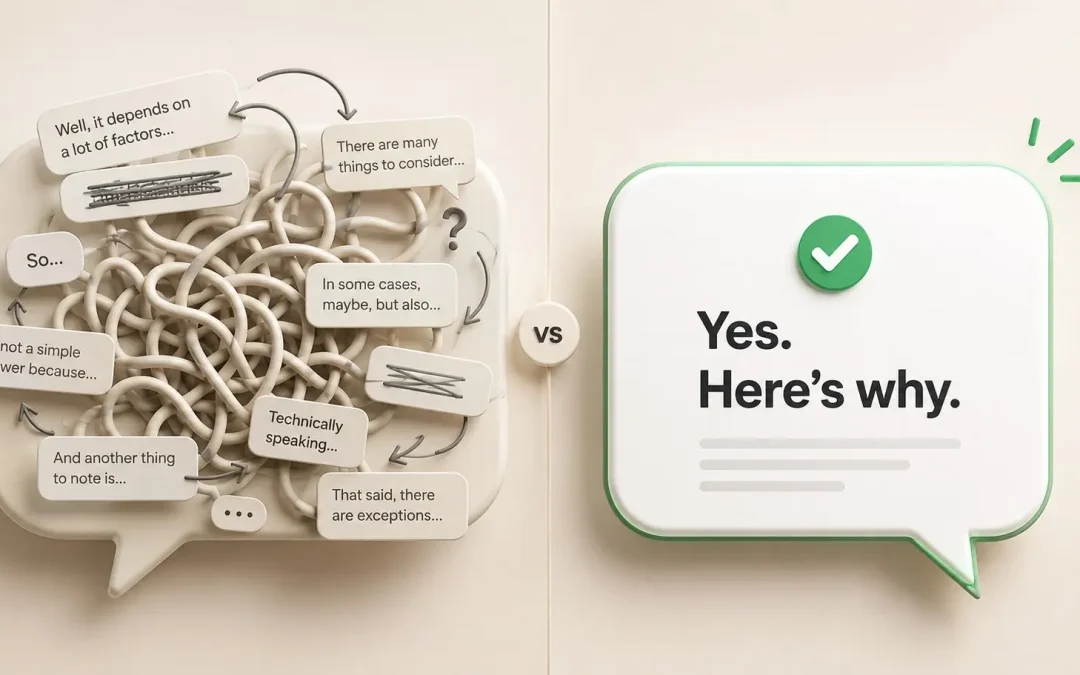
“It depends” is usually true. It’s just unfinished. Depends on what, and what does each version cost. Two more sentences and the same answer becomes something you can act on.
An SEO question gets the full treatment here: how many links a business can realistically earn in a month, where they’d come from, and why the honest number is smaller than the impressive one. Along with a limo company owner in New Jersey who asked what he was paying for, and the school-playground explanation that finally landed.
Below: what the complete version sounds like, why plain language is harder to produce than the technical version, and what to ask for if you’ve never received one.
The Question You’ve Probably Already Asked
You ask a question. A real one. Something like: “Which is better for me, the subscription or the ownership option?” And the person across from you takes a breath and says, “Well, it really depends.”
And then nothing. Or a long explanation of factors that doesn’t resolve into anything. You hang up knowing less than when you called.
That’s not an answer. That’s the shape of an answer with the substance removed. And it happens constantly in web design, across pricing, scope, SEO, timelines, any question where committing to something specific would mean being held to it later.
The frustrating part isn’t that web design is complicated. It is. The frustrating part is that “it depends” has become a full stop instead of a starting point. A way to sound thoughtful while saying nothing. And the business owner asking the question walks away feeling like they asked something wrong instead of like they were failed by the person who should have answered.
Here’s what the other side of that looks like.
The Pricing Question, Answered Properly
Pricing is where the dodge lives most. Specifically: what exactly am I getting, and can you be clear about what I’m getting on product A versus product B, marketing package A versus marketing package B?
With SEO especially, very little specificity gets offered. “We’ll build backlinks.” How many? From where? What kind? Relevant to what? The answer, if you get one, is usually a number, 30 links, 50 links, delivered with enough confidence that it sounds like a commitment.
It’s not. And here’s the part most companies won’t tell you: backlinks with no relevance to your business don’t just fail to help, they can hurt you. A link from a site that has nothing to do with your industry signals to Google that something is off. The quantity looks good on a report. The actual effect on your rankings is negative or neutral at best.
We say it differently. Instead of promising 30 or 50 backlinks, we tell clients we go after niche-relevant backlinks, and we explain exactly why that distinction matters. If you’re an electrician, how many electrician websites can you realistically get a link from in your area? Seriously, think about that. Other electricians in your city. Trade publications. Industry associations. How many of those exist, and how many of them are going to link to you every single month? In your region, maybe a handful. Nationally, more, but it’s still a finite pool, and you’re not the only electrician trying to get into it.
So we don’t promise 30 niche-relevant links a month because it’s simply not achievable at that volume without compromising the standard. We do the best we can every month depending on the SEO tier, we tell you what that looks like, and we don’t pad the number to win the deal. That’s what a real pricing answer sounds like, not a number that looks impressive on a proposal, but an honest account of what’s achievable and why.
We also don’t have separate deliverables for subscription versus ownership. The website is exactly the same either way. How you pay for something should not change what you get. That’s a hard, fast rule. A client who chooses subscription isn’t getting a lesser product, they’re getting the same build, the same care, the same standards. The payment model is a financial decision, not a quality tier. The idea that it should be any different just makes no sense.
When you talk to people that plainly, about pricing, about deliverables, about what’s real and what’s not, they appreciate it. Not because they needed someone to be nice to them, but because a straight answer can feel remarkable, which says more about how rare the full version is than about the answer.
Why Making It Simple Is the Hard Part
Here’s the thing about why web designers avoid direct answers, it’s not always protection. Sometimes it’s something more basic: they don’t know how to explain what they do in plain terms. Not because they don’t understand it. Because translating technical knowledge into plain language is a separate skill from having the knowledge.
Everything we do is complicated. The honest answer to almost any web design or SEO question is available, it exists, it’s knowable, it can be communicated. The problem is that the skill set required to make it simple is hard-won. Speaking to someone like a third grader isn’t condescension. It’s a high-level skill that requires a deep and complete understanding of what you’re talking about. When you only partially understand something, you describe it the way you learned it, with all the technical scaffolding still attached, because you haven’t yet figured out how to take it down. When you understand it thoroughly, you can strip it to the frame and hand someone just the piece they need.
Take heading tags. The technical explanation: H1, H2, H3, paragraph tags, image tags, all of them need to be structured correctly so Google can parse the hierarchy of your page. There’s not a client in the world who hears that and says “awesome, I get exactly what you’re saying, I’m glad you’re on top of that.” The response you’re going to get is: what the heck are you talking about?
Here’s what the same explanation sounds like when someone knows how to deliver it:
“Do you remember in elementary school when you wrote a book report? It had a title at the top. Underneath that was the main subject, the thing the whole paper was about. Underneath that was the supporting detail, broken into sections. Everything had a hierarchy, the big idea, then the medium idea, then the small explanation underneath it. Do you remember doing that? Maybe you wrote about Northwestern Owls or Crater Lake?”
They remember.
“Google thinks the exact same way. Your page needs one main subject, for a plumber in Portland, that’s commercial plumbing in Portland, Oregon. Under that is your main service. Under that is the description of that service. That’s what heading tags are. That’s what we get right on every single site we build. And here’s the part most people don’t realize: just because something appears in big bold letters on your homepage doesn’t mean it’s appropriately cataloged on the back end, the part of your site that Google reads. The front of the site is what your customers see. The back end is what Google reads. We make sure both are right. That’s what we worry about so you don’t have to.”
Same information. Completely different experience. The client who heard the first version walked away confused and quietly embarrassed, they didn’t understand, and they weren’t sure if that was their fault. The client who heard the second version walked away understanding exactly what they paid for and why it matters.
That gap, between the explanation that protects the person giving it and the explanation that serves the person receiving it, is where most explanations sit. Developing the second kind of explanation takes years. It requires stripping away everything you learned to get to the thing underneath it that’s true. Plenty of good builders never make it, because building and explaining are different skills, and the cost lands on whoever asked the question.
The New Jersey Limo Driver
A frustrated business owner out of New Jersey, ran a limo company, asked the question that comes up constantly in some form: “What is it I’m paying for here?”
He wasn’t being hostile. He’d been paying for SEO, he knew something was supposed to be happening, and nobody had ever connected it to anything he understood. He was paying a bill for a service he couldn’t describe. That’s an uncomfortable position to be in, not just financially, but personally. Nobody wants to admit they don’t understand what they’re paying for. It feels like a failure of intelligence, even though it isn’t one at all. It’s a failure of explanation. Nobody had done the work of making it make sense.
The answer started with: “You know how in school there were popular kids?”
He knew.
“Do you know how popular kids are known? People talk about them. That’s it. That’s the whole mechanism. Right now, your business isn’t a popular kid. Google doesn’t know you. Google is basically the school, it decides who’s known and who isn’t, and it makes that decision based on who’s talking about you. So we need to get people to talk about you. The way we do that is we get other websites, websites that Google already respects, to write about you and link back to your site. When Google sees that, it says: okay, someone credible is vouching for this business. That means something.”
But then comes the part that makes the whole thing click, niche relevance.
“Here’s where it gets specific, though. Think about the popular kids at school. If a hippie popular person vouches for a jock popular person, nobody’s really going to take that seriously. They run in different worlds. It doesn’t carry weight because they’re a different thing entirely. But if it’s another jock, maybe the baseball star talking about the football star, that’s the same world. Same niche. That means something credible.”
“For your business, that means another limo company speaking highly of you. Or a luxury transportation publication. Or a travel blog that covers high-end services in your market. That’s a niche-relevant link. That’s what we chase. Not 50 random links from websites that have nothing to do with transportation or luxury services or anything in your world, those links don’t help you and some of them can actively hurt you. We chase the ones that are credible. The ones that are the baseball star talking about the football star.”
He got it. Not partially, completely. The thing he’d been paying for and couldn’t describe suddenly had a shape he recognized from his own life.
Everyone is comfortable admitting that SEO is flat-out confusing. Nobody wants to say they don’t understand how a website works, that feels like something they should know. But SEO? That’s the one everyone cops to not understanding, because the terminology around it does almost nothing to help. The question “what am I paying for” is always somewhere underneath it. And the answer isn’t a lecture on domain authority and crawl budgets. It’s a conversation that starts where the client already is and walks them somewhere useful.
When a client says “you’re the first person who answered my question”, and they always add the second half, “and explained it in a way that I understand it”, that second half is the whole thing. Answering isn’t the standard. Understanding is the standard. A lot of companies answer. Almost none of them make sure the person asking walks away understanding something they didn’t before.
That’s the difference. And it’s not a small one.
What to Do If You’ve Never Gotten a Straight Answer
If you’re working with a web company right now and you’ve stopped asking questions, because the answers don’t land, or because you feel like you should already know this, or because the conversation always ends with you feeling more confused than when you started, that pattern is worth paying attention to.
Some of it isn’t malicious. Some companies haven’t developed the skill to explain what they do. Some people in this industry are excellent builders who are mediocre communicators, and they default to technical language because that’s the only language they have. That’s a real thing and it’s not nothing.
But some of it is protection. And when vagueness is protective, it is never protecting you. A company that answers specifically can be held to those specifics. A company that answers vaguely cannot. That’s a structural choice. And it has real consequences for you, in what you’re paying, in what you’re getting, in whether you can even evaluate whether the relationship is working.
The test is simple. Ask a direct question. A real one, not a trap. “What specifically will be done on my site this month?” Or: “What does that line item on my invoice mean?” A company doing legitimate, documented work can answer both of those in under two minutes. They might need to pull up a note or check a record, but the answer is there and it’s specific. An answer built to avoid commitment still sounds like one. Full sentences, confident tone, the right terms.
You deserve the real version. Not because it’s a nice thing to offer, but because you’re writing a check every month and you’re an adult who runs a business and you are entitled to understand what that check buys. We’ve been having that conversation, the real one, with every client since day one. The invoice reflects it. The conversations reflect it. That’s not a positioning strategy. It’s just how business should be run.
The jargon disappears when the person explaining has done the work of understanding what they’re explaining. When it stays, when every answer is hedged, qualified, or technically true but useless, that’s information. About what the relationship will look like six months from now.
Frequently Asked Questions
Is “it depends” ever a legitimate answer?
Yes, as the first half of one. “It depends” is a valid starting point when the answer varies by situation. The problem is when it’s also the ending point. If someone asks subscription or ownership and you say “it depends” and then walk through the actual math for both scenarios, that’s a real answer. If you stop at “it depends” and move on, that’s a dodge dressed up as nuance. The two words aren’t the problem. What follows them is.
Why is a specific answer so rare?
Because specifics can be wrong, and being wrong means being held accountable. Vague answers create wiggle room. “We’ll improve your rankings” is much safer than “you’ll see meaningful movement in three to six months in a competitive local market”, even though the second version is far more useful to the person asking. That version has been common long enough that most business owners have stopped expecting anything different.
What questions should I ask a web company before hiring them?
Ask something specific and note whether they answer it or redirect. “If my site has a broken page after launch, what happens and how fast?” is a good one. “What exactly is included in my monthly fee?” is another. Both have quick, clear answers if the work is documented. A response designed to commit to nothing sounds the same on the surface: full sentences, confident delivery, nothing you can verify.
What does a complete answer sound like?
We answer the question that was asked. If the real answer is complicated, we make it simple, not by leaving parts out, but by finding the explanation that connects to something you already understand. And if we don’t know something, we say that rather than hedging. That standard doesn’t apply only to the first conversation, it’s how every conversation goes, at month one and month fourteen.