
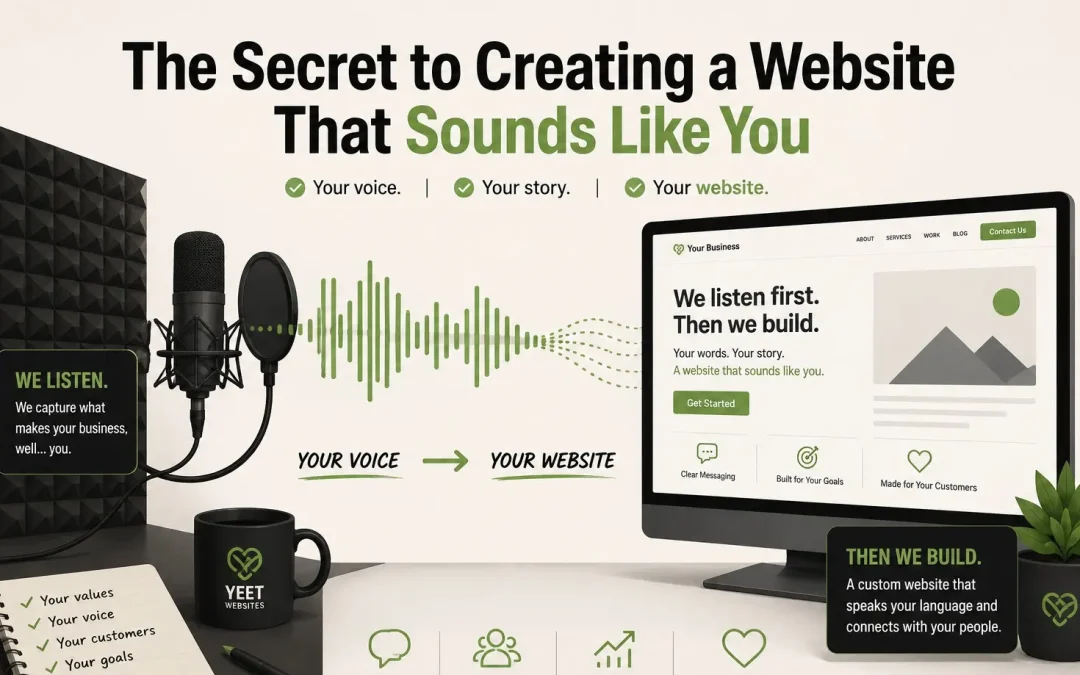
Post Summary: The Meeting Was Too Short to Catch How You Talk
A website that doesn’t sound like the business owner is almost never a technical problem. It’s a listening problem. Voice includes the specific way a person answers questions, their pace, their dialect, the shorthand their customers already use, whether they tell stories or go straight to the point. Capturing that requires a real conversation instead of an intake form, because a form can record answers but it can’t hear tone, hesitation, or the story someone has told fifty times but never put on their own site. The fix, when it’s fixable, means rewriting the copy around that specific voice rather than generic services language.
Clients often give richer, more specific answers in a real conversation than what ended up on their existing website years earlier, and the gap between what they know about their own business and what their site says becomes the starting point for the rewrite.
The rest of the post covers how to tell whether that gap was the client’s fault or the web company’s, and what the intake conversation looks like when it’s built to surface the real material instead of form answers.
What a Website Sounds Like When Nobody Asked the Right Questions
You’ve been looking at your website for two years. You know something’s off. The words are technically correct, your services are listed, your phone number is there, the photos are fine. But it doesn’t sound like you. It sounds like a description of a business that happens to do what you do. Not like the person who built it from nothing and has been running it for fifteen years.
You mentioned it once. Maybe twice. The web company said they’d look into it. Nothing changed. So you went back to running your business and the site kept sitting there, doing nothing, sounding like nobody.
That’s the situation we walk into more than you’d think. We’ve come across clients where that was the case for years, and the only reason we got the business was that they were just sick of looking at it.
So when a business owner tells us their website doesn’t sound like them, the first question isn’t about the website. It’s about what happened before the website was built, specifically, whether anyone listened at all.
Where the Voice Gets Lost
Bad people will take advantage of good people if they can get away with it. That’s a hard thing to say about an industry, but it’s true in this one as much as any other. Not every company that produced a website that doesn’t sound like you was malicious about it. But they didn’t do right by you either.
To just put out shoddy work and not try to be better, that’s not right. That’s not what we’re in the business for. But it happens, and it happens often enough that it’s become one of the more common reasons clients find us: the previous company got away with generic copy, a template layout, stock photos of people who never worked a day in the client’s industry, and content that could belong to any one of fifty other businesses offering the same service.
They got away with it. The client wasn’t happy. But to go back through the entire website and redo everything is often outside the scope, or the company won’t do it without a new contract, new fees, a new project. So it sits.
The client endures it. Months pass. Sometimes years. And eventually they land on us, not because we ran a great ad, but because they hit the wall.
When we dig in, the fix is almost never technical. The content isn’t wrong. It’s just empty. It describes the business without capturing the person who runs it. The reason is simple: nobody listened long enough to understand the difference.
What Voice Is Made Of
Voice isn’t a writing style. It’s not a tone checklist or a brand guide. Voice is the way a specific person communicates, and it has components that most web companies never think to capture.
Their voice is their voice. The way they talk. The way they answer questions. Are they short or are they long? Do they speak in an accent? Do they have a certain dialect? Do they use industry-specific shorthand that their customers use too? Do they tell stories to answer simple questions, or do they go straight to the point? Are they formal when it matters and casual everywhere else?
All of these things go into the website to make it unique and different. Google doesn’t care how you speak, they care about keyphrases, communication, and the information on the page. But the human reading your website cares deeply whether it sounds like a real person or a press release. That distinction is what separates a site that converts from one that just exists.
We try to stay as true to the client as we can, while still maintaining the most professional aspect of the business. Those two things aren’t in conflict. The goal isn’t to transcribe how someone talks over coffee. It’s to distill their personality, their confidence, their way of seeing their own work, and put that on the page in language that earns trust.
That requires listening. Not filling out a form. Not generating copy from a template. Listening, to how they describe their best clients, their worst situations, what they’re proud of, what makes them different from the person two blocks over doing the same thing.
When Your Answers Don’t Match Your Site
When we first meet a client, whether they called us or we reached out, we start forming a picture of who they are. Most of the time, what we learn in that first conversation aligns with the website they already have. Both are surface-level.
But then we start asking real questions. And sometimes, not always, but enough that it still surprises us, the answers are completely different from the website. Deeper answers. Really quality examples. Stories about specific jobs, specific customers, specific moments that tell us exactly why this business is different.
And we ask: how come your website isn’t saying any of this stuff?
And they’ll simply say: I don’t know.
That’s the moment. That’s where the opportunity lives. Because they’ve been carrying this material the whole time, the specificity, the depth, the things that make them worth choosing, and none of it ever made it onto the page. Either because nobody asked the right questions, or because the questions were asked and the answers were reduced to a bullet point in a discovery form that fed a template.
We find that a lot of fun. Not because the client’s frustration is amusing, it isn’t, but because when you find that gap between what a business owner knows and what their website says, you have a clear, direct job: close it. Build the bridge from what they’ve been carrying to what the world gets to see. That’s the work we love most.
Whose Fault It Is, and Why That Matters
This is where it gets complicated, and we’ve learned to be careful about how we frame it.
Before a business owner blames the web company, there’s a question worth sitting with: when they asked about your business, did you share? Think back to that initial intake. Did you give them the full story, the differentiators, the specific clients you love working with, the things you’d say to a prospect over lunch? Or did you give simple answers and then get surprised when the website went up sounding thin?
We got to be fair to all parties involved.
Now, on the flip side. Did the company ask the right questions to draw those answers out of you? Because if the questions were never asked, that’s not on you. The client isn’t supposed to be the expert in web design communication. You’re the master of your business domain. That’s your job. Knowing which questions unlock the right answers, that’s the web company’s job.
So there are two very different failure modes. One is a client who gave thin answers and is now frustrated with thin results. The other is a client who would have given great answers, if only someone had asked. Knowing how to evaluate which failure you’re dealing with matters before you decide what to do next.
Buyers Are Liars, and That’s Not an Insult
After being in customer service and sales for over three decades, here’s what I’ve found: very simply, buyers are liars.
Obviously salespeople are liars too. But buyers lie more. And the reason they lie more is because they’ve been hurt more. Plain and simple.
I get it. I understand it every day of the week. I’m not going to get your trust. I’m going to earn your trust. So absolutely continue to lie, I’m not saying that it shouldn’t happen. I’m acknowledging that it does and I know it does.
What that means in practice: when someone comes to us and says their web company was terrible and gave them a website that sounds nothing like them, there’s a chance that’s true. There’s also a chance they filled out an intake form with short answers and are now frustrated with short results. The two situations look identical from the outside.
Here’s how we sort it: if you gave that web company a fair chance to fix it and they didn’t, that’s on them. Full stop. But if you never gave them the chance, or if the real problem is that they should have done a better job getting those answers out of you in the first place, frankly, that is the position I would hold. Because it’s not your job to be a web content strategist. You hired someone who was supposed to be one.
Either way, the answer is the same: start over with a company whose intake process is designed to pull the real stuff out of you, not the stuff you’d give on a form at 9pm after a long day.
(Credit for “buyers are liars” to the writers who coined it before us, McDonald, Courtney, and the like. We just live it daily.)
How the Voice Gets Captured
We don’t send intake forms. We have a conversation, a real one, the kind where we’re listening for the things you’d never think to put on a form. That first conversation after you sign up is where the real work begins, where we’re listening for dialect, for the way you answer a hard question, for the phrase you use to describe your best client. For the story that explains why you started this business that you’ve probably told fifty times but never seen on your own website.
We’re also listening for what you don’t say, the hesitation before a certain topic, the shift in energy when you talk about something you’re proud of, the casual aside that turns out to be the most compelling thing on the whole site.
What comes out of that conversation becomes the foundation of every page we write. Not a template. Not a generic services description. The specific voice of the specific person who built this specific business, shaped into copy that earns attention and earns trust.
That’s how your website starts sounding like you. And if you want to hear what that process looks like before you commit to anything, we’re happy to walk you through it. You shouldn’t have to write a brief, fill out a form, or prep for a call. Just show up and talk. We’ll handle the rest.
Frequently Asked Questions
My website was built two years ago and it still doesn’t sound like me. Is it fixable without rebuilding the whole thing?
Sometimes, but it depends on how deep the problem goes. If the structure is sound and the main issue is that the copy is generic, we can often rewrite the key pages without a full rebuild. But if the site was built on a template with no real intake behind it, the copy problem is usually a symptom, the structure itself may be working against you too. We’d look at both before recommending anything.
What does the intake conversation cover?
We don’t use questionnaires. We have a conversation, one where we’re listening for how you talk, not just what you say. Most intake forms ask for your services, your tagline, your competitors. We ask questions designed to surface the stories, the differentiators, the specific language your customers already use when they describe what you do. That’s what ends up on the page. A form can’t hear tone. A conversation can.
What if I gave my previous web company bad answers during the intake?
Then some of what went wrong is on you, and that’s okay to own. But the better intake process is designed so that doesn’t happen. It’s the web company’s job to ask the questions that unlock the real material. If nobody asked those questions, the thin answers aren’t entirely your fault. We’re used to working with clients who gave short answers elsewhere and are now surprised by how much more comes out when someone asks differently.
What does “sounding like the business owner” mean on a website?
It means a stranger reading your site can feel that a specific person built this business, not a committee, not a template, not a company that could be anyone. It means your best clients would read it and say “yes, that’s exactly how they talk.” It means the copy doesn’t sound borrowed. Voice capture isn’t about making your site casual or quirky. It’s about making it irreducibly yours. That’s what builds trust before the first phone call.
How much does it cost to get a website that sounds like me?
Our subscription model is a $600 setup fee and $130 per month, no contracts, no surprise charges. Ownership builds start at $4,000 with $350 per year for hosting, which includes 30 minutes of monthly edits. Both include the same intake process and the same commitment to building something specific to your business. You can see all of it at our website design page, no hidden tiers, no discovery call that ends with a number you didn’t expect.